The Dark Night
English/Spanish
Israel Centeno
The dark night of the soul always struck me as more than a trial—it felt like cruelty. But is it God who abandons us? No. God never withholds His grace. It is we, still bound by the law of gravity—as Simone Weil would say—who fail to sustain ourselves in that luminous, unitive state where all is peace.
The world pulls us down. The flesh weighs heavy. The sensory attachments woven deep within us do not fall away without pain. To detach from the visible, the audible, the pleasurable, is to enter a realm of darkness and desolation. There arise the lacerations, there is where we feel the tearing.
And yet, God is present.
He is present like invisible light that passes through matter. He is present like the radio waves the ear cannot hear. He is there, even when we cannot feel Him. For the soul to perceive Him, it must be freed from the gravity of this world, from the dense logic of the senses, from the demand for signs.
The passage to the fifth dwelling, as Saint Teresa describes it, is a mysterious entrance into the dwelling of silence, where the will loves without feeling, and where faith takes the place of sweetness. To remain there does not depend on emotions, but on a firm and loving decision: to keep believing that He is present, even when everything human says otherwise.
In dryness, in darkness, in spiritual desolation, the united soul endures if it accepts that the presence of God is not measured by consolations, but by the inner certainty that He does not abandon, even if hidden from the senses.
Remaining in God is an act of fidelity, not of fervor.
Christianity does not glorify pain. It does not call to suffering as if it were an ideal in itself, nor is it a masochistic religion. It is a religion that does not lie. It offers no cheap comforts or painless path. What it does offer—and what makes it unique—is meaning, a purpose, a promise that gives eternal value to every fleeting moment of sorrow.
To live in this world, to be an embodied soul in history, inevitably brings sorrow, loss, illness, separation, and death. The Gospel does not conceal this. Jesus Himself wept, anguished, sweat blood, cried out on the Cross. Spiritual dryness—this felt absence of God—is part of that same condition. It is not punishment; it is condition: a consequence of the fallen state, and paradoxically, an opportunity for grace.
Because even when God is not felt, He is more present than ever. The soul that continues to love and believe in the void offers its purest act. It does not love for comfort. It loves because it understands. And that is the sign of spiritual maturity: to remain in love even when love cannot be felt.
This fidelity in darkness does not go unrewarded. There is a theological compensation, not merely moral or emotional. Suffering embraced in union with Christ becomes eternal merit, invisible treasure stored in heaven, as the tradition of the saints teaches. Moreover, it bears fruit in other souls—souls we may never know. Saint Thérèse of Lisieux spoke of offering her inner dryness for the conversion of those far from God.
Christianity does not say: “suffer and resign yourself.” It says: embrace suffering as one embraces death, knowing it is not the end. Knowing that the Cross cannot be separated from the Resurrection. That every drop of pain can have meaning if it is lived in Christ, with Christ, for Christ.
“Blessed are those who mourn, for they shall be comforted” (Matthew 5:4). This beatitude is not a promise of spiritual anesthesia. It is a promise of redemption. That what now dries will blossom. That the fire that now burns will purify for the eternal embrace.
Many believers today experience God’s silence not in a monastery cell, but in the noise of a city, in the distractions of daily work, in the loneliness of a room lit by screens. Spiritual dryness has taken on new forms, but its essence remains: an unfulfilled longing, a search that yields no answer, a love that continues even without response.
And yet, the soul that remains faithful in that night is the one most like Christ in Gethsemane. Because it continues loving God for who He is, not for what He gives. It believes even without seeing. It hopes even without feeling.
This is the highest form of faith. And also the most silent. It is not celebrated, not posted, not followed. But in heaven, it resounds as the purest hymn.
Christianity does not demand constant sensitivity or unbroken enthusiasm. It calls for fidelity. It calls for standing with Christ as Mary stood by the Cross: upright, without consolations, but with a soul pierced by love.
To remain in the night, in dryness, in the soul’s solitude, is already to participate in Easter. Because everything that dies in faith shall rise in glory. Everything given in love, even if dry, arid, and tasteless, is inscribed in eternity.
The dark night, then, is not God’s absence, but the pedagogy of a God who strips us of all that is not Himself—so that He may give Himself entirely to us.
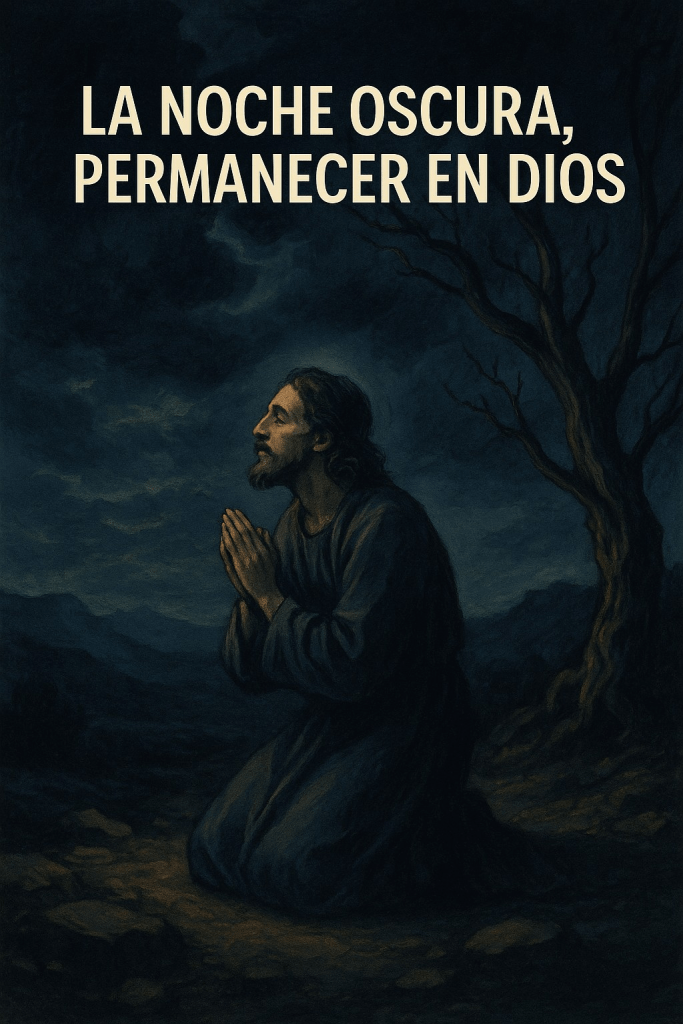
La Noche Oscura.
Permanecer en Dios
La noche oscura del alma siempre me pareció, más que una prueba, una crueldad. Pero ¿es Dios quien nos abandona? No. Dios no niega nunca su gracia. Somos nosotros, los que vivimos aún bajo la ley de la gravedad —como diría Simone Weil—, quienes no logramos sostenernos en ese estado unitivo, luminoso, donde todo es paz.
El mundo tira. La carne pesa. Las ataduras sensoriales, tan hondamente entretejidas en nosotros, no se cortan sin dolor. Deshacerse de lo visible, de lo audible, de lo que apetece, es entrar en una región sin luz ni consuelo. Allí surgen las laceraciones. Allí se siente el desgarro.
Y sin embargo, Dios está.
Está como está la luz invisible que atraviesa la materia. Está como están las ondas de radio que el oído no capta. Está, aunque no se le sienta. El alma, para percibirlo, necesita liberarse de la gravedad de este mundo, de la pesada lógica de lo sensible, de la exigencia de signos.
El paso a la quinta morada, como describe Santa Teresa, es una entrada misteriosa a la morada del silencio, donde la voluntad ama sin sentir, y donde la fe sustituye a la dulzura. Permanecer allí no depende de estados emocionales, sino de una decisión amorosa y firme: seguir creyendo que Él está, aunque todo lo humano diga lo contrario.
En la sequedad, en la oscuridad, en la aridez, el alma unida permanece si acepta que la presencia de Dios no se mide por consuelos, sino por la certeza interior de que Dios no abandona, aunque esté oculto a los sentidos.
Permanecer en Dios es un acto de fidelidad, no de fervor.
El cristianismo no glorifica el dolor. No llama al sufrimiento como si fuera un ideal en sí mismo, ni es una religión masoquista. Es una religión que no engaña. No ofrece consuelos baratos ni un camino sin espinas. Lo que sí ofrece —y esto lo hace única— es un sentido, un fin, una promesa que da valor eterno a cada instante pasajero de dolor.
Vivir en este mundo, ser un ser encarnado en la historia, eventualmente traerá pena, pérdida, enfermedad, separación, muerte. El Evangelio no lo oculta. Jesús mismo llora, se angustia, suda sangre, clama en la cruz. La sequedad espiritual, esa ausencia sensible de Dios, forma parte de esa misma condición. No es castigo, es condición: una consecuencia del estado de caída, pero también, paradójicamente, una oportunidad de gracia.
Porque incluso cuando no se siente a Dios, está más presente que nunca. El alma que sigue amando y creyendo en el vacío ofrece su acto más puro. No ama por consuelo. Ama porque ha comprendido. Y esa es la señal de madurez espiritual: permanecer en el amor cuando el amor no se siente.
Esta fidelidad en la oscuridad no queda sin respuesta. Hay una compensación teológica, no solo moral o afectiva. El sufrimiento abrazado en unión con Cristo se transforma en mérito eterno, en tesoro invisible acumulado en el cielo, como enseña la tradición de los santos. Aún más, produce frutos en otras almas, que tal vez nunca conoceremos. Santa Teresa del Niño Jesús hablaba de ofrecer la aridez interior por las almas frías, distantes de Dios.
El cristianismo no dice: “sufre y resígnate”. Dice: abraza el sufrimiento como se abraza la muerte, sabiendo que no es el final. Sabiendo que la cruz es inseparable de la resurrección. Que cada gota de dolor puede tener sentido si se vive en Cristo, con Cristo, por Cristo.
“Bienaventurados los que lloran, porque serán consolados” (Mateo 5,4). Esta bienaventuranza no es promesa de anestesia espiritual. Es promesa de redención. De que lo que ahora se seca, florecerá. De que el fuego que quema ahora purifica para el abrazo eterno.
Muchos creyentes hoy experimentan el silencio de Dios no en la celda de un monasterio, sino en el ruido de una ciudad, en la dispersión de una jornada laboral, en la soledad de una habitación iluminada por pantallas. La aridez espiritual ha tomado nuevas formas, pero su esencia permanece: ese anhelo que no se colma, esa búsqueda que no encuentra, ese amor que persiste aun cuando no siente reciprocidad.
Y sin embargo, el alma que permanece fiel en esa noche es la que más se parece a Cristo en Getsemaní. Porque sigue amando a Dios por quien es, no por lo que le da. Sigue creyendo aunque no vea. Espera aunque no sienta.
Esta es la forma más alta de fe. Y también la más silenciosa. No se celebra, no se publica, no da likes ni seguidores. Pero en el cielo resuena como el cántico más puro.
El cristianismo no exige una sensibilidad perpetua ni un entusiasmo ininterrumpido. Pide fidelidad. Pide estar con Cristo como María junto a la cruz: de pie, sin consuelos, pero con el alma traspasada por amor.
Permanecer en la noche, en la sequedad, en la soledad del alma, es participar ya de la Pascua. Porque todo lo que muere en la fe resucita en la gloria. Todo lo que se entrega con amor, aunque sea seco, árido y sin sabor, queda inscrito en la eternidad.
La noche oscura, entonces, no es ausencia de Dios, sino la pedagogía de un Dios que nos despoja de todo lo que no es Él, para dársenos a Sí mismo.
 Centeno's Lighthouse
Leave a comment