A reflection on war through the philosophy of Eleonore Stump
Israel Centeno English/Spanish
Thanks for reading Israel’s Substack! Subscribe for free to receive new posts and support my work.Subscribed
War is one of the most brutal faces of evil. In it, destruction, physical pain, loss, humiliation, fear, and often the loss of meaning converge. But how can we think about the suffering that emerges from war without falling into cold political or theological justifications that ignore the embodied experience of those who suffer? This is the question addressed by the philosophical-theological framework developed by Eleonore Stump in Wandering in Darkness, a work that offers a narrative and personalist approach to the problem of evil.
Stump begins with a radical intuition: suffering is not only a philosophical problem; it is a lived experience. And as such, it cannot simply be explained — it must be inhabited. To think about war from this perspective is to refuse to see it through military success or political strategy. It is to look at it from the heart of the soldier, the civilian, the exile, the defeated enemy, and even the one who never wanted to take part. Because even when evil seems to arise from impersonal structures, the soul remains the place where that evil is suffered and where decisions are made.
At the center of Stump’s thought is freedom. God permits human freedom because without it, true love is impossible. But that same freedom also allows for error, betrayal, and violence. War thus appears as a collective wound caused by the misuse of free will. But it is also the battlefield of many souls who had no choice and suffer without understanding why.
In contrast to theories that attempt to justify evil, Stump insists that theodicy must offer more than an abstract argument — it must have “interior accessibility”: a way to accompany the one who suffers. God, if He is to be good, cannot be indifferent. But if He is to love truly, He cannot coerce. That is the mystery of His presence: He does not interrupt human freedom, but neither does He abandon. Like Christ in Bethany, who weeps before raising Lazarus. Like Christ in Gethsemane, who asks not to suffer, but accepts the cup.
War wounds the body but also divides the soul. Many soldiers and civilians act against their conscience out of fear, pressure, or confusion. Stump’s philosophy dwells on that internal division. She calls it “the fragmentation of the will”: the soul wants one thing but does another. That division not only causes guilt but also profound suffering. And often, once the inner unity is broken, the person is left unable to love, to trust, even to believe.
But there is something even more disturbing: when people come to believe that killing is just. Not merely necessary or inevitable, but good in itself. Here, the soul no longer acts in division but in a false unity with itself, blinded by a logic that has replaced the voice of conscience with ideology or collective mandate. One kills not with regret but with conviction. The other is destroyed as if fulfilling a virtue. This deeply dehumanizing phenomenon requires moral anesthesia: the enemy ceases to be human, the self dissolves into a cause, responsibility is diluted in “duty.” The will aligns, but in the wrong direction. For Stump, this is a perverse form of integrity: a will coherent with a misguided end. Only grace breaking in from outside — a word, a look, a beloved face returning to memory — can fracture that coherence and open the soul to compunction. Sometimes it takes a dead child in one’s arms, an unbidden prayer, or the face of the enemy resembling that of a brother. That crack is the threshold where moral awakening can begin — and with it, healing.
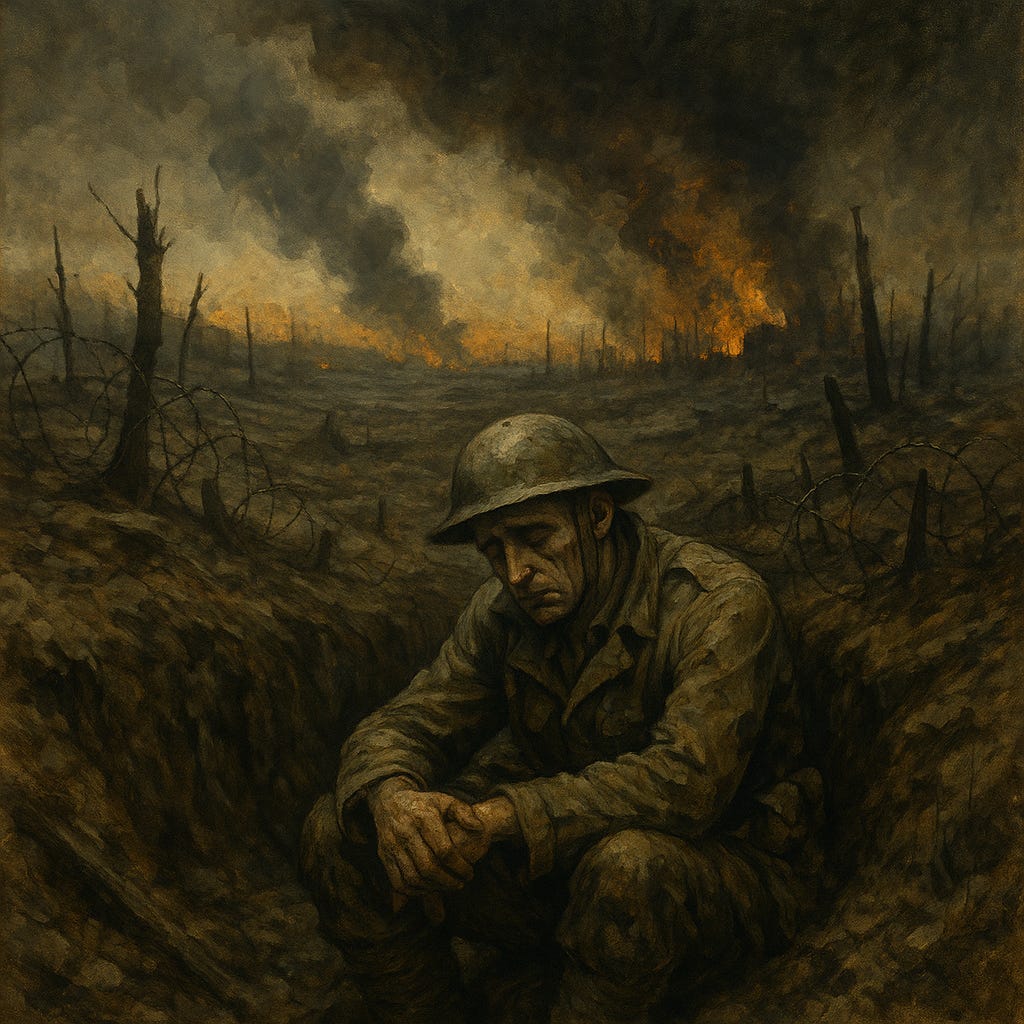
God does not appear as an engineer fixing systems, but as a lover entering the wound. In the context of war, this means that God may be present in the trench, in the hospital, in the exile’s lament. Not necessarily to prevent pain, but to inhabit it. The relationship with God, in Stump’s theology, is not a system of rewards but a second-person bond: someone who sees you, hears you, is with you.
There is no promise of automatic healing. But there is the possibility of redemption. The survivor who finds meaning in serving others. The soldier who weeps for his guilt and seeks reconciliation. The displaced person who prays from exile. Grace is not the restoration of justice, but the possibility of communion. Sometimes visible, sometimes hidden — but real.
To think about war through Eleonore Stump is to think of it from the concrete soul. From the one who suffers, not from the court. From the betrayed love, not from power. And in doing so, to open a possibility: that God does not flee the battlefield, even if He does not prevent it. That there is hope even among the ruins. That evil does not have the final word.
And that love, even when broken, may be the beginning of healing.
Sufrir en la trinchera del alma
Una lectura de la guerra desde la filosofía de Eleonore Stump
Israel Centeno
La guerra es uno de los rostros más crudos del mal. En ella se condensan la destrucción, el dolor físico, la pérdida, la humillación, el miedo y, muchas veces, la pérdida de sentido. Pero ¿cómo pensar el sufrimiento que brota de la guerra sin caer en frías justificaciones políticas o teológicas que ignoren la vivencia encarnada del que sufre? A esta pregunta intenta responder la lógica filosófico-teológica que Eleonore Stump desarrolla en Wandering in Darkness, una obra que propone una forma narrativa y personalista de aproximarse al mal.
Stump parte de una intuición radical: el sufrimiento no es solo un problema filosófico, es una experiencia vivida. Y como tal, no basta con explicarla; hay que habitarla. Pensar la guerra desde esa perspectiva es rehusarse a mirarla desde el éxito militar o la estrategia política. Es mirarla desde el corazón del soldado, del civil, del exiliado, del enemigo vencido y del que nunca quiso tomar parte. Porque incluso cuando el mal parece venir de estructuras impersonales, el alma sigue siendo el lugar donde ese mal se sufre y se decide.
En el centro del pensamiento de Stump está la libertad. Dios permite la libertad humana porque sin ella no es posible el amor verdadero. Pero esa misma libertad permite también el error, la traición, la violencia. La guerra aparece, entonces, como una herida colectiva causada por decisiones libres mal ejercidas. Pero también es el campo de batalla de muchas almas que no tuvieron elección y que sufren sin entender por qué.
Frente a las explicaciones que quieren justificar el mal, Stump insiste en que lo que una teodicea debe ofrecer no es un argumento abstracto, sino algo que tenga “accesibilidad interior”: una forma de acompañar al que sufre. Dios, si ha de ser bueno, no puede ser ajeno. Pero si ha de amar, tampoco puede forzar. Ahí está el misterio de su presencia: no interrumpe la libertad humana, pero tampoco se ausenta. Como Cristo en Betania, que llora antes de resucitar a Lázaro. Como Cristo en Getsemaní, que pide no sufrir, pero acepta beber el cáliz.
La guerra hiere el cuerpo, pero también divide el alma. Muchos soldados, muchos civiles, actúan en contra de su conciencia por miedo, por presión o por confusión. La filosofía de Stump se detiene en esa división interna. La llama “fragmentación de la voluntad”: el alma quiere una cosa, pero hace otra. Esa división no solo causa culpa, también causa sufrimiento profundo. Y muchas veces, una vez rota la unidad interior, la persona queda incapacitada para amar, para confiar, incluso para creer.
Pero hay algo aún más inquietante: cuando los hombres llegan a creer que matar es justo. No solo necesario, no solo inevitable, sino bueno en sí mismo. Aquí el alma ya no actúa dividida, sino en una falsa unidad consigo misma, cegada por una lógica que ha suplantado la voz de la conciencia por una ideología o un mandato colectivo. Se mata no con pesar, sino con convicción. Se destruye al otro como si se cumpliera una virtud. Este fenómeno, profundamente deshumanizador, requiere de una anestesia moral: el enemigo deja de ser humano, el yo se disuelve en una causa, la responsabilidad se diluye en el “deber”. La voluntad se alinea, pero en una dirección equivocada. Para Stump, esta es una forma perversa de integridad: una voluntad coherente con un fin erróneo. Solo una gracia que irrumpe desde fuera —una palabra, una mirada, un rostro amado que regresa a la memoria— puede entonces quebrar esa coherencia y abrir el alma a la compunción. A veces basta un niño muerto en los brazos, una oración que irrumpe sin ser llamada, o el rostro del enemigo que se parece demasiado al del hermano. Esa grieta es el umbral donde puede comenzar el despertar moral, y con él, la sanación.
Dios no aparece como un ingeniero que corrige sistemas, sino como un amante que entra en la herida. En el contexto de la guerra, eso significa que Dios puede estar en la trinchera, en el hospital, en el lamento del exiliado. No necesariamente para evitar el dolor, pero sí para habitarlo. La relación con Dios, en la teología de Stump, no es un sistema de recompensas, sino un vínculo de segunda persona: alguien que te mira, que te escucha, que está.
No hay una promesa de sanación automática. Pero sí una posibilidad de redención. El sobreviviente que encuentra sentido sirviendo a otros. El combatiente que llora su culpa y busca reconciliación. El desplazado que reza desde el exilio. La gracia no es restitución de justicia, sino posibilidad de comunión. A veces visible, a veces secreta. Pero real.
Pensar la guerra desde Eleonore Stump es pensarla desde el alma concreta. Desde el que sufre, no desde el tribunal. Desde el amor traicionado, no desde el poder. Y en ese pensar, abrir una posibilidad: que Dios no huye del campo de batalla, aunque no lo evite. Que hay esperanza incluso entre las ruinas. Que el mal no tiene la última palabra.
Y que el amor, aun roto, puede ser el inicio de la sanación.
 Centeno's Lighthouse
Leave a comment