Israel Centeno
Spanish and English version👇
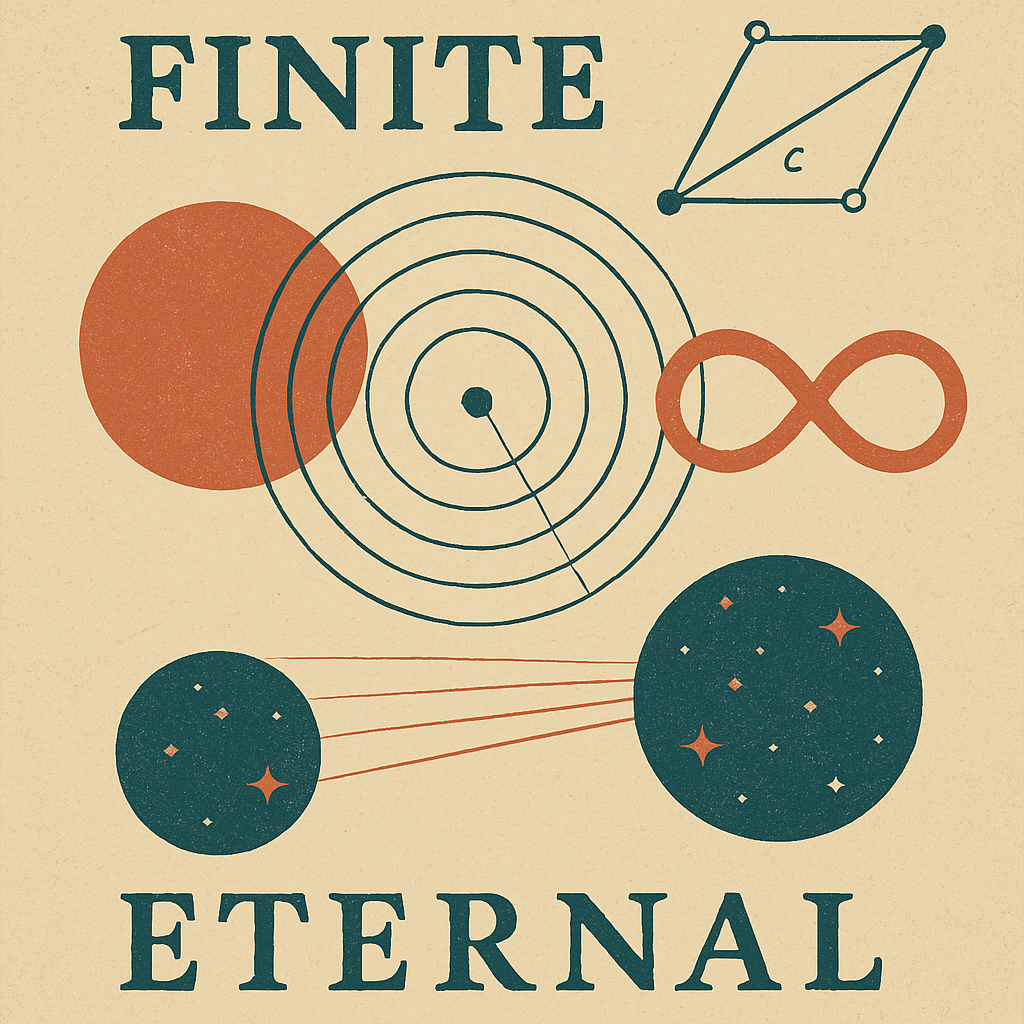
Una de las tensiones más profundas en la cosmología moderna surge cuando se intenta reconciliar dos categorías que, por definición, se excluyen mutuamente: lo finito y lo eterno. Algunos modelos especulativos —como los de inflación eterna o el multiverso— intentan postular un universo eterno, sin origen ni fin. Pero, si tomamos en serio esta afirmación, entonces enfrentamos una paradoja lógica y ontológica de primer orden: un universo eterno no puede contener en su interior fenómenos verdaderamente finitos sin contradicción.
Una hipótesis científica rigurosa no puede autonegación. Decir que un universo es finito y eterno al mismo tiempo equivale a postular una cuadratura del círculo. Si el universo es eterno, todo lo que contiene debería, de algún modo, participar de esa eternidad. Pero nosotros, los seres humanos, somos finitos en cuerpo, y temporales en experiencia. ¿Cómo podemos, entonces, existir dentro de un universo eterno sin ser nosotros mismos eternos?
Desde la filosofía cristiana —especialmente en las voces de Santo Tomás de Aquino, Edith Stein y otros pensadores del realismo metafísico— se da una respuesta coherente a este dilema. Se reconoce que el ser humano, en cuanto creado por Dios, es eterno en su alma, pero no en su cuerpo. El cuerpo nace, cambia y muere; pero el alma, al haber sido creada directamente por el Logos divino, no se extingue. Su existencia no es infinita hacia atrás (como Dios), pero sí inmortal hacia adelante. En otras palabras: el alma humana no es eterna por naturaleza, pero es hecha inmortal por participación.
De allí se deduce que la eternidad no es el escenario del universo material, sino el horizonte de destino del alma. Solo por la acción transformadora de Dios —en la muerte, en el juicio, en la gloria o la condena— puede el ser creado cruzar el umbral de lo eterno.
Esto nos lleva a una conclusión radicalmente contraria a la especulación física impersonal: no existe un universo eterno que contenga seres finitos, sino que existe un universo finito que puede ser transfigurado por Dios en una nueva creación eterna.
Desde esta perspectiva, la paradoja cosmológica no se resuelve con más matemáticas, sino con metafísica:
Lo eterno no puede contener lo finito sin absorberlo. Lo finito no puede habitar lo eterno sin ser transfigurado. Y el único puente posible entre ambos órdenes no es una ley física, sino una Persona que llama al ser desde fuera del tiempo: el Logos
English 🇺🇸🇬🇧
A Rigorous Scientific Hypothesis Cannot Self-Negate: Can the Finite Inhabit the Eternal?
The Cosmological Paradox from a Christian Perspective on Being
One of the deepest tensions in modern cosmology arises when it attempts to reconcile two categories that, by definition, exclude one another: the finite and the eternal. Some speculative models—such as eternal inflation or the multiverse—seek to postulate an eternal universe, without beginning or end. But if we take this claim seriously, we are faced with a first-order logical and ontological paradox: an eternal universe cannot contain truly finite phenomena without contradiction.
A rigorous scientific hypothesis cannot contradict itself. To say that the universe is both finite and eternal is akin to proposing the squaring of the circle. If the universe is eternal, then everything it contains must in some way participate in that eternity. But we human beings are finite in body and temporal in experience. How, then, can we exist within an eternal universe without ourselves being eternal?
From the standpoint of Christian philosophy—especially in the voices of Thomas Aquinas, Edith Stein, and other metaphysical realists—a coherent response to this dilemma is offered. The human being, as created by God, is eternal in soul but not in body. The body is born, it changes, and it dies; but the soul, having been created directly by the divine Logos, does not cease to exist. Its existence is not infinite backward (like God’s), but it is immortal forward. In other words, the human soul is not eternal by nature, but it is made immortal by participation.
From this follows the idea that eternity is not the stage of the material universe, but the horizon of the soul’s destiny. Only through the transformative action of God—in death, in judgment, in glory or condemnation—can a created being cross the threshold into the eternal.
This leads us to a conclusion radically opposed to impersonal physical speculation: there is no eternal universe containing finite beings, but rather a finite universe that can be transfigured by God into a new eternal creation.
From this perspective, the cosmological paradox is not resolved through more mathematics, but through metaphysics:
The eternal cannot contain the finite without absorbing it. The finite cannot inhabit the eternal without being transfigured. And the only possible bridge between these two orders is not a physical law, but a Person who calls being from outside of time: the Logos.
 Centeno's Lighthouse
Leave a comment