Israel Centeno
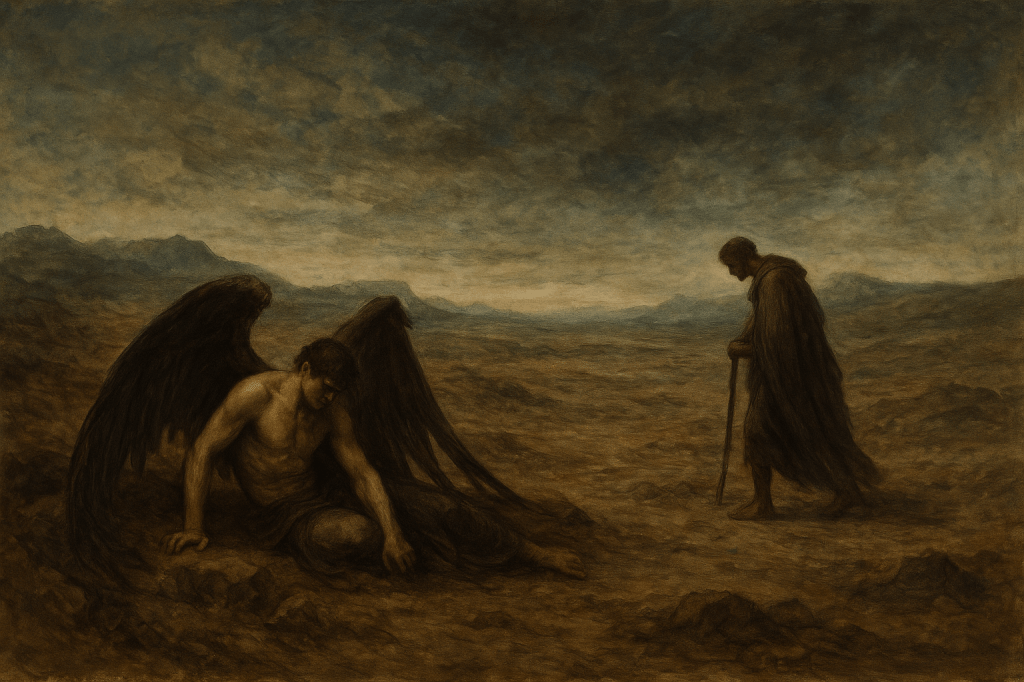
Cosmic-Type Complex
An Essay on Lucifer’s Rebellion and the Oedipal Mythology of the Modern Soul
“If there is a God, how could I bear not to be Him?”
—Friedrich Nietzsche
I. The Eternal Suspicion
There is a suspicion that runs through all myths, all religions, and all systems of thought:
Man is not simply trying to understand the world—
he is trying to usurp its throne.
From the beginning, the desire was not merely to know, but to rule without origin. It is not enough to exist: the fallen soul desires to exist without having been created, to be without having been called. In the depths of the modern soul, even in its most secular forms, dwells the shadow of an ancient rebellion.
That rebellion has a name: Lucifer.
The most beautiful of the angels did not fall out of mere disobedience, but for something more grave:
He could not bear to be a creature.
He wanted to be like God—not by participation, but by usurpation.
The founding cry of his fall —Non serviam— is not the lament of a slave yearning for freedom, but a metaphysical declaration of independence from the One to whom he owes his very being.
And in that same logic—proud, dazzling, irreverent—lies the tragic structure of modern thought: the desire to be transcendent without having been transcended, to possess consciousness without having been breathed into.
Like Oedipus, the modern soul kills the Father and possesses the Mother. And like Oedipus, it cannot bear that stolen glory without paying the price: the blindness of meaning and the sentence of spiritual exile.
II. The Rebellion of Lucifer: Non serviam
Lucifer’s sin is not passion—it is metaphysical pride.
Not moral disorder, but ontological rebellion.
He cannot bear to be second. He cannot accept that love came before. He rejects inheritance: he wants authorship.
He does not want to serve: he wants to reign over being.
Thus he becomes the first nihilist, the first autonomist, the first technocrat of the abyss.
And that cry of absolute autonomy —“I will not serve”— still echoes in countless modern forms:
In the scientist who seeks immortality without a soul. In the philosopher who reduces consciousness to the brain but believes in the power of his own mind. In the ideologue who replaces nature with self-perception. In the politician who promises redemption without a redeemer.
Lucifer’s rebellion is not over.
It has simply been technologized.
It has become system, discourse, program, algorithm.
But it remains the same: to not be a child, to not be a creature, to owe nothing to anyone.
III. The Oedipal Complex: Freud and the Inheritance of a Broken Soul
Freud, though a materialist, uncovered a truth deeper than his own system could bear.
The Oedipal complex—killing the father and possessing the mother—was meant to explain neurosis, but it revealed something far greater: a structural rebellion of the human soul.
Modern man, like Oedipus, commits a symbolic double crime:
He kills the Father-Creator: erasing Him from the story, denying Him, replacing Him with chance, evolution, or statistical necessity. He possesses Mother Nature: manipulating, dominating, exploiting her while simultaneously worshiping her body and denying her mystery.
And now he reigns—yet reigns over interior ruins.
For the soul that usurps the throne of origin cannot bear the weight of its own desire.
He sought freedom,
and found loneliness.
He sought sovereignty,
and lost the earth.
Like Oedipus, the modern soul will gouge out its eyes once it realizes—too late—that it has built its world on the denial of the Love that made it possible.
IV. Mother Nature, the New Faceless Goddess
Without the Father, man does not become an orphan—he becomes an idolater.
His new goddess is Mother Nature, both adored and exploited.
She is venerated in ecological discourse, yet violated by genetic mining and climate manipulation. She is called “life,” but reduced to chemical processes. She is exalted as a fertile goddess, but denied all true sanctity.
The modern soul no longer sees nature as a gift, but as a faceless womb, a mother without voice, a source to be manipulated at will.
In this new ecological religion, the Earth is sacred but godless, and man is her priest and her engineer.
We have turned creation into a system, fertility into code, and the cosmos into a mirror where only our will is reflected.
The result: the mother falls silent, the child becomes lost, and the Father has been erased from the Book.
V. Consequences of the Cosmic Oedipus: Sovereignty Without Redemption
Today’s most accepted theories in cosmology and neuroscience are not neutral—they are responses to the vacuum left by the Father.
The multiverse: infinite possible universes to avoid confronting the improbable precision of this one. Cyclical models like Penrose’s: eternal returns to evade a beginning that smells of design. Quantum consciousness: a soul without soul, a spark without source.
All of these models avoid the direct question:
Who called me into being?
They accept that consciousness may not be reducible to the brain—but not that it might have an Author.
They accept the soul, but deny the Spirit who breathed it forth.
Thus man reigns—in solitude.
A king without inheritance.
A sovereign without a kingdom.
A god without an altar.
VI. Epilogue: Science as an Escape from the Father
Science, born of wonder and humility, has in many cases been hijacked by the same impulse that condemned Oedipus: the desire to know without being known, to understand without being understood.
Theories like Penrose’s, the multiverse, string theory, quantum consciousness—they are not false by virtue of being unprovable.
They are ontological evasions, dressed in mathematical elegance.
Because a universe with a finely tuned beginning is a problem for the soul that refuses to kneel.
Because a mind capable of understanding the universe, but that did not invent itself, implies the trace of Another.
And that, for the modern ego, is intolerable.
It prefers to invent ten thousand worlds than bow to a single Creator.
But there is a more noble path:
Not to renounce reason, but to follow it to the threshold of Mystery.
To accept that I am transcendent—yes.
But also to accept that I did not give myself being.
That there is a Thou who thought of me before I ever thought of the world.
And that to recognize the Father is not slavery—it is the beginning of all redemption
 Centeno's Lighthouse
Leave a comment