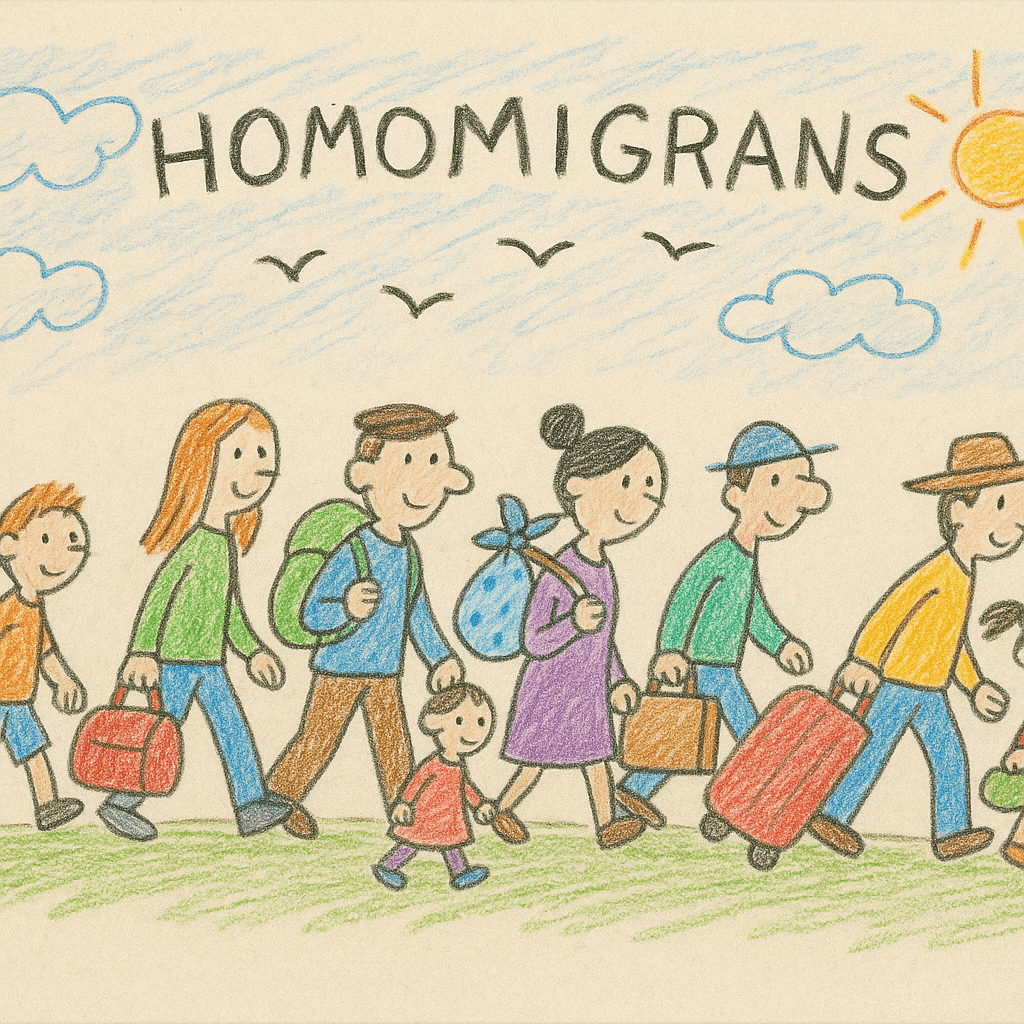
Israel Centeno
I. Humans are, above all, migrants
Since the dawn of humanity, people have been on the move. The first great migration was not a conscious choice, but an instinctive impulse. A group of hominids left southern Africa—likely from what is now Angola or the Democratic Republic of the Congo—and crossed jungles, deserts, rivers, straits, and mountain ranges. They did not found cities; they opened roads. Wherever they went, they left traces behind. Homo sapiens are not born sedentary—they are born wanderers.
This migratory drive was the rule, not the exception. From that primal exodus arose peoples, languages, and cultures. The earliest tribes were nomadic groups, wandering and dispersed by necessity. Only with the advent of agriculture, and the pressing need to control the cycles of the seasons, did they begin to settle. Yet even the first settlements did not escape conflict over land. When the land stops moving, humans begin to fight for it.
II. From Tribes to Empires: Space Becomes Power
The transition from tribe to kingdom marked the beginning of a profound transformation: territory was no longer just a source of sustenance, but a symbol of power. Land became inheritance, border, and object of conquest. The first kings emerged as tribal leaders transformed into sovereigns—some by invoking mythical ancestry, others by force. From these kingdoms, empires were born: armed migrations transformed into political order.
The Egyptian Empire marked the start of centralized expansion. The Macedonian Empire—with Alexander the Great as its archetype—demonstrated that conquest could redraw the world. Rome, in turn, defined the modern idea of the territorial state: with roads, citizenship, laws, and the integration of conquered peoples, all at the service of the Imperium.
Each of these imperial systems arose from displacement. Humanity kept moving, but now marched under banners. They no longer fled hunger; now they marched for glory, for faith, for resources. Migration ceased to be mere wandering and became colonization.
Yet empires never truly unified peoples. Beneath the surface, conflict always simmered. Foreigners, when conquered, were sometimes absorbed but more often exploited. This persistent inability to integrate remains a defining flaw of civilization—one we have yet to overcome.
English Version
III. America Before America: Migration, War, and Domination
The migratory history of humanity does not end in Eurasia. The Americas, too, are the product of countless waves of migration, despite modern myths that portray them as pure lands, untouched until the arrival of Europeans.
The most widely accepted theory holds that humans entered the Americas via the Bering Strait during the Paleolithic ice ages, when Siberia and Alaska were linked by a land bridge. Other research suggests additional arrivals from Polynesia or even the South Atlantic. Yet all evidence points to one fact: the Americas were settled by migrants.
These arrivals did not form a single, unified nation but were diverse tribal groups—Chibchas, Mapuches, Guaraníes, Maya, Mexicas, Caribs, Arawaks, among others. Some remained semi-nomadic, while others built empires. The idea of a “single Native American” is a modern fiction. What existed was a network of peoples, each with its own interests and conflicts.
The Mexica (Aztec) Empire
The Mexicas were originally a northern people, likely desert migrants. After moving into the Valley of Mexico, they founded Tenochtitlan and rapidly expanded their dominion. They did not unify Mesoamerica—they subjugated it. To the subjugated peoples, the Mexica were a tyranny: exacting tribute, imposing brutal punishments, and practicing human sacrifice. When the Spanish arrived, many native nations allied with Cortés to overthrow the Mexicas.
The Inca Empire
The Incas, ruling from Cusco, expanded their reach north and south. Their system was more administrative but no less imperial. An elite organized, displaced, and subdued dozens of Andean peoples. The mit’a system institutionalized forced labor. Integration was achieved through cultural, religious, and military imposition.
War Before the Conquest
Even before Columbus set foot in the Americas, the continent was shaped by conflict. Tribal wars, enslavement, shifting alliances, betrayals, and forced migrations were not inventions of Europe. What Europeans introduced was systematic violence and superior technology, reinforcing patterns already present.
Migration in the Americas was never harmonious—it was a struggle for land, power, survival, and meaning.
IV. Europe Colonizes the World… and the World Returns to Europe
With the overseas expansion of European powers in the 15th century, migration shifted in both scale and intention. It was no longer just a quest for land or survival; it became a calculated imperial project. Spain, Portugal, England, France, the Netherlands, and Belgium systematically occupied, exploited, and evangelized every inhabited continent.
The conquest of the Americas, beginning in 1492, marked the first truly global imperial migration. Soldiers were not the only ones to arrive—merchants, monks, bureaucrats, families, and millions of enslaved Africans were also swept into this totalizing movement. This flow subjugated entire peoples and redrew the face of continents.
Colonial Migration as Violent Departure
Latin America was populated not only by Iberian Europeans, but also by the dispossessed: peasants, prisoners, adventurers, widows, and refugees from Europe’s own wars. Alongside them came enslaved Africans in the millions. This was not harmonious blending—it was a forced, often brutal, imposed mixing, born from hierarchical and traumatic structures.
Asia and Africa saw similar patterns. Europe did not merely extract resources; it reconfigured the social and territorial foundations of its colonies. Borders in the Middle East, tribal tensions in Africa, and the artificial states drawn in Brussels or London were all products of imperial mapping, far from local realities.
Colonial Migrations: The Inevitable Return
Yet, as with all things in history, what goes around comes around. Empires did more than export language, religion, and currency; they opened routes that could never be closed. When these empires collapsed in the 20th century, the former colonies flowed back to the metropoles:
- Hindus, Pakistanis, and Caribbeans arrived in the United Kingdom.
- Maghrebi and Francophone Africans moved to France.
- Congolese settled in Belgium.
- Filipinos and Vietnamese came to the United States.
Thus, the colonizers became the hosts.
This created a new phenomenon: the very capitals that once exported colonization began receiving cultures they could not integrate. A new form of xenophobia emerged—the colonizer unable to tolerate becoming a reflection of the world he once subjugated.
Colonization was never just domination. It was the unleashing of flows that cannot be reversed. Europe globalized the world, and now the world—with all its trauma, poverty, and history—has come back to Europe.
But modern states were ill-prepared to integrate these new cultures. Their only skills were to organize, dominate, and draw boundaries.
Thus, when migrants arrived, the ghosts of history arrived with them.
V. The 20th and 21st Centuries: Perpetual Flux and the Failure to Integrate
After two world wars, Europe faced a profound paradox. No longer the center of the world, it nonetheless continued to bear the consequences of its imperial past. The migrations of the 20th century were no longer those of explorers or settlers, but of refugees, exiles, the persecuted, and the desperate. The world that Europe had once colonized now returned to haunt it—and it was wounded.
The 20th Century: Wars, Famines, and Exile
After the Spanish Civil War, thousands of Republicans fled to Latin America—Mexico, Venezuela, Argentina.
During and after World War II, Jews, Poles, Germans, and Italians scattered across the Americas, fleeing Nazism, fascism, communism, and devastation.
There were also quiet but significant waves of Irish, Lebanese, Armenian, and Greek migrants—victims of political or economic upheaval—finding new homes in the Americas.
Meanwhile, millions of Africans began emigrating to France, Belgium, and England, often unwittingly demanding the moral reckoning of empire.
Latin America, too, became both a land of welcome and, later, a land of expulsion.
In every case, the pattern was the same: a promise of welcome accompanied by mechanisms of exclusion. Exiles were tolerated, but rarely integrated. They carried their language, their color, and their accent as though they were marks of guilt.
The 21st Century: Displacement as the New Norm
Today, migration is not an anomaly—it is the global norm.
Its causes are almost always the same:
- Hunger and climate collapse
- Endless civil wars
- Failed dictatorships
- Drug trafficking and paramilitary violence
- Systemic labor exploitation
Countries like Syria, Venezuela, Afghanistan, Haiti, Ukraine, Sudan, and Honduras have suffered mass displacements. These migrants are not tourists or seekers of adventure—they are people cast out by a world that could not make room for them.
And the pattern repeats: migrants arrive, but are not welcomed. They are feared, demeaned, accused, and exploited. Modern states—with their borders, passports, and immigration laws—try to control what is, by nature, restless. Yet human beings continue to wander, and violence flares wherever movement is met with force.
Humanity Still Does Not Know How to Integrate
To integrate is to recognize the other as legitimate—as one’s own—not to absorb or impose. Neither the twentieth nor the twenty-first century has achieved this. Each new wave of migration seems to reactivate ancient xenophobic reflexes, seeing the other as a threat rather than a mirror. It is as if we have yet to understand: we are all children of the same ancient journey.
VI. Migration and Rejection: The Return of Ancient Demons
In the twentieth century, humanity witnessed the greatest mass migrations in history—world wars, collapsing empires, revolutions, famines, and ideological and religious exiles. Amid this constant movement, a sinister pattern emerged: the systematic rejection of those who arrive wounded.
The twenty-first century, despite its technology and the rhetoric of human rights, has revived that same rejection. A migrant is no longer just a foreigner; he is seen as an intruder, a suspect, a carrier of disease, crime, and backwardness. What once seemed like a remnant of a barbaric past—open xenophobia and the dehumanization of others—has returned with renewed force.
Echoes of the Interwar Period
What is unfolding today in the United States, Europe, the Mediterranean, and at the Colombian-Venezuelan border recalls the rhetoric of the interwar years. In 1930s Germany, Jews were blamed for economic decline. In Vichy France, migrants were considered traitors. In fascist Italy, Slavs were deemed subhuman. The narrative was always the same: “They do not belong,” “They are invading us,” “They are taking what is ours.”
Today, the same refrains echo:
“They are stealing our jobs.”
“They threaten our culture.”
“They contaminate the nation.”
“They don’t fit in.”
The only difference is the medium—social networks and twenty-four-hour news cycles. But the narrative of fear is unchanged: someone from outside threatens the purity of what is “ours.” This myth of a pure, homogeneous nation remains the fuel of violence.
Systematic Rejection Is the Seed of Genocide
Not every rejection ends in genocide, but every genocide begins with rejection. It begins the moment someone ceases to be “human” and becomes “the other.” From there, it becomes possible to deport, exclude, dispossess—and, ultimately, to exterminate.
Genocide is never born out of chaos; it grows from the idea that “the other” can never be part of us.
- In Rwanda, Belgian colonialism stoked and racialized tensions between Hutus and Tutsis, setting the stage for massacre.
- In Armenia, the Ottoman Empire made Christian Armenians into internal enemies during World War I, blaming them for military failures.
- During the Holocaust, the Jewish people were dehumanized, turned into a “plague,” and reduced to ashes.
- In the Balkans at the end of the twentieth century, “ethnic cleansing” was justified by histories of humiliation, failed coexistence, and incompatible identities.
In every case, violence was not an accident—it was the consequence of an idea: the other cannot belong.
Today, we witness the normalization of contempt. Rejection of migrants has become policy, a media spectacle, and a rallying cry for elections. Instead of asking how to integrate, the question is how to repel.
Walls in Texas.
Detention centers in Libya.
Children in cages.
Boats sinking in the Mediterranean.
Police confiscating blankets from migrants in Paris.
Venezuelan migrants treated as plague in South America.
Humanity still does not learn: those who flee hell find only another hell at the border.
The Problem Is Not the Migrant, But the Failure to Integrate
The great failure is not political, economic, or logistical—it is ethical. After centuries of mixing, war, empire, and colonization, humanity still believes that the other is alien. We still fail to recognize the most basic truth:
We are all migrants. Even those with “ancient roots” descend from wanderers.
To deny this is not just a lie—it is a form of moral blindness. And moral blindness breeds hatred, and hatred is the prelude to barbarism.
VII. The Short Memory of Hatred
Today, the loudest voices against migration often come from the far right, but certain far-left nationalist movements also join the chorus. They accuse, stigmatize, and promise to “regain sovereignty,” “cleanse the nation,” or “restore order.” Mass deportations are discussed as if they were merely technical measures, devoid of history or tragedy. What is forgotten—or deliberately denied—is that many of these same voices descend from people who were themselves expelled, deported, or persecuted not so long ago.
From Refugees to Jailers of Discourse
What right does a Frenchman, the grandson of a pied-noir, have to expel an Algerian?
How can a descendant of Italians who fled famine in 1910 deny entry to an African escaping climate collapse today?
What memory does a Spaniard possess, whose grandmother was welcomed in Mexico with shouts of “¡Viva la República!,” when he now votes to close borders and deport Latin Americans?
With what moral authority does a Cuban exile speak, if he despises the Central American seeking the same refuge his family sought forty years ago?
The problem is not the reasoned critique of migration systems. The problem is historical hypocrisy, moral cynicism, and the narcissism of prosperity that makes people forget their origins.
No one is forged in stillness. We are all the result of movement, mixture, and flight.
To claim a pure identity—cultural, racial, or national—is a dangerous illusion.
A Homeland Is Not Property; It Is a Shared Legacy
No land belongs to anyone absolutely. Every territory has been crossed, conquered, lost, reclaimed, and redefined. To believe that the country of our birth is solely “ours” is to deny history, memory, and justice.
Those who propose mass deportations, detention camps, or the suspension of asylum are not defending the homeland—they are destroying its soul.
A nation’s greatness is not measured by the walls it builds, but by its ability to integrate others without losing itself, without fear or destruction.
Those who cannot integrate are left only with the path of exclusion and, ultimately, extermination. That is the lesson of the twentieth century.
Remember this, so that we do not repeat it.
Today, as the drums of deportation sound again in Texas, Paris, Rome, Budapest, and Buenos Aires, our response must be clear and unwavering:
It is impossible to build the future by denying the past.
It is immoral to condemn others to exile when we ourselves are the children of exiles.
The migrant who arrives today is the mirror of the grandfather who arrived yesterday.
Those who forget this resemblance not only lose their memory—they lose their humanity.
VIII. Identity, the Other, and Hospitality: Who Am I to Say You Are Not From Here?
Across all of human history—with its exoduses, mixtures, conquests, forced marriages, and adaptations—a simple yet uncomfortable truth has been proven time and again: there is no identity without the other.
There is no pure culture, no immutable language, no unmixed people. What we call “our own” is always the result of integration, negotiation, and shared trauma. Yet the myth of closed identity has become a political weapon.
Today, the far right in Spain calls for mass deportations, forgetting that half the country was once made up of war refugees, forgetting the Republican grandparents who found refuge in Mexico, Chile, France, or the USSR. They also forget that Spain itself is Berber, Celtic, Roman, Jewish, Visigoth, Arab, and Latin American all at once.
The identitarian left, meanwhile, often falls into its own trap of essentialism and closed-group victimhood: forgetting that identity is not property or inheritance, but openness.
Who am I to say that you are not from here?
This question should resonate in every conscience. Every homeland is borrowed. Every land has been traveled. The world has never belonged to anyone.
The other is not a threat to my identity; the other completes it.
Fear of foreigners is ultimately fear of losing oneself. But that fear is childish. Only those who do not understand history believe their identity will vanish through coexistence.
A strong identity is never diluted—it is enriched, refined, expanded.
When a Muslim integrates into Barcelona, Catalan identity does not disappear; rather, it is renewed, proven by its capacity for coexistence.
Likewise, when a Colombian works in Madrid, Spanish identity is not erased; instead, the spirit of hospitality that once sustained Spaniards in exile comes alive again.
The other is not a menace—they are a revelation.
They reveal who we truly are.
Hospitality Is a Civilizing Act
From ancient Greece to biblical scripture, hospitality has always been sacred. To welcome strangers, travelers, orphans, widows, and the wounded was the ultimate proof of humanity.
Today, however, that virtue has been replaced by “immigration policy.” Hospitality has become a “crisis,” a “problem,” or a “burden.”
Yet, one question endures—echoing throughout history:
What kind of civilization will we be, if we do not know how to welcome others?
The greatest challenge of the 21st century is not migration—it is spiritual.
We have lost the soul that knows how to say “welcome.”
We must recognize our own fragility in others.
No one migrates by whim. No one crosses deserts, walls, seas, jungles, and borders with children in their arms unless they have stared death in the face and believe life might exist elsewhere.
To refuse hospitality is not only a political act; it is also a denial of our own fragility. No one is exempt from migration. Tomorrow, it could be our turn.
And when the cycle reverses—what will you hope to find on the other side?
IX. We Are All Human: Exile as a Mirror of Dignity
The history of displacement, conquest, exile, integration, and rejection—from ancient African tribes to today’s migrants crossing the Darién Gap or the Mediterranean—leads to one central ethical truth:
Every human being possesses inviolable dignity, simply by being human.
From conception to natural death, a human life cannot be measured by passport, immigration status, ethnicity, or economic utility. This is not a matter of left or right, religious or secular. It is what sets us apart from becoming beasts in human skin.
Returning to Fundamental Values as Universal Heritage
In a world saturated with relativism, tribalism, and political cynicism, we must reclaim values that transcend power. Call them natural rights, moral law, or commandments—they all point to the same center:
“Thou shalt not kill.”
“Thou shalt not steal.”
“Thou shalt not lie.”
“Thou shalt not enslave.”
“Thou shalt not deny bread to the hungry, or shelter to the stranger.”
These principles are not exclusive to any one tradition. They are the deepest language of our species. Hospitality is not just a virtue—it is the foundation of civilization.
“Remember that you were a stranger in Egypt,” says scripture. That ancient phrase remains the most urgent message of our century.
We are all part of the same species. We share the Earth.
Exclusionary nationalism, hatred of difference, and fear of the foreigner are symptoms of a humanity suffering from amnesia.
We forget that we are all descendants of migrants. No one is pure. Every culture is a blend. The blood of those who arrive flows just like ours.
What is truly revolutionary today is not building walls, but recognizing the other as my equal before I know their name.
True progress is a humanity capable of integration.
Technology advances. Cities grow. Economies become more complex.
Yet we have not resolved the oldest dilemma:
How do we live with others without hating them?
How do we welcome others without fear?
How do we share without dominating?
These are the true frontiers of civilization. Here, the future will be measured.
Perhaps human beings are not, first of all, citizens or consumers.
Perhaps, at their core, humans are travelers—
Migrants through time. Exiles from Eden. We have been living away from home since the beginning.
As long as we keep walking, the only thing that can redeem us is this:
To recognize in every stranger’s face a reflection of our own.
Those who were strangers in Egypt cannot, in good conscience, close the door to their homeland.
 Centeno's Lighthouse
Leave a comment