Girard, Aquinas, and the Banality of Evil in the Culture of Spectacle
Israel Centeno
Revisiting the Menéndez family case isn’t just a return to a chilling crime. It’s a distorted mirror reflecting the deeper cultural mechanisms at play in contemporary Western society. The Menéndez brothers brutally murdered their parents, José and Kitty Menéndez. It was a premeditated act, carried out with cold precision. And yet, after a televised trial—like that of O.J. Simpson—and years of media coverage, the narrative has shifted.
Today, documentaries on popular streaming platforms no longer frame the parents as the main victims. The spotlight has moved. Childhood suffering, alleged abuse, trauma… The sons—self-confessed perpetrators—are now seen by many as victims. In this postmodern narrative, guilt dissolves. There is no evil. No sin. Only “contexts.” Only trauma. Only “systems.”
From René Girard’s perspective, this is no accident—it’s mimetic logic. Society seeks a scapegoat, someone onto whom it can project its own frustrations, guilt, and hatred. At first, the sons were the scapegoats. They were convicted. But then, in a second mimetic turn, society redirects its longing for absolution toward them, and shifts the sacrificial blame onto the parents—now cast as the real culprits. Their crime? Representing authority, success, and privilege. Having already been physically murdered, they are now symbolically killed.
This pattern repeats endlessly in our culture. Take the recent case of a health insurance CEO, gunned down in broad daylight and captured on a security camera. The killer, far from being labeled a criminal, was raised by media narratives to Robin Hood status. The story is rewritten: the perpetrator becomes the victim of “the system.” The real victim—the man shot—is erased. His face, his life, no longer matter. What matters is what he symbolized.
And what did he symbolize? Power. Authority. Capital. The paternal figure. What the collective desire needs to destroy in order to declare itself innocent.
Here Girard’s logic resounds with force: we are living in a culture that depends on rotating scapegoats to sustain cohesion and relieve guilt. The problem is that there’s no longer any ritual to channel the sacrifice. No altar, no redemption, no confession. Only spectacle. Only screens. Only live-streamed social trials.
Through the lens of Thomas Aquinas, this culture reveals a structural absence of the good. For Aquinas, the good is not simply what pleases or benefits—it is what perfects a being in accordance with its nature. But in today’s mediatized world, that kind of perfection no longer matters. What is rewarded is what shocks, what provokes, what “goes viral.” The good is replaced by engagement.
And when the notion of the good is lost, so is the idea of true guilt. There is no justice, only justification. No conversion, only competing narratives. Sin is no longer sin if it’s well explained. Murder is not murder if the “context is understood.” Slowly, hell ceases to be a place, becoming instead a screen where we all play the role of faceless judges.
In American society—the epicenter of these phenomena—we are witnessing a deeper spiritual decomposition: the cult of fame, of exposure, of celebrity. We see it in the grotesque phenomenon of people falling in love with serial killers, writing letters to convicted criminals, or making viral content out of those who have openly embodied evil. What should horrify us now seduces. What ought to remain hidden is broadcasted.
Why?
Because hierarchy has dissolved. There is no longer good or evil, only “narratives.” No longer truth, only “perspectives.” God has been removed from the stage, as Nietzsche foresaw—not to make room for freedom, but to leave a void. And in that void echoes the hollow fascination with spectacle, violence, and nameless evil.
This is what Hannah Arendt called the banality of evil. But now, that banality is not merely tolerated—it is adored. Evil is not just normalized—it is celebrated. It becomes desirable. It becomes content. It becomes trending.
Girard would say that we adore the desires of others. That’s why we rush to look at what others are watching, to share what outrages, to viralize what scandalizes. But when that collective desire has no moral limits, it becomes a perpetual engine of sacrifice, where anyone can become a victim—and anyone, even a murderer, can become an idol.
And so we live in a society with no center, no altar, no truth. The loudest voice wins the narrative. And what was once sacred—life, truth, innocence—is reduced to a currency in the infinite cycle of spectacle.
Can Christians still speak of goodness, guilt, and justice without being canceled by the new priests of the trending topic?
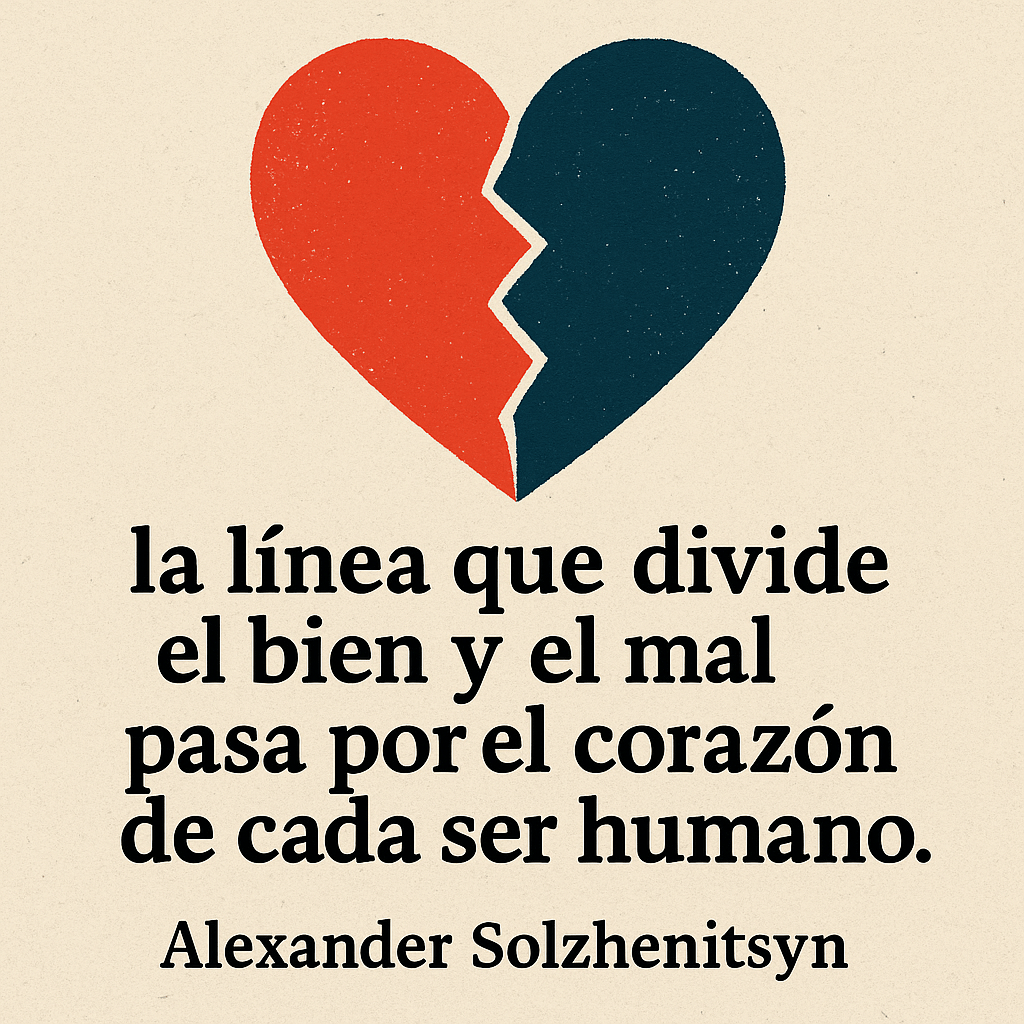
Perhaps. But only with courage, compassion, and a deep awareness that evil is not merely “out there”—as Solzhenitsyn wrote, “the line dividing good and evil cuts through the heart of every human being.”
And in a culture that has forgotten the heart, perhaps the only way to heal is to look up again.
But the spectacle doesn’t end there. In the darker corners of digital culture, a new symptom of collapse emerges: the rebirth of totalitarian imagination. Hitler is no longer condemned with the moral clarity once deemed sacred. Stalin’s name no longer strikes fear. These figures return, like ghosts reshaped by scandal aesthetics and ironic provocation—figures who embodied absolute evil in the 20th century.
Social media accounts now exalt their “strategic brilliance,” relativize their crimes, aestheticize their legacies. Young people who never experienced the horror consume it as entertainment, as an emblem of unchecked power. Ironic memes multiply, revisionist podcasts abound. It is the return of the repressed—without shame, without mourning, without awareness.
And this doesn’t happen in a vacuum. It is the predictable result of removing God from the center. Without transcendence to orient our values, without truth to resist mimetic frenzy, the human soul is adrift—open to any fascination. And so Girard’s cycle reactivates in full: desire imitates, rivalry escalates, violence erupts, another sacrifice is demanded.
When no new victim is available, an old one is summoned: the Jew, the foreigner, the other. Anti-Semitism returns. Xenophobia resurfaces. Values are inverted. The world plays with fire again, unaware that it has already burned everything down.
Because when we abandon the notion of the good, the monstrous doesn’t vanish—it disguises itself, reinvents itself, goes viral.
And in the end, the only real barrier against this infinite loop of destructive mimeticism is not the right ideology, the just party, or the perfect economic system.
It is the human heart pierced by grace.
It is God.
Or the abyss.
 Centeno's Lighthouse
Leave a comment