One does not need to be a theologian to sense the truth of original sin. History itself bears witness. Time and again, with the best of intentions, human beings have gathered in groups, tribes, villages, nations, empires—seeking peace, longing to build a kingdom of justice. And yet, again and again, the same pattern emerges: the dream turns to ruin.
In the twentieth century, humanity sought to bring history to its final conclusion, to end the historical dialectic once and for all. Through historical materialism, some aimed to abolish classes; through Nazism, others sought to abolish all but one “superior” race, destined to rule over the planet. Both were aberrations. In the democracies, the experiment took a different form: the construction of a middling society, content with a median happiness, sustained by the shared rhythm of consumerism. Now, in the aftermath, we find ourselves in an age of excess—excess of diversification, of divergence, of stratification; of identity politics hardened into tribalism, or nationalism driven to its extremes.
Beneath all this lies the same ancient wound. Atonement means “to be at one with.” As Eleonore Stump notes, when humanity lost its union with the Absolute, it became mortal. A fracture entered the soul—one that drives us toward barbarity, makes us both victim and victimizer, predator and prey, allows the animal within to overpower what calls us to transcendence.
We have been told, in countless ways, that progress is the road to salvation. The narrative is seductively simple: humanity is on an upward path toward some final aim, a superior state of life. But if we are honest, the road so often ends not in paradise, but in hell—or in endless circles, where each turn leaves us more lost than before. Progress alone does not save.
Stagnation is no better. It is a slow decay disguised as safety. And the dream of returning to some primal innocence is an illusion; what is behind us is not Eden, but a history already marked by the wound.
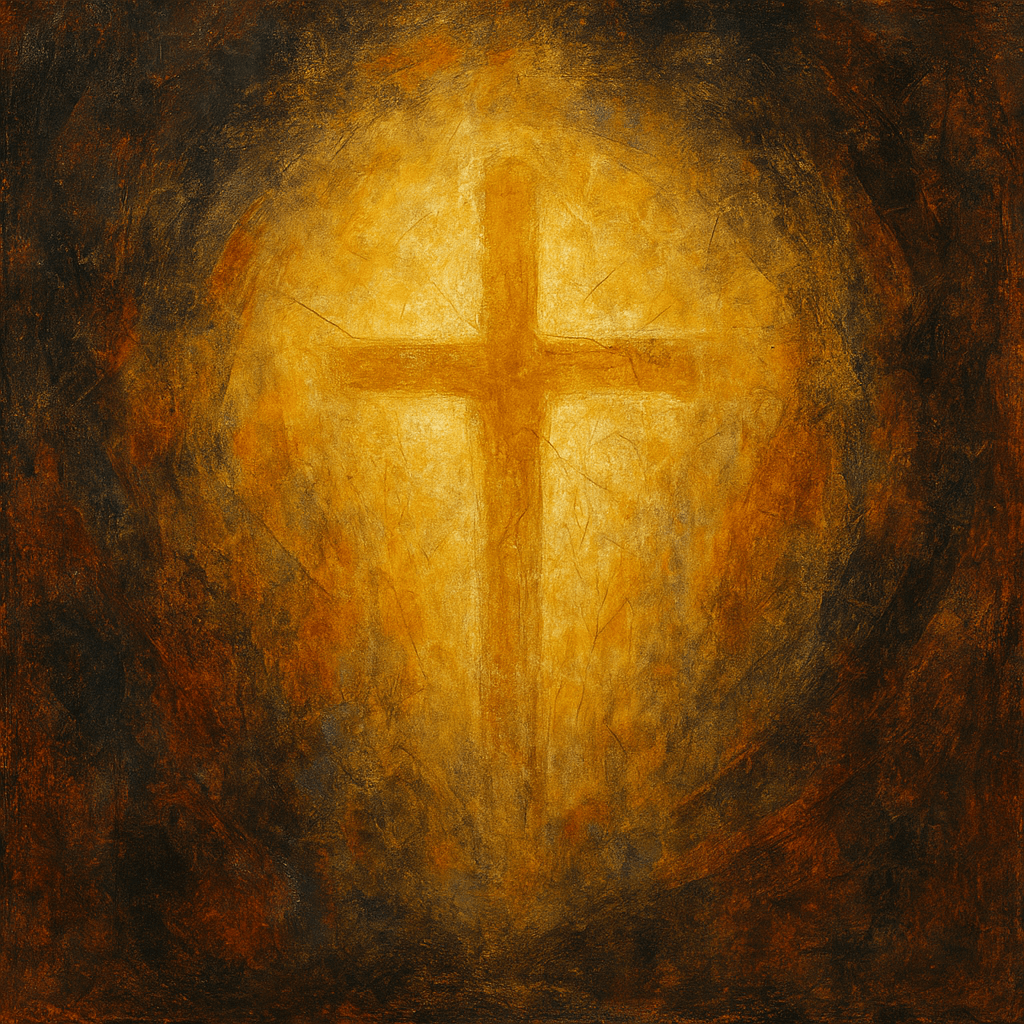
The true path is something else entirely. It is the search for union—not with an idea, not with a system, but with God Himself. To be one with God, to be drawn back into the unity from which we came. This is no easy journey, because it passes through the cross.
The cross is not merely a symbol of suffering; it is the portal through which humanity is gathered and made one. To take up the cross is to accept that our reconciliation will cost us ourselves. In its wood we discover the meeting point of heaven and earth, the axis where the fracture in our being is healed.
Only in the One do we find what every heart craves: the All Good, the All Love, the All Goodness, and the All Beauty. Without that union, even our noblest projects turn to ashes. With it, the true story begins: the story not of our striving, but of our return; not of our power, but of the One who makes all things one.
If you like, I can now prepare a shorter, poetic prelude to place before this text — so the reader steps into it as if entering a sacred meditation before the main reflection begins. That would pair beautifully with your abstract image.
 Centeno's Lighthouse
Leave a comment