(Spanish / English bilingual essay)
Israel Centeno
Español
No cabe duda: el ser humano comparte con los animales su naturaleza gregaria. Como muchos otros, vive en manada, protege a su grupo, establece jerarquías y sanciona a quienes rompen el orden. Basta observar lobos, elefantes o primates superiores: la manada impone una disciplina que garantiza la supervivencia colectiva. Y cuando alguien desafía esa jerarquía, suele ser castigado por el líder, restableciendo así el equilibrio. Podríamos incluso hablar de “organizaciones tribales” en el reino animal.
Pero en los animales, el castigo termina allí. Nunca aparece, después del acto, el remordimiento. Ningún lobo se atormenta por haber mordido a su rival, ningún león se arrepiente de haber devorado a la cría de una manada enemiga. El remordimiento, esa punzada íntima que pesa sobre la conciencia, no entra en el cálculo de la evolución biológica. Desde el punto de vista de la caza y la supervivencia, el remordimiento es incluso una desventaja: debilita al cazador, lo hace vacilar, lo vuelve menos apto frente al instinto.
Y sin embargo, el hombre siente remordimiento. No sólo por quitar la vida dentro de su grupo, sino también por herir o matar a un extraño, incluso de otra especie. Ninguna ley evolutiva explica este dolor del alma. Es algo más: un signo de interioridad. Edith Stein lo llamó la capacidad de autoposesión y autotrascendencia del espíritu humano1.
Lo mismo ocurre con el heroísmo. En la naturaleza, el más débil queda atrás: la manada sigue adelante, porque detenerse pondría en peligro la supervivencia de todos. Pero el ser humano es el único que se devuelve, arriesga su vida, enfrenta al enemigo y protege al herido. Ese gesto heroico no se explica por el instinto: responde a una ley más alta, inscrita en el corazón.
La rivalidad y la mímesis, que René Girard estudió como núcleo de la condición humana, también se observan en el mundo animal. Los machos compiten por el territorio, por la hembra, por la primacía, y la imitación del deseo genera choques inevitables. Incluso el mecanismo del chivo expiatorio —el sacrificio de un individuo que momentáneamente restaura la paz del grupo— aparece, de manera más elemental, en algunas especies2. Pero en el hombre, estos impulsos toman una forma cualitativamente distinta: se transforman en violencia ritual, en linchamiento colectivo, en sacrificios humanos y divinos.
¿Dónde se rompe este ciclo? Según Girard, sólo en Cristo3. El Hijo de Dios, el inocente sin pecado, acepta ser el chivo expiatorio universal, pero al resucitar revela la falsedad de la violencia sacrificial. En Él, el ciclo de la mímesis y de la rivalidad encuentra su fin: ya no hay víctima que sostenga la paz a costa de la sangre, sino un reino donde “los sordos oyen, los ciegos ven, los cojos caminan y los muertos se levantan” (cf. Mt 11,5). Cristo, que es todo bondad y todo amor, inaugura un camino distinto: la comunión no fundada en el sacrificio de otro, sino en el don de sí mismo para redimir a todos.
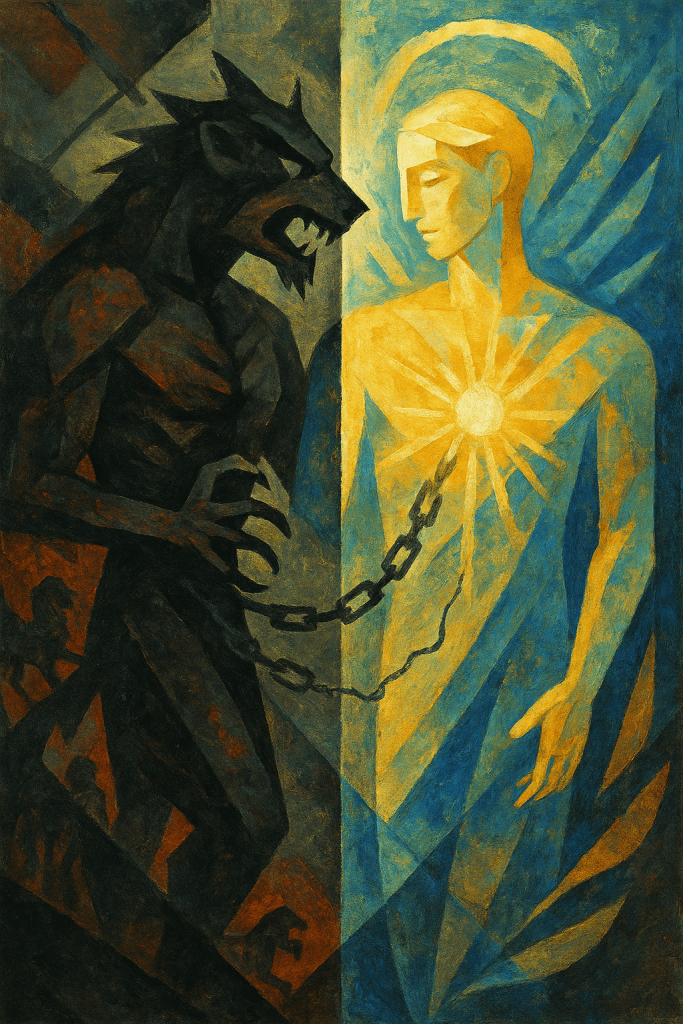
El hombre, claro, sigue siendo un animal cruel. Su historia está marcada por violencia, dominio y venganza. Pero a diferencia de otros animales, su alma nunca lo deja en paz. Esa alma —creada a imagen y semejanza de Dios4— lleva en sí misma la bondad y la verdad. Y por eso el hombre vive en conflicto: entre los impulsos de la carne y la voz de su conciencia, entre la brutalidad del instinto y la llamada a la eternidad.
Aristóteles lo intuyó cuando dijo que el hombre es zoón logikón, el animal racional5. Tomás de Aquino lo desarrolló al afirmar que el hombre es capaz de Dios (capax Dei), precisamente porque posee un alma espiritual6. Heidegger, desde otro horizonte, reconoció que somos el ser que se pregunta por el Ser mismo7. Y Charles Taylor, más recientemente, subrayó que el hombre no sólo actúa, sino que se interpreta a sí mismo8.
En todos ellos, desde la filosofía antigua hasta el pensamiento contemporáneo, resuena la misma intuición: lo que nos separa del resto de los animales no es la manada, ni la jerarquía, ni el instinto de supervivencia. Es el alma. Un alma que, al buscar la verdad y el bien, se convierte en el escenario de un conflicto interminable. Y quizá allí, en ese conflicto, resida la verdadera dignidad del hombre y su trascendencia hacia una forma superior de vida que no está limitada por el espacio ni por el tiempo, sino que es eterna porque es plena, como lo prometió Cristo: agua viva que nunca se agota (cf. Jn 4,14).
English
There is no doubt: the human being shares with animals its gregarious nature. Like many others, he lives in a herd, protects his group, establishes hierarchies, and sanctions those who break the order. One only needs to observe wolves, elephants, or higher primates: the herd imposes a discipline that guarantees collective survival. And when someone challenges that hierarchy, he is usually punished by the leader, thus restoring balance. We could even speak of “tribal organizations” in the animal kingdom.
But in animals, punishment ends there. Remorse never appears after the act. No wolf torments itself for biting a rival, no lion regrets devouring the offspring of an enemy herd. Remorse, that intimate pang weighing on conscience, does not enter into the calculation of biological evolution. From the perspective of hunting and survival, remorse is even a disadvantage: it weakens the hunter, makes him hesitate, renders him less fit against instinct.
And yet, man feels remorse. Not only for taking life within his group, but also for harming or killing a stranger, even of another species. No evolutionary law explains this pain of the soul. It is something more: a sign of interiority. Edith Stein called it the capacity for self-possession and self-transcendence of the human spirit1.
The same is true of heroism. In nature, the weakest are left behind: the herd moves on, for to stop would endanger the survival of all. But the human being is the only one who turns back, risks his life, confronts the enemy, and protects the wounded. That heroic gesture cannot be explained by instinct: it responds to a higher law inscribed in the heart.
Rivalry and mimesis, which René Girard studied as central to the human condition, are also observed in the animal world. Males compete for territory, for the female, for primacy, and the imitation of desire generates inevitable clashes. Even the scapegoat mechanism—the sacrifice of an individual that momentarily restores the peace of the group—appears, in a more elementary form, in some species2. But in man, these impulses take a qualitatively different form: they become ritual violence, collective lynching, human and divine sacrifices.
Where is this cycle broken? According to Girard, only in Christ3. The Son of God, the innocent without sin, accepts being the universal scapegoat, but in rising again reveals the falsehood of sacrificial violence. In Him, the cycle of mimesis and rivalry meets its end: there is no longer a victim to sustain peace through blood, but a kingdom where “the deaf hear, the blind see, the lame walk, and the dead are raised” (cf. Mt 11:5). Christ, who is all goodness and all love, inaugurates a different way: communion not founded on the sacrifice of another, but on the gift of Himself to redeem all.
Man, of course, remains a cruel animal. His history is marked by violence, domination, and vengeance. But unlike other animals, his soul never leaves him in peace. That soul—created in the image and likeness of God4—carries within itself both goodness and truth. And that is why man lives in conflict: between the impulses of the flesh and the voice of his conscience, between the brutality of instinct and the call to eternity.
Aristotle intuited it when he said that man is zoón logikón, the rational animal5. Thomas Aquinas developed it by affirming that man is capable of God (capax Dei), precisely because he possesses a spiritual soul6. Heidegger, from another horizon, recognized that we are the being who asks about Being itself7. And Charles Taylor, more recently, underlined that man not only acts, but interprets himself8.
In all of them, from ancient philosophy to contemporary thought, the same intuition resounds: what separates us from the rest of the animals is not the herd, nor hierarchy, nor the instinct for survival. It is the soul. A soul that, in seeking truth and goodness, becomes the stage of an unending conflict. And perhaps there, in that conflict, lies the true dignity of man and his transcendence toward a higher form of life that is not bound by space or time, but is eternal because it is full, as Christ promised: living water that never runs dry (cf. Jn 4:14).
Notes
Footnotes
- Edith Stein, Endliches und ewiges Sein (Ser finito y ser eterno / Finite and Eternal Being), 1936. ↩ ↩2
- René Girard, La violencia y lo sagrado (Violence and the Sacred), 1972. ↩ ↩2
- René Girard, Yo veía a Satanás caer como el relámpago (I Saw Satan Fall Like Lightning), 1999. ↩ ↩2
- Génesis 1,27 / Genesis 1:27. ↩ ↩2
- Aristóteles, Política, I, 1253a / Aristotle, Politics, I, 1253a. ↩ ↩2
- Tomás de Aquino, Summa Theologiae, I, q.12, a.1 / Thomas Aquinas, Summa Theologiae, I, q.12, a.1. ↩ ↩2
- Martin Heidegger, Ser y tiempo (Being and Time), 1927. ↩ ↩2
- Charles Taylor, Sources of the Self: The Making of the Modern Identity, Harvard University Press, 1989. ↩ ↩2
 Centeno's Lighthouse
Leave a comment