In an age of polarization and mimetic contagion, we either demonize or idolize, but rarely see clearly. René Girard’s lens helps us uncover the hidden mechanism of “all against one” and discover a new path: not myth, not scapegoating, but the truth revealed in the Cross — the innocence of the victim and the call to reconciliation.
Bilingual
✍️ Article in English
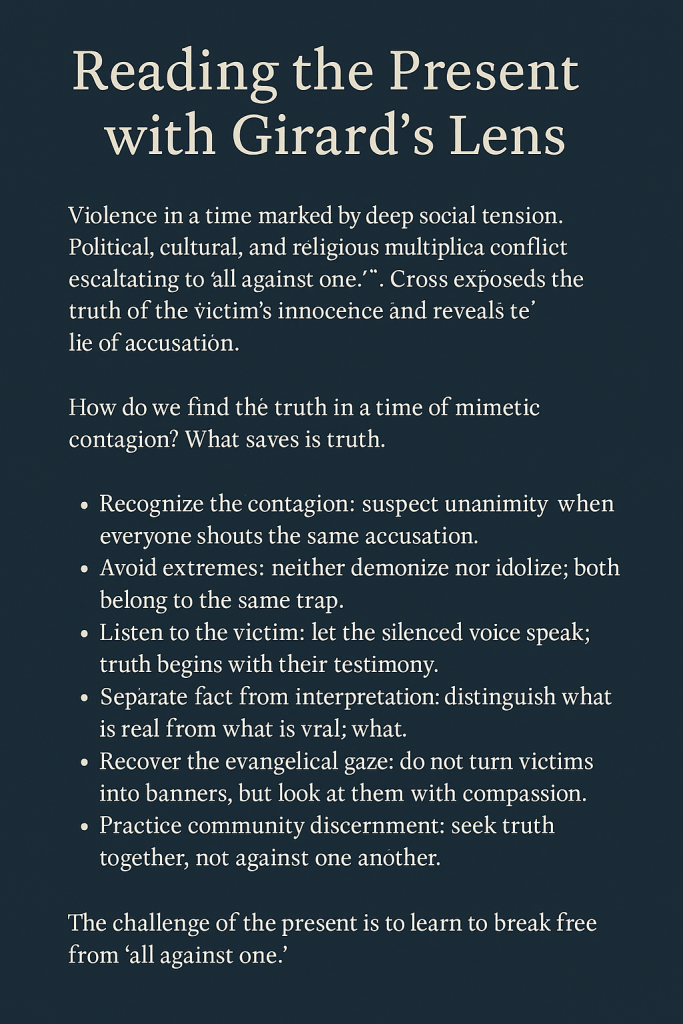
Reading the Present with Girard’s Lens
We live in a time marked by deep social tension. Political, cultural, and religious polarization multiplies divisions, and each side mirrors in the other the very passions that fuel its anger. Hatred imitates hatred, indignation spreads like fire, fear multiplies by contagion. In this collective mirror, conflict escalates until the entire community vibrates under the invisible pressure of finding someone to blame, someone to bear the weight of all unrest.
Then the most ancient mechanism of humanity emerges: the convergence of all against one. A culprit is identified, a face that concentrates suspicion and rage. It can be an individual, a minority, even a symbol. The unanimous cry rises: “If we eliminate this one, there will be peace.” And the sacrifice takes place: exclusion, lynching, assassination, social cancellation. The group feels, for an instant, a false peace, as if the problem had been solved.
But what follows is the building of a narrative. In the mythic logic, the victim is presented as guilty; their elimination is justified, even sacred. Violence is thus legitimized. In the evangelical logic, however, the victim is shown to be innocent. Their exclusion does not save the community but reveals the injustice of unanimity. It shows that supposed peace is built upon a lie.
This is our present: one sector demonizes, another deifies; one cries “monster”, the other “martyr.” Both fall into the mimetic trap. Neutrality becomes almost impossible, because contagion pressures everyone to take sides, to reproduce collective passion.
Against this endless cycle, the Cross opens another path. It is not a military or political triumph; it does not resemble the victory of a Roman general dragging prisoners in chains. The triumph of the Cross is paradoxical: it exposes the very mechanism of violence and strips it of its prestige. In the innocence of the victim, the lie of accusation is revealed. The Cross shows that neither demonization nor sacralization can save. What saves is truth — the recognition that we all participate in the mechanism and all stand in need of conversion.
How, then, do we find the truth in a time of mimetic contagion?
- Recognize the contagion: when everyone shouts the same accusation, suspect the unanimity.
- Avoid extremes: neither demonize nor idolize; both belong to the same trap.
- Listen to the victim: let the silenced voice speak; truth begins with their testimony.
- Separate fact from interpretation: distinguish what is real from what is viral.
- Recover the evangelical gaze: do not turn victims into banners, but look at them with compassion.
- Practice community discernment: seek truth together, not against one another.
The challenge of the present is not to choose whom to demonize or whom to sacralize, but to recognize how the “all against one” still operates and to learn to break free from it. The evangelical revelation calls us not to justify violence or glorify victims as idols, but to humanize: to defend innocence, resist contagion, dismantle the narratives that legitimize exclusion, and open a path toward reconciliation.
✍️ Artículo en Español
Leer el presente con la mirada de Girard
Vivimos en un tiempo marcado por la tensión social. La polarización política, cultural y religiosa multiplica las divisiones, y cada bando refleja en el otro las pasiones que alimentan su furia. El odio imita al odio, la indignación se contagia como fuego, el miedo se multiplica. En este espejo colectivo, el conflicto crece hasta que toda la comunidad vibra bajo una presión invisible: la necesidad de encontrar a alguien a quien culpar, alguien que cargue con el peso del malestar.
Entonces aparece el mecanismo más antiguo de la humanidad: la convergencia de todos contra uno. Se identifica un culpable, un rostro que concentra la sospecha y la rabia. Puede ser un individuo, una minoría, incluso un símbolo. El grito unánime se eleva: «Si eliminamos a este, habrá paz». Y el sacrificio se consuma: exclusión, linchamiento, asesinato, cancelación social. El grupo experimenta, por un instante, una paz ilusoria, como si el problema hubiera sido resuelto.
Pero lo que sigue es la construcción de un relato. En la lógica mítica, la víctima aparece como culpable; su eliminación se presenta como justa, necesaria o incluso sagrada. Así, la violencia queda legitimada. En la lógica evangélica, en cambio, la víctima es mostrada como inocente. Su exclusión no salva: desnuda la injusticia de la unanimidad, muestra que la paz aparente se levanta sobre una mentira.
Este es nuestro presente: un sector demoniza, otro sacraliza; unos gritan «monstruo», otros «mártir». Ambos caen en la trampa mimética. La neutralidad se vuelve casi imposible, porque la presión del contagio empuja a tomar partido, a reproducir la pasión colectiva.
Frente a este ciclo interminable, la Cruz abre otro camino. No es un triunfo militar ni político; no se parece a la victoria de un general romano que arrastra prisioneros encadenados. El triunfo de la Cruz es paradójico: consiste en exponer el mecanismo de la violencia y despojarlo de su prestigio. En la inocencia de la víctima se revela la mentira de la acusación. La Cruz enseña que ni la demonización ni la sacralización salvan; lo que salva es la verdad: reconocer que todos participamos en el mecanismo y todos necesitamos conversión.
¿Cómo encontrar, entonces, la verdad en un tiempo de contagio mimético?
- Reconocer el contagio: cuando todos acusan lo mismo, sospechemos de la unanimidad.
- Evitar los extremos: ni demonizar ni idolatrar; ambos pertenecen a la misma trampa.
- Escuchar la voz de la víctima: dejar hablar a quien fue silenciado; la verdad comienza con su testimonio.
- Separar hechos de interpretaciones: distinguir lo real de lo viral.
- Recuperar la mirada evangélica: no convertir a las víctimas en banderas, sino mirarlas con compasión.
- Practicar el discernimiento comunitario: buscar la verdad juntos, no unos contra otros.
El desafío del presente no es elegir a quién demonizar ni a quién sacralizar, sino reconocer cómo sigue operando el “todos contra uno” y aprender a liberarnos de él. La revelación evangélica no nos llama a justificar la violencia ni a glorificar a las víctimas como ídolos, sino a humanizar: a defender la inocencia, resistir el contagio, desmontar las narrativas que legitiman la exclusión y abrir un camino de reconciliación.
 Centeno's Lighthouse
Leave a comment