🇪🇸 Día Decimotercero
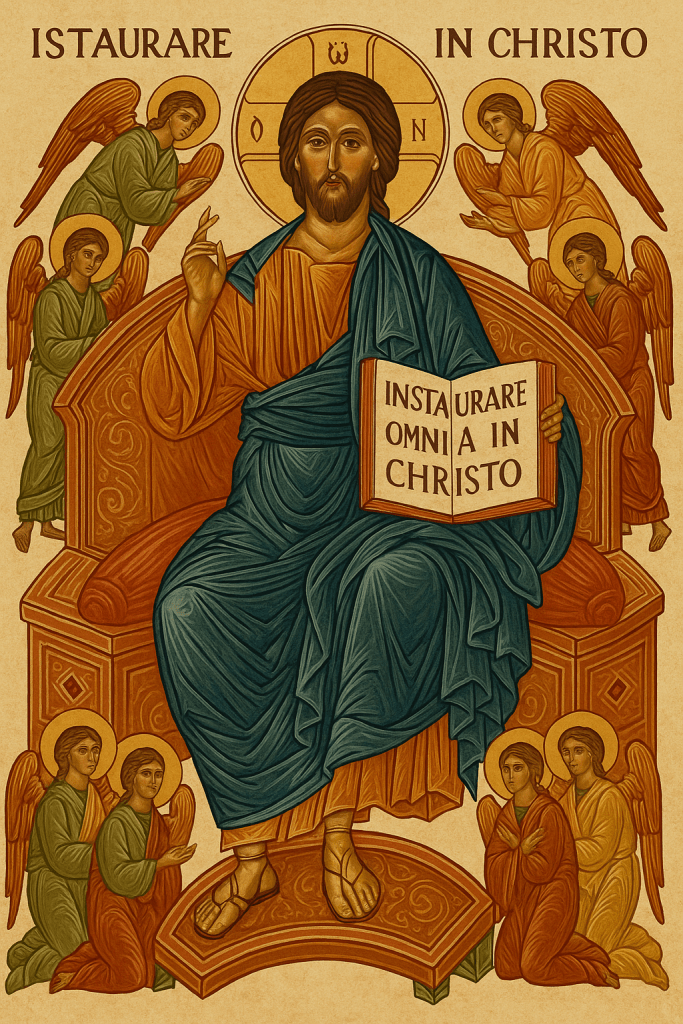
- “Instaurare omnia in Christo.”
De nuevo es San Pablo quien me instruye, San Pablo que acaba de sumergirse en el gran designio de Dios y que me dice “que Él ha resuelto en sí mismo restaurar todas las cosas en Cristo.”
Para que yo pueda realizar personalmente este plan divino, es también San Pablo quien viene en mi ayuda y quien me traza una regla de vida:
“Caminad en Jesucristo —me dice—, arraigados en Él, edificados en Él, fortalecidos en la fe, creciendo cada vez más en Él con acción de gracias.” - Caminar en Jesucristo me parece que significa salir de uno mismo, perderse de vista, renunciarse, para entrar cada vez más profundamente en Él, momento tras momento, tan profundamente que el alma quede allí enraizada.
Entonces, ante cada acontecimiento, ante toda circunstancia, podemos lanzar este hermoso desafío:
“¿Quién me separará del amor de Jesucristo?”
Cuando el alma se ha establecido en Él a tal profundidad que sus raíces penetran hondo, la savia divina circula en ella y toda esa vida imperfecta, vulgar y natural es destruida. Entonces, en lenguaje del Apóstol, “lo mortal es absorbido por la vida.”
El alma así “despojada” de sí misma y “revestida” de Jesucristo ya no tiene nada que temer de los encuentros exteriores ni de las dificultades interiores, pues estas cosas, lejos de ser un obstáculo, sirven únicamente para “arraigarla más profundamente en el amor” de su Maestro.
A través de todo, a pesar de todo, el alma puede “adorarle siempre por Él mismo”.
Porque es libre, libre de sí y de todo lo demás; puede cantar con el salmista:
“Si un ejército acampa contra mí, no temeré; si se desata la guerra, confiaré en medio de todo; porque Yahveh me esconderá en el secreto de su tienda.”
Y esa tienda no es otra cosa que Él mismo.
Creo que eso es lo que San Pablo quiere decir cuando dice: “Estad arraigados en Jesucristo.” - ¿Y qué significa ahora estar edificados en Él?
El profeta también canta:
“Él me ha puesto en alto sobre una roca, y ahora mi cabeza se alza sobre mis enemigos que me rodean.”
Creo que esto puede tomarse como figura del alma “edificada en Jesucristo”.
Él es esa roca sobre la cual se eleva el alma por encima de sí misma, de los sentidos y de la naturaleza, por encima de las consolaciones o de las penas, por encima de todo lo que no sea Él solo.
Allí, en perfecto dominio de sí misma, el alma vence y trasciende todo.
Luego, San Pablo me exhorta a ser fortalecida en la fe: en esa fe que nunca deja adormecer al alma, sino que la mantiene completamente vigilante bajo la mirada del Maestro, totalmente absorbida en el recuerdo de su palabra creadora, en esa fe “en su amor sobreabundante”, que permite a Dios —dice San Pablo— “llenar al alma con su plenitud.” - Finalmente, quiere que “crezca en Jesucristo por la acción de gracias”, pues todo debe concluir en esto:
“Padre, te doy gracias.”
Mi Maestro cantó estas palabras en su alma y desea oír su eco en la mía.
Pero pienso que el “cántico nuevo” que más encantará y cautivará a mi Dios es el de un alma despojada y libre de sí, en la cual Él puede reflejar todo lo que es y hacer todo lo que quiere.
Esa alma permanece bajo su toque como una lira, y todos los dones que Él le concede son cuerdas que vibran sin cesar, día y noche, para cantar la alabanza de su gloria.
— Santa Isabel de la Trinidad
🇬🇧 Thirteenth Day
- “Instaurare omnia in Christo.”
Once again, it is St. Paul who instructs me —St. Paul who has immersed himself in the great counsel of God and tells me that “He has resolved within Himself to restore all things in Christ.”
To help me personally realize this divine plan, it is again St. Paul who comes to my aid and who lays out for me a rule of life:
“Walk in Jesus Christ,” he tells me, “rooted in Him, built up in Him, strengthened in faith, growing more and more in Him through thanksgiving.” - To walk in Jesus Christ seems to me to mean to leave self, lose sight of self, give up self, in order to enter more deeply into Him moment by moment, so deeply that one becomes rooted there.
Then, before every event and circumstance, one can throw down this beautiful challenge:
“Who will separate me from the love of Jesus Christ?”
When the soul is established in Him so deeply that its roots are thrust far within, the divine sap flows through it, and all that imperfect, common, natural life is destroyed. Then, in the Apostle’s words, “that which is mortal is swallowed up by life.”
The soul thus “stripped” of self and “clothed” in Jesus Christ has nothing more to fear from outward encounters or inner trials, for these, far from being obstacles, serve only “to root it more deeply in the love” of its Master.
Through everything, in spite of everything, the soul can “adore Him always because of Himself.”
For it is free —free from self and from everything else; it can sing with the psalmist:
“Though an army encamp against me, I will not fear; though war be waged upon me, I will trust in spite of all, for Yahweh will hide me in the secrecy of His tent.”
And that tent is nothing else but Himself.
I believe this is what St. Paul means when he says, “Be rooted in Jesus Christ.” - And now, what does it mean to be built up in Him?
The prophet also sings:
“He has set me high upon a rock, and now my head is lifted up above my enemies who surround me.”
I think this may well represent the soul “built up in Jesus Christ.”
He is that rock upon which the soul rises above itself, the senses, and nature —above consolations or sorrows, above all that is not Him alone.
There, in perfect self-mastery, it overcomes and transcends all.
Next, St. Paul exhorts me to be strengthened in faith: that faith which never lets the soul sleep, but keeps it wholly vigilant beneath the gaze of its Master, wholly absorbed in remembrance of His creative word, in that faith “in His exceeding love,” which allows God, as St. Paul says, “to fill the soul with His fullness.” - Finally, he wants me “to grow in Jesus Christ through thanksgiving,” for everything must end in this:
“Father, I thank You!”
My Master sang this in His soul, and He wishes to hear its echo in mine.
But I believe that the “new song” which will most delight and captivate my God is that of a soul stripped and freed from self —one in which He can reflect all that He is and do all that He wills.
Such a soul remains beneath His touch like a lyre, and all His gifts to it are like strings that vibrate day and night to sing the praise of His glory.
— Saint Elizabeth of the Trinity
 Centeno's Lighthouse
Leave a comment