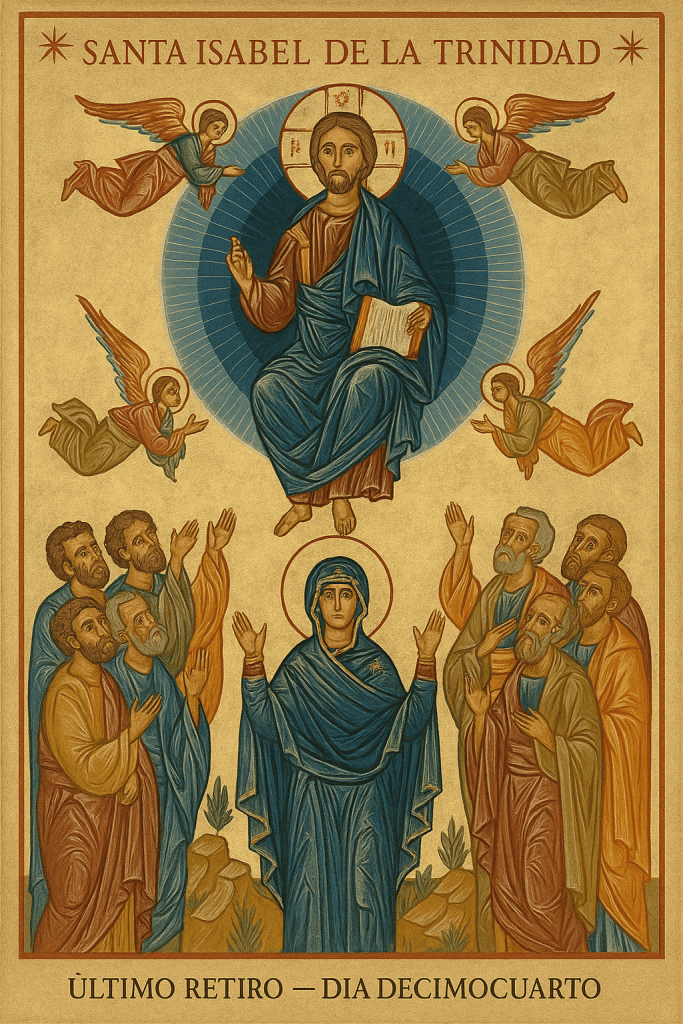
“Me parece que todo es pérdida desde que conocí la excelencia del conocimiento de mi Señor Jesucristo. Por amor a Él lo he perdido todo; todo lo demás lo tengo por basura, con tal de ganar a Cristo y ser hallada en Él, no con mi propia justicia, sino con la que viene de Dios por la fe.
Lo que deseo es conocerlo, compartir sus sufrimientos, asemejarme a Él en su muerte.
Prosigo mi carrera, esforzándome por alcanzar aquello para lo cual Cristo me ha tomado; mi único afán es olvidar lo que queda atrás y avanzar sin cesar hacia lo que está delante; corro recto hacia la meta, hacia el premio de la vocación celestial a la que Dios me ha llamado en Cristo Jesús.” (Filipenses 3:8-14)
El Apóstol ha revelado muchas veces la grandeza de esta vocación:
“Dios nos eligió en Él antes de la creación del mundo para que fuéramos santos e inmaculados en su presencia por amor… Hemos sido predestinados según el designio de Aquel que realiza todas las cosas conforme al consejo de su voluntad, para que seamos alabanza de su gloria.” (Efesios 1:4-12)
¿Cómo respondemos a la dignidad de esta vocación? Este es el secreto:
“Mihi vivere Christus est… Vivo autem, iam non ego, vivit vero in me Christus.” — “Para mí, vivir es Cristo… Ya no soy yo quien vive, sino que Cristo vive en mí.” (Filipenses 1:21; Gálatas 2:20)
Debemos ser transformados en Cristo.
San Pablo enseña:
“A los que Dios conoció de antemano, los predestinó a ser conformes a la imagen de su Hijo.” (Romanos 8:29)
Por tanto, debemos estudiar este divino Modelo, hasta identificarnos tanto con Él que podamos reflejarlo incesantemente ante los ojos del Padre.
¿Qué dijo el Hijo al venir al mundo?
“Aquí estoy, oh Dios, para hacer tu voluntad.” (Hebreos 10:7)
Esa oración debería ser como el latido del corazón del alma consagrada:
“Aquí estamos, oh Padre, venimos a hacer tu voluntad.”
El Maestro fue la Verdad misma en esa oblación inicial. Su vida entera fue consecuencia de ella:
“Mi alimento es hacer la voluntad del que me envió.” (Juan 4:34)
Así también debe ser para quien lo ama —y, al mismo tiempo, su espada y su cruz—:
“Padre, si es posible, pase de mí este cáliz; pero no se haga mi voluntad, sino la tuya.” (Lucas 22:42)
Y así podrá ir con gozo al sacrificio, sabiendo que el Padre la “ha conocido” al crucificarla con su Hijo.
“Tus mandamientos son mi herencia perpetua; son el gozo de mi corazón.” (Salmo 119:111)
Por la fidelidad constante a esos decretos, dará testimonio de la Verdad y podrá decir:
“El que me envió no me ha dejado solo, porque yo hago siempre lo que le agrada.” (Juan 8:29)
Entonces irradiará “ese poder secreto” que salva y libera almas.
Despojada y libre de sí misma, podrá subir con el Maestro al monte, a orar con Él “una oración de Dios”, ofreciendo un sacrificio continuo de alabanza:
“Por Él, ofrezcamos continuamente a Dios un sacrificio de alabanza, es decir, el fruto de unos labios que confiesan su nombre.” (Hebreos 13:15)
Y cuando llegue la hora de la humillación, recordará:
“Jesús autem tacebat” — Jesús callaba. (Mateo 26:63)
Guardará silencio, “reservando todas sus fuerzas para el Señor”, porque “de la quietud nace la fortaleza”.
Y cuando llegue la hora del abandono, del grito y del vacío, repetirá con su Maestro:
“Dios mío, Dios mío, ¿por qué me has abandonado?” (Mateo 27:46)
Y al beber el cáliz hasta las heces, hallará dulzura divina en su amargura.
Finalmente, tras haber dicho tantas veces “Tengo sed”, sed de poseerte en la gloria, cantará:
“Todo está consumado. En tus manos encomiendo mi espíritu.” (Juan 19:30; Lucas 23:46)
Entonces el Padre vendrá a “introducirla en su herencia”, donde “en tu luz veremos la luz”. (Salmo 36:9)
Porque el Señor habrá glorificado en ella a su Santo, destruyendo todo lo que no era Él para “revestirla de sí mismo”.
Así habrá vivido plenamente las palabras del Precursor:
“Es necesario que Él crezca y que yo disminuya.” (Juan 3:30)
— Santa Isabel de la Trinidad
Último Retiro — Día Decimocuarto
🇬🇧 Fourteenth Day — Last Retreat of Saint Elizabeth of the Trinity
“It seems to me that all is loss since I have known the surpassing worth of knowing Christ Jesus my Lord. For love of Him I have forfeited everything; I consider all else rubbish that I may gain Christ and be found in Him, not having my own justice but that which comes through faith in God. What I want is to know Him, to share in His sufferings, to become like Him in His death.
I press on, striving to take hold of that for which Christ Jesus has taken hold of me; forgetting what lies behind and straining forward to what lies ahead, I press toward the goal — the prize of the heavenly calling of God in Christ Jesus.” (Philippians 3:8–14)
The Apostle has revealed many times the greatness of this vocation:
“God chose us in Him before the creation of the world, to be holy and blameless in His sight, in love… having been predestined according to the plan of Him who works out everything in conformity with the purpose of His will, so that we might be to the praise of His glory.” (Ephesians 1:4–12)
How can we respond to such dignity? The secret is this:
“Mihi vivere Christus est… Vivo autem, iam non ego, vivit vero in me Christus.” — “For me to live is Christ… It is no longer I who live, but Christ who lives in me.” (Philippians 1:21; Galatians 2:20)
We must be transformed into Christ.
St. Paul teaches:
“Those whom God foreknew, He also predestined to be conformed to the image of His Son.” (Romans 8:29)
Thus we must study the Divine Model so closely that we reflect Him constantly before the Father’s eyes.
What did the Son say when He came into the world?
“Here I am, O God, I come to do Your will.” (Hebrews 10:7)
That prayer should be like the heartbeat of the soul:
“Here we are, O Father, we come to do Your will.”
The Master was truth itself in that first oblation. His whole life flowed from it:
“My food is to do the will of Him who sent me.” (John 4:34)
So it should be for the soul who loves Him — her food and her sword alike.
“Father, if it is possible, let this cup pass from me; yet not as I will, but as You will.” (Luke 22:42)
She will joyfully follow Him in every sacrifice, rejoicing to be known by the Father, since He crucifies her with His Son.
“Your decrees are my inheritance forever; they are the joy of my heart.” (Psalm 119:111)
Through fidelity to these decrees, she will “bear witness to the truth” and say:
“He who sent me has not left me alone, for I always do what pleases Him.” (John 8:29)
Remaining in this union, she will radiate “that secret power which saves and delivers souls.”
Stripped and free from self, she can follow the Master to the mountain to pray in her soul a “prayer of God,” offering through Him the “sacrifice of praise, the fruit of lips that confess His name.” (Hebrews 13:15)
When her hour of humiliation comes, she will remember:
“Jesus autem tacebat” — Jesus was silent. (Matthew 26:63)
She will keep silence, “reserving all her strength for the Lord,” for “from silence comes strength.”
And when the hour of abandonment comes, she will recall His cry:
“My God, my God, why have You forsaken me?” (Matthew 27:46)
And drinking the cup prepared by the Father, she will find divine sweetness in its bitterness.
Finally, after having said so often “I thirst,” thirsting to possess Him in glory, she will sing:
“It is finished. Into Your hands I commend my spirit.” (John 19:30; Luke 23:46)
Then the Father will come to bring her into His inheritance, where “in Your light we shall see light.” (Psalm 36:9)
For the Lord will have glorified His Holy One in her, clothing her entirely with Himself, and she will have lived truly the words of the Forerunner:
“He must increase and I must decrease.” (John 3:30)
— Saint Elizabeth of the Trinity
Last Retreat — Fourteenth Day
 Centeno's Lighthouse
Leave a comment