Después de Jesucristo, sin duda a la distancia que existe entre lo Infinito y lo finito, hay una que también fue la gran alabanza de gloria de la Santísima Trinidad. Ella respondió plenamente a la elección divina de la que habla el Apóstol: fue siempre “pura, inmaculada e irreprochable” (Efesios 1:4) ante los ojos del Dios tres veces santo.
Su alma es tan simple, sus movimientos tan profundos, que escapan a toda mirada humana. Parece reproducir en la tierra la vida misma del Ser divino, del Ser simple.
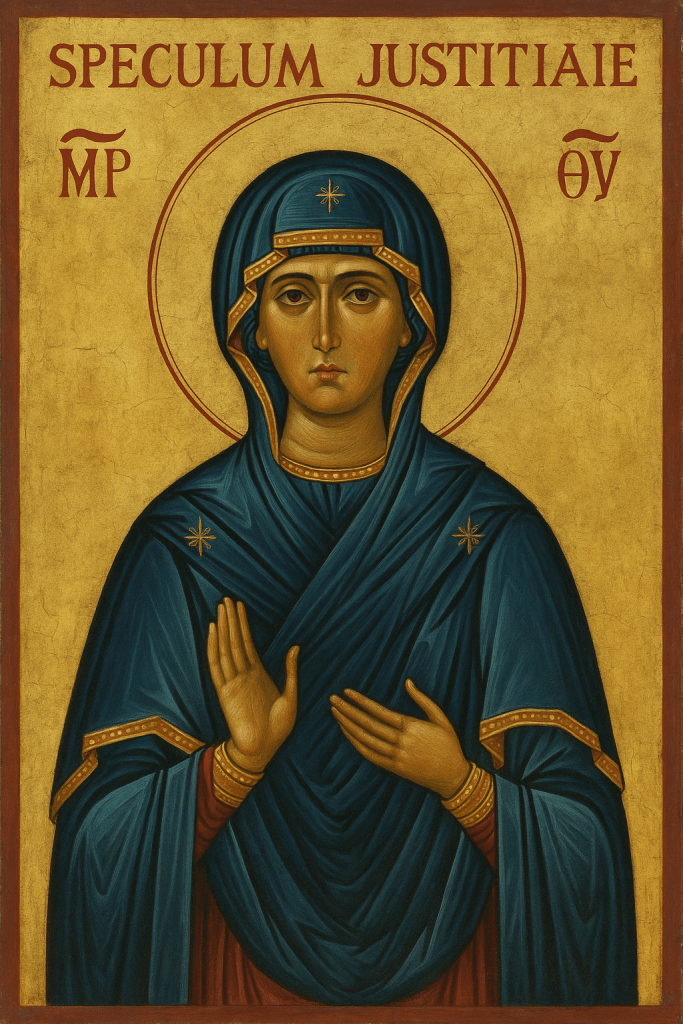
Es tan transparente, tan luminosa, que uno podría confundirla con la luz; pero ella no es sino el “espejo del Sol de Justicia”: Speculum justitiae!
“La Virgen guardaba todas estas cosas en su corazón.” (Lucas 2:19)
¡Toda su historia puede resumirse en estas pocas palabras! Vivió en el interior de su corazón, y a una profundidad tal que ningún ojo humano puede seguirla.
Cuando leo en el Evangelio que “María fue de prisa a la región montañosa de Judea” (Lucas 1:39) para servir amorosamente a su prima Isabel, la imagino caminando con serenidad, hermosa y majestuosa, absorta en la presencia del Verbo de Dios que llevaba en su seno.
Como Él, su oración era siempre: Ecce! — “Aquí estoy”.
¿Quién? “La sierva del Señor” (Lucas 1:38), la más humilde de las criaturas, ¡ella, Su Madre!
Su humildad era perfecta, porque siempre se olvidaba de sí misma, liberada del yo. Por eso pudo cantar:
“El Todopoderoso ha hecho obras grandes por mí, y su nombre es santo. Desde ahora todas las generaciones me llamarán bienaventurada.” (Lucas 1:48–49)
Esta Reina de las vírgenes es también Reina de los mártires; pero en su caso, la espada atravesó su corazón (Lucas 2:35), porque en ella todo acontecía dentro, en el silencio interior.
¡Qué hermosa es de contemplar en su largo martirio! Serena, envuelta en una majestad que irradia fuerza y dulzura.
Aprendió del Verbo mismo cómo deben sufrir aquellos que el Padre ha elegido como víctimas, aquellos que Él ha decidido asociar a su obra de redención, los que “han sido conocidos y predestinados para ser conformes a Cristo” (Romanos 8:29), crucificados por amor.
Está allí, al pie de la Cruz, firme, llena de fortaleza y de amor, y mi Maestro me dice:
“Ecce Mater tua” — “He aquí a tu Madre.” (Juan 19:27)
Él me la entrega por Madre.
Y ahora que Él ha regresado al Padre y me ha sustituido en la Cruz “para que en mi carne complete lo que falta a su pasión por el bien de su Cuerpo, que es la Iglesia” (Colosenses 1:24), la Santísima Virgen está de nuevo a mi lado, para enseñarme a sufrir como Él, para hacerme oír los últimos cantos de Su alma, esos que sólo Ella, Su Madre, pudo escuchar.
Y cuando yo diga mi propio “consummatum est” (Juan 19:30), será Ella, Janua Coeli — “Puerta del Cielo” — quien me introducirá en las moradas eternas, susurrándome las palabras del salmo:
“Me alegré cuando me dijeron: Vamos a la casa del Señor.” (Salmo 122:1)
— Santa Isabel de la Trinidad
🇬🇧 Fifteenth Day — Last Retreat of Saint Elizabeth of the Trinity
After Jesus Christ—at the distance that lies between the Infinite and the finite—there is one who was also the great praise of glory of the Holy Trinity. She fully responded to the divine election of which the Apostle speaks: she was always “pure, immaculate, and without reproach” (Ephesians 1:4) in the eyes of the thrice-holy God.
Her soul is so simple, her movements so deep, that they cannot be perceived. She seems to reproduce on earth the very life of the Divine Being—the simple Being.
And she is so transparent, so luminous, that one might mistake her for the light itself; yet she is only the “mirror of the Sun of Justice”: Speculum justitiae!
“The Virgin kept all these things in her heart.” (Luke 2:19)
Her whole history can be summed up in these few words! She lived within her heart, at such a depth that no human eye could follow her.
When I read in the Gospel that “Mary went in haste to the hill country of Judea” (Luke 1:39) to render loving service to her cousin Elizabeth, I imagine her passing so beautiful, calm, and majestic, wholly absorbed in the presence of the Word of God within her.
Like Him, her prayer was always: Ecce! — “Here I am.”
Who? “The handmaid of the Lord” (Luke 1:38), the lowliest of His creatures, yet His Mother!
Her humility was absolute, for she was always forgetful of self, freed from all self-consciousness. And she could sing:
“The Almighty has done great things for me, and holy is His name. From now on all generations will call me blessed.” (Luke 1:48–49)
This Queen of Virgins is also Queen of Martyrs; but with her, the sword pierced her heart (Luke 2:35), for everything took place within!
Oh, how beautiful she is to contemplate during her long martyrdom—serene, clothed in majesty, radiating both strength and gentleness.
She learned from the Word Himself how those must suffer whom the Father has chosen as victims, those He has decided to associate with Himself in the great work of redemption, those whom He “foreknew and predestined to be conformed to His Christ” (Romans 8:29), crucified by love.
She stands at the foot of the Cross, full of strength and courage—and here my Master says to me:
“Ecce Mater tua” — “Behold your Mother.” (John 19:27)
“I rejoiced when they said to me: Letus go to the house of the Lord.” (Psalm 122:1)
He gives her to me as my Mother.
— Saint Elizabeth of the Trinityq
And now that He has returned to the Father and has substituted me on the Cross, “that in my own body I may complete what is lacking in His passion for the sake of His Body, which is the Church” (Colossians 1:24), the Blessed Virgin is again there, teaching me how to suffer like Him, making me hear the last songs of His soul, which only she, His Mother, could hear.
And when I shall have said my own “consummatum est” (John 19:30), it will be she, Janua Coeli — “Gate of Heaven” — who will lead me into the courts of Heaven, whispering to me these words:
“I rejoiced when they said to me: Let us go to the house of the Lord.” (Psalm 122:1)
Last Retreat — Fifteenth Day
Fifteenth Day — Last Retreat of Saint Elizabeth of the Trinity
After Jesus Christ—at the distance that lies between the Infinite and the finite—there is one who was also the great praise of glory of the Holy Trinity. She fully responded to the divine election of which the Apostle speaks: she was always “pure, immaculate, and without reproach” (Ephesians 1:4) in the eyes of the thrice-holy God.
Her soul is so simple, her movements so deep, that they cannot be perceived. She seems to reproduce on earth the very life of the Divine Being—the simple Being.
And she is so transparent, so luminous, that one might mistake her for the light itself; yet she is only the “mirror of the Sun of Justice”: Speculum justitiae!
“The Virgin kept all these things in her heart.” (Luke 2:19)
Her whole history can be summed up in these few words! She lived within her heart, at such a depth that no human eye could follow her.
When I read in the Gospel that “Mary went in haste to the hill country of Judea” (Luke 1:39) to render loving service to her cousin Elizabeth, I imagine her passing so beautiful, calm, and majestic, wholly absorbed in the presence of the Word of God within her.
Like Him, her prayer was always: Ecce! — “Here I am.”
Who? “The handmaid of the Lord” (Luke 1:38), the lowliest of His creatures, yet His Mother!
Her humility was absolute, for she was always forgetful of self, freed from all self-consciousness. And she could sing:
“The Almighty has done great things for me, and holy is His name. From now on all generations will call me blessed.” (Luke 1:48–49)
This Queen of Virgins is also Queen of Martyrs; but with her, the sword pierced her heart (Luke 2:35), for everything took place within!
Oh, how beautiful she is to contemplate during her long martyrdom—serene, clothed in majesty, radiating both strength and gentleness.
She learned from the Word Himself how those must suffer whom the Father has chosen as victims, those He has decided to associate with Himself in the great work of redemption, those whom He “foreknew and predestined to be conformed to His Christ” (Romans 8:29), crucified by love.
She stands at the foot of the Cross, full of strength and courage—and here my Master says to me:
“Ecce Mater tua” — “Behold your Mother.” (John 19:27)
He gives her to me as my Mother.
And now that He has returned to the Father and has substituted me on the Cross, “that in my own body I may complete what is lacking in His passion for the sake of His Body, which is the Church” (Colossians 1:24), the Blessed Virgin is again there, teaching me how to suffer like Him, making me hear the last songs of His soul, which only she, His Mother, could hear.
And when I shall have said my own “consummatum est” (John 19:30), it will be she, Janua Coeli — “Gate of Heaven” — who will lead me into the courts of Heaven, whispering to me these words:
“I rejoiced when they said to me: Let us go to the house of the Lord.” (Psalm 122:1)
 Centeno's Lighthouse
Leave a comment