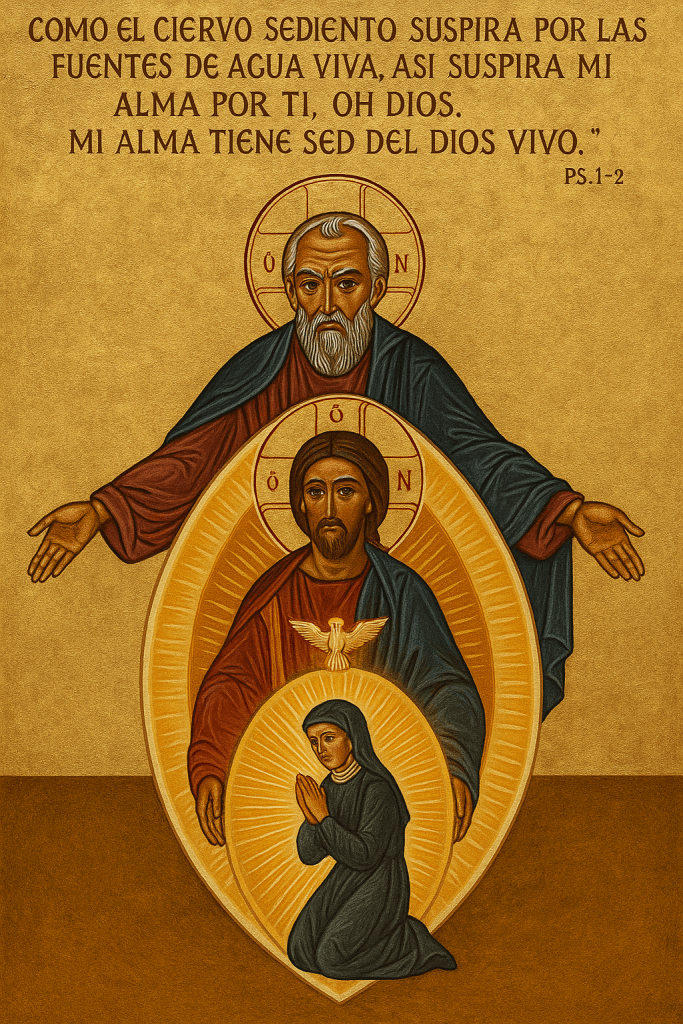
«Como la cierva sedienta suspira por las fuentes de agua viva,
así suspira mi alma por Ti, oh Dios.
Mi alma tiene sed del Dios vivo.
¿Cuándo entraré a contemplar Su rostro?»
Y, sin embargo, así como el gorrión ha hallado una casa
y la tórtola un nido donde poner sus polluelos,
así Laudem Gloriae ha encontrado, mientras espera
ser llevada a la Jerusalén santa, beata pacis visio,
su retiro, su bienaventuranza, su cielo anticipado,
donde comienza su vida de eternidad.
«En Dios mi alma está en silencio;
de Él viene mi liberación.
Él es la roca de mi salvación, mi fortaleza;
no vacilaré.»
Éste es el misterio que canta hoy mi lira.
Mi Maestro me ha dicho, como a Zaqueo:
«Desciende pronto, porque hoy debo hospedarme en tu casa.»
¿Desciende? ¿A dónde?
Al centro más íntimo de mi ser,
tras haberme abandonado, desprendido,
quedado sin mí misma,
sin yo.
«Debo quedarme en tu casa.»
Es mi Maestro quien expresa este deseo,
el que quiere habitar en mí con el Padre y el Espíritu de Amor,
para que, en palabras del discípulo amado,
tenga comunión con Ellos.
«Ya no sois extranjeros ni forasteros,
sino conciudadanos de los santos
y miembros de la casa de Dios», dice San Pablo.
Así entiendo yo pertenecer a la casa de Dios:
vivir en el seno de la Trinidad tranquila,
en mi abismo interior,
en esa invencible fortaleza de santa recolección
de la que habla San Juan de la Cruz.
David cantó: «Mi alma desfallece por los atrios del Señor.»
Y pienso que esa debería ser la actitud
de toda alma que entra en sus atrios interiores
para contemplar a su Dios
y acercarse a Él en el contacto más profundo:
cae desmayada en un éxtasis divino
ante el Amor omnipotente,
ante la infinita Majestad que mora en ella.
No es la vida la que abandona al alma,
es el alma la que desdeña esta vida natural
y se retira de ella;
siente que esta vida no es digna de Su rica esencia,
y así muere y se derrama en su Dios.
¡Oh, qué hermosa es esta criatura despojada,
libre de sí misma!
Puede usar «las ascensiones de su corazón»
para pasar de este valle de lágrimas
(a saber, de todo lo que es menos que Dios)
al lugar que es su meta,
ese espacio inmenso del que canta el salmista,
que no es otro que la insondable Trinidad:
Immensus Pater, Immensus Filius, Immensus Spiritus Sanctus.
Asciende, se eleva sobre los sentidos,
sobre la naturaleza,
se trasciende,
supera todo gozo y todo dolor
y pasa a través de las nubes,
sin detenerse hasta penetrar
en el interior de Aquel a quien ama,
que le da el reposo del abismo.
Y todo eso, sin salir de la santa fortaleza.
El Maestro le había dicho: «Desciende pronto…»
Y es sin salir de ella que el alma vivirá,
como la Trinidad inmutable,
en un eterno presente,
adorándole siempre por Él mismo,
y volviéndose, con una mirada cada vez más simple y unificada,
el resplandor de Su gloria:
la alabanza incesante
de Su adorable perfección.
🇬🇧 Saint Elizabeth of the Trinity — Final Retreat, Sixteenth Day
“As the thirsty deer longs for the springs of fresh water,
so my soul longs for You, O God!
My soul thirsts for the living God—
when shall I appear before His face?”
And yet, just as “the sparrow has found a home
and the turtledove a nest for her young,”
so Laudem Gloriae has found, while waiting
to be led into the holy Jerusalem, beata pacis visio—
her retreat, her blessedness,
her anticipated Heaven,
where her life of eternity begins.
“In God alone my soul is silent;
from Him comes my deliverance.
Yes, He is my rock and my salvation,
my fortress—I shall not be moved.”
This is the mystery my lyre sings today.
My Master has said to me, as to Zacchaeus:
“Hurry and come down, for today I must stay in your house.”
Hurry and come down—but where?
Into the innermost depths of my being:
after forsaking self,
after being stripped of self,
in a word—without self.
“I must stay in your house.”
It is my Master who desires this!
He who wishes to dwell within me
with the Father and the Spirit of Love,
so that, in the words of the beloved disciple,
I may have communion with Them.
“You are no longer strangers or guests,” says St. Paul,
“but members of the household of God.”
This, to me, is what it means
to belong to the house of God:
to live in the bosom of the tranquil Trinity,
within my interior abyss,
within that invincible fortress of holy recollection
of which St. John of the Cross speaks.
David sang: “My soul faints for the courts of the Lord.”
And I think this must be the posture
of every soul that enters its inner sanctuary
to contemplate its God,
to come into closest contact with Him:
it “falls fainting” in a divine swoon
before the all-powerful Love,
the infinite Majesty dwelling within.
It is not life that leaves the soul—
it is the soul that scorns this natural life
and withdraws from it;
for it feels that this life is unworthy
of His rich essence,
and thus it dies and flows into its God.
Oh, how beautiful is this creature—
stripped, free from self!
It may use “the ascensions in its heart”
to pass from this valley of tears
(that is, from all that is less than God)
to its destined place—
that spacious realm
of which the psalmist sings,
which seems to me to be the unfathomable Trinity:
Immensus Pater, Immensus Filius, Immensus Spiritus Sanctus!
It ascends, it rises above the senses,
above nature, beyond every joy and pain,
passing through the clouds
until it reaches the innermost heart
of the One it loves,
who Himself gives it “the repose of the abyss.”
And all this without leaving the holy fortress.
The Master had said: “Hurry and come down…”
And it is without leaving it
that the soul will live, like the unchanging Trinity,
in an eternal present—
adoring Him always because of Himself,
and becoming, through a gaze ever simpler, ever more united,
the radiance of His glory,
the unceasing praise of His adorable perfections.
 Centeno's Lighthouse
Leave a comment