From Human Knowledge to the Divine Mind
Israel Centeno
I. Truth as the Event of Being
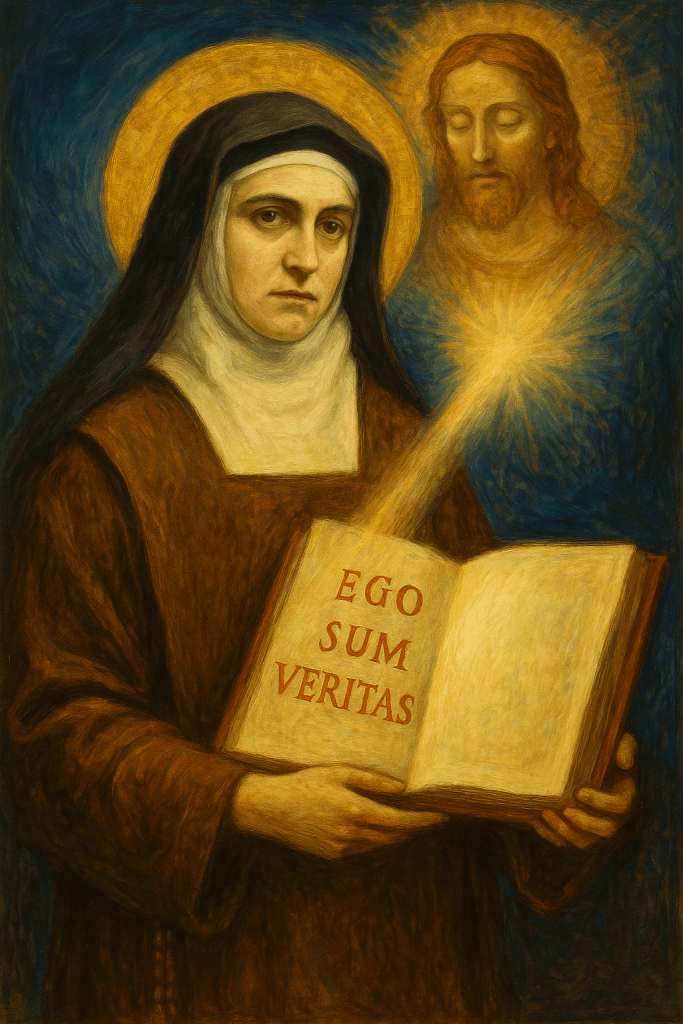
Truth, says Edith Stein, occurs when a mind encounters a being.
It is not a substance but a living relation between being and intelligence.
In the Aristotelian-Thomistic tradition, truth is defined as the adaequatio rei et intellectus—the correspondence of intellect and thing.
Stein, however, goes further: she roots truth in the structure of Being itself, and ultimately, in the divine Logos that sustains all existence.
II. The Infinite and the Finite Mind
In the divine Mind—the absolute Being—there is no distinction between knowing and being.
God is truth because in Him being and knowing coincide perfectly.
Hence the Logos can say: “I am the Truth.”
In God, every creature is known before it exists; its truth precedes its temporal appearance.
Truth is eternal because it participates in God’s eternal knowledge.
The human mind, by contrast, knows in time, step by step.
Truth, for us, is both goal and path—the result of the act of knowing.
The soul does not possess truth; it dwells in it incompletely.
Only God possesses it in fullness.
III. Created Truths and Language
St. Thomas speaks of veritas creata—“created truth”:
the finite truths born when the human intellect formulates judgments about the world.
Each true proposition is a finite reflection of the divine Mind.
When we say “the rose is red,” the act of judgment concludes the process of knowing.
The intellect unites essence (quidditas) and existence (haecceitas).
Language becomes the place where the human mind recreates in miniature the structure of the Logos.
Thus, true propositions have an “ideal existence” even before we think them:
the world is knowable because it is already thought in God.
IV. The Incarnate Logos: Truth Made Flesh
When Stein moves from philosophy to theology, she identifies the fullness of truth with the Incarnation.
The eternal Logos—the Word of God—does not only create; He enters creation.
In Christ, divine knowledge and human reality become one.
The Incarnate Word is the visible form of eternal Truth:
God knowing man from within.
Human knowledge, wounded by fragmentation and doubt, is redeemed in Christ.
It no longer knows from distance but from communion.
The Incarnation turns knowledge into an act of love:
to know is to participate in Being as gift.
V. The Light of Knowledge
The prologue of John’s Gospel illuminates this entire ontology:
“In Him was life, and the life was the light of men.”
That light is the divine intelligence sustaining all human understanding.
Each time the soul perceives a truth, it participates—however slightly—in the eternal act by which the Logos knows the Father.
Hence the act of knowing has a Trinitarian structure:
- The I who knows (image of the Son),
- The object known (work of the Father),
- And the light of understanding (the Spirit’s action).
To know, then, is a form of communion with the Trinity.
True thought does not divide: it unites.
VI. Truth as Communion and Redemption
For Stein, truth does not oppose faith; it reaches its fulfillment in it.
Faith is the highest form of knowledge because it is knowledge through union.
On the cross, the incarnate Logos pushes truth to its limit: He confronts falsehood, pain, and death, transforming them into revelation.
Human knowing is thus redeemed—it can now perceive meaning even in suffering.
Knowledge ceases to be conquest; it becomes contemplation.
Truth is no longer something to possess, but something to inhabit.
VII. Conclusion: Dwelling in Truth
In Stein’s synthesis, truth is not a logical property but a mode of being.
To be true is to exist in relation to the Logos.
Every creature participates in truth to the extent that it participates in being.
The human drive to know is not mere curiosity—it is nostalgia for its origin.
Thus, the soul that knows through love participates in the very act by which God knows and loves the world.
Truth is not possessed: it is inhabited.
And in that dwelling, the definitive word of the Logos is fulfilled:
“I am the Truth.”
🇪🇸 El Logos y la Verdad del Ser
Del conocimiento humano a la mente divina
I. La verdad como acontecimiento del ser
La verdad —dice Edith Stein— sucede cuando una mente conoce un ser.
No es una sustancia ni un objeto, sino una relación viva entre el ser y la inteligencia.
En la tradición aristotélico-tomista, se la define como adaequatio rei et intellectus (la adecuación del intelecto a la cosa).
Pero Stein va más allá: muestra que toda verdad se enraíza en la estructura del Ser mismo y, en última instancia, en el Logos divino que sostiene la existencia.
II. La mente infinita y la mente finita
En la Mente divina —el ser absoluto— no hay distinción entre conocer y ser.
Dios es la verdad porque en Él el ser y el conocimiento coinciden plenamente.
Por eso el Logos puede decir: “Yo soy la Verdad.”
En Dios, cada criatura es conocida antes de existir; su verdad precede a su aparición temporal.
La verdad es eterna porque participa del conocimiento eterno de Dios.
La mente humana, en cambio, conoce en el tiempo, paso a paso.
La verdad, para nosotros, es meta y camino: el resultado del proceso de conocer.
El alma no posee la verdad, sino que la busca y la habita parcialmente.
Solo Dios la posee en plenitud.
III. Las verdades creadas y el lenguaje
Santo Tomás habla de veritas creata, “verdad creada”:
las verdades particulares que surgen cuando el intelecto humano formula juicios sobre el mundo.
Cada proposición verdadera es un reflejo finito de la mente divina.
Stein explica que cuando decimos “la rosa es roja”, el juicio concluye un proceso de conocimiento.
El intelecto ha unido la esencia (quidditas) con su existencia concreta (haecceitas).
El lenguaje no es solo expresión: es el lugar donde la mente humana reproduce en pequeño la estructura del Logos.
Por eso las proposiciones verdaderas tienen una “existencia ideal” anterior a su formulación:
el mundo es cognoscible porque está ya pensado en Dios.
IV. El Logos encarnado: la Verdad hecha carne
Cuando Stein pasa de la filosofía a la teología, identifica la plenitud de la verdad con la Encarnación.
El Logos eterno —la Palabra de Dios— no solo crea, sino que entra en la creación.
En Cristo, el conocimiento divino y la realidad humana se hacen uno.
El Verbo encarnado es la forma visible de la Verdad eterna:
Dios conoce al hombre desde dentro.
El conocimiento humano, herido por la fragmentación y la duda, es redimido en Cristo.
Ya no conoce desde la distancia, sino desde la comunión.
La Encarnación convierte el conocer en un acto de amor:
conocer es participar en el Ser que se dona.
V. La luz del conocimiento
El prólogo del Evangelio de Juan ilumina toda esta ontología:
“En Él estaba la vida, y la vida era la luz de los hombres.”
Esa luz es la inteligencia divina que sostiene todo conocimiento humano.
Cada vez que el alma comprende una verdad, participa —aunque sea mínimamente— de la luz del Logos.
Por eso el acto de conocer tiene una estructura trinitaria:
- El yo que conoce (imagen del Hijo),
- El objeto creado (obra del Padre),
- Y la luz del entendimiento (acción del Espíritu).
Conocer, entonces, es un modo de comunión con la Trinidad.
El pensamiento verdadero no separa: une.
VI. La verdad como comunión y redención
Para Stein, la verdad no se opone a la fe, sino que encuentra en ella su consumación.
La fe es el conocimiento más alto porque es conocimiento por unión.
En la cruz, el Logos encarnado lleva la verdad al límite: enfrenta la mentira, el dolor y la muerte, y los transforma en revelación.
El conocimiento humano queda así redimido: puede ver el sentido incluso en el sufrimiento.
Conocer deja de ser conquista: se vuelve contemplación.
La verdad ya no se busca como posesión, sino como morada.
VII. Conclusión: habitar la verdad
En la síntesis de Edith Stein, la verdad no es una fórmula lógica, sino un modo de ser.
Ser verdadero es existir en relación con el Logos.
Toda criatura participa de la Verdad en la medida en que participa del Ser.
El impulso de conocer no es simple curiosidad: es nostalgia del origen.
Por eso, el alma que conoce con amor participa del acto mismo por el cual Dios conoce y ama al mundo.
La verdad no se posee: se habita.
Y en esa morada se cumple la palabra definitiva del Logos:
“Yo soy la Verdad.”
 Centeno's Lighthouse
Leave a comment