conocimiento humano a la mente divina
Israel Centeno
Interpretando a Santa Teresa Benedicta de la Cruz
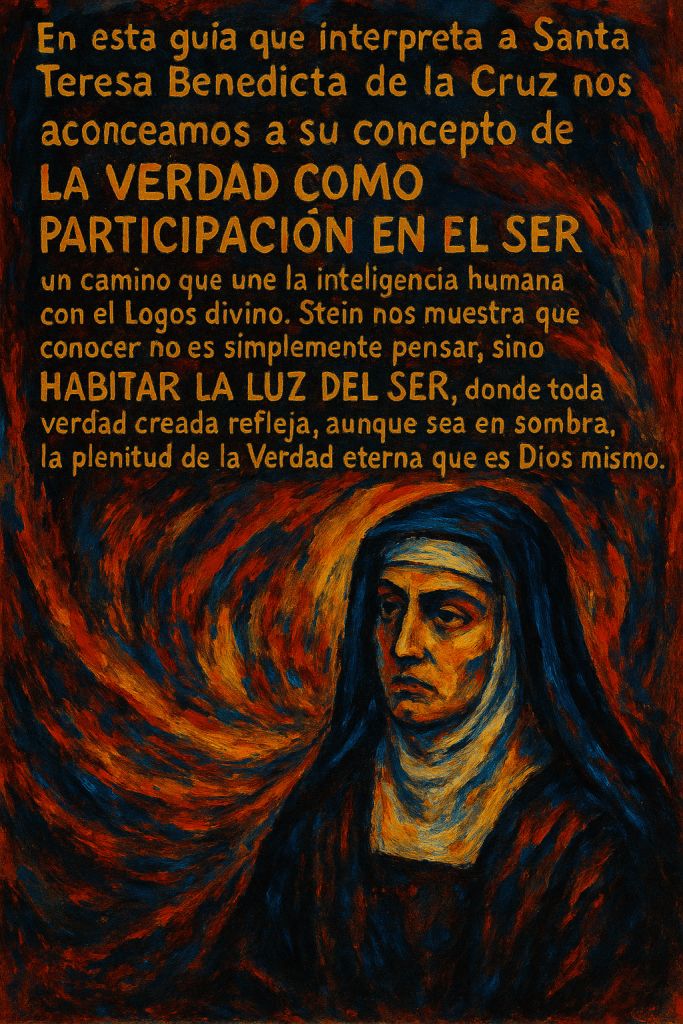
I. La verdad como acontecimiento del ser
La verdad, dice Edith Stein, sucede cuando una mente conoce un ente. No es una sustancia ni un objeto, sino una relación viva entre el ser y la inteligencia. En la tradición aristotélico-tomista, se define como adaequatio rei et intellectus (la adecuación del intelecto con la cosa). Pero Stein va más allá: muestra que toda verdad está enraizada en la estructura misma del Ser y, en última instancia, en el Logos divino que sostiene la existencia.
II. La mente infinita y la mente finita
En la Mente divina —el ser absoluto— no hay distinción entre conocer y ser. Dios es la verdad porque en Él el ser y el conocer coinciden plenamente. Por eso el Logos puede decir: “Yo soy la Verdad.” En Dios, toda criatura es conocida antes de existir; su verdad precede a su aparición temporal. La verdad es eterna porque participa del conocimiento eterno de Dios.
La mente humana, en cambio, conoce en el tiempo, paso a paso. Para nosotros, la verdad es a la vez meta y camino: el resultado del proceso de conocer. El alma no posee la verdad, la busca y la habita parcialmente. Solo Dios la posee en plenitud.
III. Verdades creadas y lenguaje
Santo Tomás habla de la veritas creata, la “verdad creada”: las verdades particulares que surgen cuando el intelecto humano formula juicios sobre el mundo. Cada proposición verdadera es un reflejo finito de la mente divina.
Stein explica que cuando decimos “la rosa es roja”, el juicio concluye un proceso de conocimiento. El intelecto ha unido la esencia (quidditas) con su existencia concreta (haecceitas). El lenguaje no es solo expresión: es el lugar donde la mente humana reproduce en miniatura la estructura del Logos. Por eso las proposiciones verdaderas tienen una “existencia ideal” anterior a su formulación: el mundo es cognoscible porque ya está pensado en Dios.
IV. El Logos encarnado: la verdad hecha carne
Cuando Stein pasa de la filosofía a la teología, identifica la plenitud de la verdad con la Encarnación. El Logos eterno —la Palabra de Dios— no solo crea, sino que entra en la creación. En Cristo, el conocimiento divino y la realidad humana se hacen uno. El Verbo encarnado es la forma visible de la Verdad eterna: Dios conoce a la humanidad desde dentro.
El conocimiento humano, herido por la fragmentación y la duda, es redimido en Cristo. Ya no conoce desde la distancia, sino desde la comunión. La Encarnación convierte el conocer en un acto de amor: conocer es participar del Ser que se entrega.
V. La luz del conocimiento
El prólogo del Evangelio de Juan ilumina toda esta ontología: “En Él estaba la vida, y la vida era la luz de los hombres.” Esa luz es la inteligencia divina que sostiene todo conocimiento humano. Cada vez que el alma comprende una verdad, participa —aunque sea mínimamente— en la luz del Logos. Por eso el acto de conocer tiene una estructura trinitaria:
- El yo que conoce (imagen del Hijo),
- El objeto creado (obra del Padre),
- Y la luz del entendimiento (acción del Espíritu).
Conocer, entonces, es un modo de comunión con la Trinidad. El pensamiento verdadero no separa: une.
VI. La verdad como comunión y redención
Para Stein, la verdad no se opone a la fe, sino que halla en ella su plenitud. La fe es el conocimiento más alto porque es conocimiento por unión. En la cruz, el Logos encarnado lleva la verdad a su límite: enfrenta la falsedad, el dolor y la muerte, y los transforma en revelación. Así, el conocimiento humano es redimido: puede ver sentido incluso en el sufrimiento.
El conocer deja de ser conquista: se vuelve contemplación. La verdad ya no se busca como posesión, sino como morada.
VII. Conclusión: habitar la verdad
En la síntesis de Edith Stein, la verdad no es una fórmula lógica, sino un modo de ser. Ser verdadero es existir en relación con el Logos. Toda criatura participa de la Verdad en la medida en que participa del Ser. El impulso de conocer no es mera curiosidad: es nostalgia del origen.
Por eso el alma que conoce con amor participa en el mismo acto por el cual Dios conoce y ama al mundo. La verdad no se posee: se habita. Y en esa morada se cumple la palabra definitiva del Logos: “Yo soy la Verdad.”
II
I. El ser real y el ser actual
Cuando Stein habla de “ser actual” (aktuell), no se refiere al punto culminante del ser, sino a su realidad efectiva, al hecho de existir realmente en el tiempo. Toma como ejemplo una rosa: su color rojo, su fragancia y su forma son propiedades esenciales que la constituyen. Aunque la flor se marchite o pierda su aroma, sigue siendo la misma rosa, porque su realidad no depende de conservar la plenitud de sus propiedades, sino de la continuidad de su sustancia.
La rosa en capullo aún no es plenamente “real”: está en potencia. Y cuando se seca y pierde sus hojas, deja de ser. Por eso, el ser finito nunca es plenamente actual en toda su posibilidad de ser; siempre permanece parcialmente potencial. En cada momento de su existencia, algo en él aún no se ha desplegado, o ya ha comenzado a desaparecer.
El ser finito, para Stein, vive en la tensión entre lo que es y lo que puede llegar a ser.
II. El ser ideal y las especies
Aquí introduce el concepto de ser ideal. Cuando hablamos del color rojo de la rosa, podemos entenderlo no solo como propiedad de una flor concreta, sino como especie ideal de “rojo brillante”, que puede repetirse en otras rosas o en otros objetos. Esta posibilidad de actualizarse en distintos individuos pertenece a la naturaleza del ser ideal.
El ser ideal no depende de la materia ni de un individuo particular; su posibilidad reposa en sí mismo, no en las cosas. Es el ámbito de las formas puras: colores, sonidos, figuras geométricas, que existen fuera del tiempo y del cambio.
El ser ideal está más cerca del ser puro que el ser de las cosas, porque no fluye ni se degrada: permanece. Stein reconoce aquí la intuición platónica —el “mundo de las ideas” como más real que el sensible—, pero no acepta que esas ideas sean “rígidas y muertas”. Redefine la actualidad (Aktualität) no solo como existencia o plenitud, sino también como eficacia y acción (Wirksamkeit). Las ideas, entonces, no son modelos estáticos: son formas activas que operan en la génesis de las cosas.
III. El vínculo entre el ser ideal, el ser divino y el ser de las cosas
Stein distingue tres modos de ser:
- El ser divino —Actus Purus—, plenitud absoluta sin potencialidad.
- El ser de las cosas, donde coexisten realidad y potencia.
- El ser ideal, que participa del ser puro, pero sin plenitud: posee una “posibilidad no cumplida.”
Las ideas o especies son el puente entre Dios y la creación. No existen independientemente, como en Platón, sino en la mente divina, donde son “tipos eternos” según los cuales las cosas se forman. Así, cuando existe una rosa, participa de su especie ideal —la “rosidad”—, pero esa especie no está fuera de Dios, sino en su mente creadora.
IV. Individuación: materia y forma
Stein retoma la pregunta clásica de Aristóteles y Santo Tomás: ¿qué hace que una cosa sea este individuo y no otro? La respuesta tradicional es que la materia (materia signata quantitate) es el principio de individuación. Pero Stein se pregunta si esto siempre se cumple: ¿hay seres individuales cuya identidad no dependa de la materia? (Ejemplo: almas, ángeles, formas puras.)
En los seres materiales, la materia da “plenitud y peso” al ser; pero no puede explicar la existencia por sí sola, pues es solo potencia. La forma —la especie o essentia— da estructura, pero tampoco basta: sin materia, sería solo posibilidad vacía. Por tanto, el ser real resulta del todo: materia configurada por la especie y por la forma individual.
La cosa concreta no es solo “una especie + materia”, sino una unidad irreductible, con una plenitud que no puede descomponerse.
V. El artista y el modelo
Stein usa una analogía artística: cuando un escultor modela en mármol la figura de un joven, la obra final —la estatua— es el individuo concreto. El artista tenía previamente una “idea” en mente: esa idea corresponde a la especie o forma esencial de lo que la escultura será. La materia (el mármol) recibe forma según ese modelo.
Del mismo modo, Dios es el artista creador. Las ideas —los arquetipos de las cosas— están en su mente, y el mundo es su realización en la materia. Por eso, dice Santo Tomás, la verdad puede llamarse “creada”: antes de existir, la cosa solo “es” en la mente divina, no como criatura, sino como esencia creadora.
VI. Interpretación final
Este fragmento de Stein describe un sistema ontológico trinitario del ser:
- Ser divino —acto puro, fuente de todo.
- Ser ideal —formas eternas en la mente divina.
- Ser real —cosas finitas que participan de esas formas en el tiempo.
Materia y forma, potencia y acto, idea y realización son modos de participación en el único Ser absoluto. El mundo no es mera copia de ideas, sino acto de comunicación del Ser divino. Cada cosa, al existir, “imita” al Verbo creador, que es su arquetipo y causa.
Así, cuando Tomás dice que las ideas están en Dios y no fuera de Él, Stein ve confirmada su visión cristológica: el Logos no es un intermediario abstracto, sino el mismo acto de creación, la forma viva del ser.
Síntesis interpretativa
Edith Stein sintetiza en este fragmento tres tradiciones:
- Aristóteles y Santo Tomás: acto y potencia, materia y forma, ser compuesto.
- Platón: las ideas como tipos eternos.
- La fenomenología: la experiencia del ser como don de sentido al sujeto.
El resultado es una metafísica dinámica: el ser ideal no está separado, sino activo en el devenir del mundo. El Creador es a la vez artista y modelo, causa y arquetipo.
Cada criatura —como la rosa— es una expresión temporal de una forma eterna que vive en la mente divina.
El ser humano, al conocer, participa de ese mismo dinamismo creador: cuando conoce una verdad, actualiza una forma ideal en su intelecto y así imita el acto divino de conocer.
Interpreting Saint Teresa Benedicta of Jesus
The Logos and the Truth of Being
From Human Knowledge to the Divine Mind
I. Truth as an Event of Being
Truth, says Edith Stein, happens when a mind knows a being. It is not a substance or an object, but a living relationship between being and intelligence. In the Aristotelian-Thomistic tradition, it is defined as adaequatio rei et intellectus (the adequacy of the intellect to the thing). But Stein goes further: she shows that all truth is rooted in the structure of Being itself and, ultimately, in the divine Logos that sustains existence.
II. The Infinite Mind and the Finite Mind
In the Divine Mind—the absolute being—there is no distinction between knowing and being. God is the truth because in God, being and knowledge fully coincide. That is why the Logos can say: “I am the Truth.” In God, every creature is known before it exists; its truth precedes its temporal appearance. Truth is eternal because it participates in God’s eternal knowledge.
The human mind, on the other hand, knows in time, step by step. For us, truth is both goal and path: the result of the process of knowing. The soul does not possess the truth, but seeks and inhabits it partially. Only God possesses it in fullness.
III. Created Truths and Language
Saint Thomas speaks of veritas creata, “created truth”: the particular truths that arise when the human intellect makes judgments about the world. Each true proposition is a finite reflection of the divine mind.
Stein explains that when we say “the rose is red,” the judgment concludes a process of knowledge. The intellect has united the essence (quidditas) with its concrete existence (haecceitas). Language is not just expression: it is the place where the human mind reproduces in miniature the structure of the Logos. That is why true propositions have an “ideal existence” prior to their formulation: the world is knowable because it is already thought in God.
IV. The Incarnate Logos: Truth Made Flesh
When Stein moves from philosophy to theology, she identifies the fullness of truth with the Incarnation. The eternal Logos—the Word of God—not only creates, but enters creation. In Christ, divine knowledge and human reality become one. The incarnate Word is the visible form of eternal Truth: God knows humanity from within.
Human knowledge, wounded by fragmentation and doubt, is redeemed in Christ. It no longer knows from a distance, but from communion. The Incarnation turns knowing into an act of love: to know is to participate in the Being that gives itself.
V. The Light of Knowledge
The prologue of the Gospel of John illuminates this entire ontology: “In Him was life, and the life was the light of men.” That light is the divine intelligence that sustains all human knowledge. Each time the soul understands a truth, it participates—even minimally—in the light of the Logos. That is why the act of knowing has a Trinitarian structure:
– The I who knows (image of the Son),
– The created object (work of the Father),
– And the light of understanding (action of the Spirit).
To know, then, is a mode of communion with the Trinity. True thought does not separate: it unites.
VI. Truth as Communion and Redemption
For Stein, truth is not opposed to faith, but finds its consummation in it. Faith is the highest knowledge because it is knowledge by union. On the cross, the incarnate Logos brings truth to its limit: faces falsehood, pain, and death, and transforms them into revelation. Human knowledge is thus redeemed: it can see meaning even in suffering.
Knowing ceases to be conquest: it becomes contemplation. Truth is no longer sought as possession, but as dwelling.
VII. Conclusion: Dwelling in Truth
In Edith Stein’s synthesis, truth is not a logical formula, but a way of being. To be true is to exist in relation to the Logos. Every creature participates in Truth to the extent that it participates in Being. The impulse to know is not mere curiosity: it is nostalgia for the origin.
That is why the soul that knows with love participates in the very act by which God knows and loves the world. Truth is not possessed: it is inhabited. And in that dwelling, the definitive word of the Logos is fulfilled: “I am the Truth.”
II
I. Real Being and Actual Being
When Stein speaks of “actual being” (aktuell), she does not refer to the culminating point of being, but to its effective reality, to the fact of really existing in time. She takes as an example a rose: its red color, its fragrance, its form are essential properties that constitute it. Even if the flower withers or loses its aroma, it is still the same rose, for its reality does not depend on maintaining the fullness of its properties, but on the continuity of its substance.
The rose in bud is not yet fully “real”: it is in potency. And when it dries and loses its leaves, it ceases to be. Hence, finite being is never fully actual in all its possibility of being; it always remains partially potential. At every moment of its existence, something in it has not yet been unfolded, or has already begun to disappear.
Finite being, for Stein, lives in the tension between what it is and what it can become.
II. Ideal Being and Species
Here she introduces the concept of ideal being. When we speak of the red color of the rose, we can understand it not only as a property of a concrete flower, but as an ideal species of “brilliant red,” which could be repeated in other roses or other objects. This possibility of being actualized in different individuals belongs to the nature of ideal being.
Ideal being does not depend on matter or a particular individual; its possibility rests in itself, not in things. It is the realm of pure forms: colors, sounds, geometric figures, which exist outside time and change.
Ideal being is closer to pure being than the being of things, because it does not flow or degrade: it remains. Stein recognizes here the Platonic intuition—the “world of ideas” as more real than the sensible world—but does not accept that these ideas are “rigid and dead.” She redefines actuality (Aktualität) not only as existence or fullness, but also as efficacy and action (Wirksamkeit). Ideas, then, are not mere static models: they are active forms that operate in the genesis of things.
III. The Link Between Ideal Being, Divine Being, and the Being of Things
Stein distinguishes three modes of being:
– Divine being—Actus Purus—which is absolute fullness, without potentiality.
– The being of things, where reality and potentiality coexist.
– Ideal being, which participates in pure being, but without fullness: it possesses an “unfulfilled possibility.”
Ideas or species are the bridge between God and creation. They do not exist independently, as in Plato, but in the divine mind, where they are “eternal types” according to which things are formed. Thus, when a rose exists, it participates in its ideal species—the “roseness”—but that species is not outside God, but in his creative mind.
IV. Individuation: Matter and Form
Stein takes up the classic question of Aristotle and Thomas Aquinas: what makes a thing this individual and not another? The traditional answer is that matter (materia signata quantitate) is the principle of individuation. But Stein asks if this always holds: are there individual beings whose identity does not depend on matter? (Example: souls, angels, pure forms.)
In material beings, matter provides the “fullness and weight” of being; but it cannot explain existence by itself, for it is only potency. Form—the species or essentia—gives structure, but is not enough: without matter, it would be only empty possibility. Therefore, real being results from the whole: matter configured by the species and by the individual form.
The concrete thing is not just “a species + matter,” but an irreducible unity, with a fullness that cannot be decomposed.
V. The Artist and the Model
Stein uses an artistic analogy: when a sculptor models in marble the figure of a youth, the final work—the statue—is the concrete individual. The artist previously had an “idea” in mind: that idea corresponds to the species or essential form of what the sculpture will be. The matter (the marble) receives form according to that model.
Similarly, God is the creative artist. The ideas—the archetypes of things—are in his mind, and the world is their realization in matter. That is why, says Thomas, truth can be called “created”: before existing, the thing only “is” in the divine mind, not as a creature, but as a creative essence.
VI. Final Interpretation
This fragment of Stein describes a Trinitarian ontological system of being:
– Divine being—pure act, source of all.
– Ideal being—the eternal forms in the divine mind.
– Real being—finite things that participate in those forms in time.
Matter and form, potency and act, idea and realization, are modes of participation in the one absolute Being. The world is not a mere copy of ideas, but an act of communication of the divine Being. Each thing, by existing, “imitates” the creative Word, which is its archetype and cause.
Thus, when Thomas says that ideas are in God, not outside Him, Stein sees her Christological vision confirmed: the Logos is not an abstract intermediary, but the very act of creation—the living form of being.
Interpretative Synthesis
Edith Stein synthesizes in this fragment three traditions:
– Aristotle and Thomas Aquinas: act and potency, matter and form, composite being.
– Plato: ideas as eternal types.
– Phenomenology: the experience of being as a gift of meaning to the subject.
The result is a dynamic metaphysics: ideal being is not separate, but active in the becoming of the world. The creator is at once artist and model, cause and archetype. Every creature—like the rose—is a temporal expression of an eternal form that lives in the divine mind.
The human being, in knowing, participates in that same creative dynamism: when one knows a truth, one realizes an ideal form in the intellect, and thus imitates the divine act of knowledge.´
 Centeno's Lighthouse
Leave a comment