Author: Israel Centeno

  • Cristo en el corazón de toda la Escritura: Testimonio Apostólico, Tradición y Lectura Patrística

    Israel Centeno

    Entre los primeros que escribieron sobre Cristo, el apóstol Pablo es, con toda probabilidad, la voz más inmediata en el tiempo a la muerte y resurrección del Señor. En su primera carta a los Corintios (1 Co 15, 3-8), Pablo transmite una proclamación que no inventa, sino que él mismo “recibió” (παρέλαβον, parelabon), empleando el término técnico de la tradición rabínica para la transmisión oral autorizada. El texto dice:

    “Porque primeramente les he enseñado lo que asimismo recibí: que Cristo murió por nuestros pecados, según las Escrituras; que fue sepultado, y que resucitó al tercer día, según las Escrituras; que apareció a Cefas, y después a los Doce; luego apareció a más de quinientos hermanos a la vez, de los cuales muchos viven aún, y otros ya duermen. Después apareció a Jacobo; después a todos los apóstoles; y al último de todos, como a un abortivo, me apareció a mí.”

    La mayoría de los exégetas modernos (James D. G. Dunn, Jesus Remembered, 2003; Larry Hurtado, Lord Jesus Christ, 2003; N. T. Wright, The Resurrection of the Son of God, 2003) reconocen en este pasaje la formulación de un credo cristiano primitivo, con estructura paralelística, ritmo memorizable y una teología pascual ya plenamente articulada. Joachim Jeremias y C. H. Dodd coinciden en situar este credo en Jerusalén, transmitido a Pablo durante su primera visita (Ga 1,18-19), es decir, tres a cinco años después de la crucifixión. Su proximidad temporal, unida a la presencia de testigos oculares vivos, lo convierte en la pieza documental más temprana del cristianismo.

    Este núcleo kerigmático muestra que, desde el inicio, la fe en la muerte y resurrección de Jesús no fue el resultado de una lenta evolución literaria, sino el fundamento inalterable de la predicación apostólica. De hecho, el propio Pablo lo presenta como “lo primero” (ἐν πρώτοις), tanto en orden de transmisión como en jerarquía doctrinal.

    Resulta difícil, incluso para la imaginación moderna, concebir que un grupo de pescadores galileos, acompañados por un doctor de la ley como Pablo, pudiese haber fabricado deliberadamente una red tan vasta y coherente de referencias entre el Antiguo Testamento y la vida de Jesús. Y más difícil aún si se considera el contexto: carecían de recursos técnicos, trabajaban en la expansión de un movimiento que en pocas décadas alcanzó Asia Menor, Siria, el norte de África y, según la tradición, la misma Hispania (cf. Ad Romanos 15, 24.28), todo ello en medio de persecuciones, viajes y fundación de comunidades.

    Sin embargo, en muy poco tiempo, la totalidad del canon veterotestamentario comenzó a leerse como un mapa que conducía al Mesías: desde Job y Génesis, pasando por Deuteronomio, Reyes y Jueces, hasta los Salmos, el Cantar de los Cantares y la Sabiduría. No se trataba de un ejercicio literario retrospectivo, sino de una comprensión nueva, iluminada por el acontecimiento pascual. Como afirmará siglos después san Ireneo:

    “Quoniam enim una eademque est dispositio salutis Dei, semper idem et idem est Deus, qui et legem dedit, et Evangelium instituit, et legem in Evangelio, et Evangelium in lege praedicavit” (Adversus Haereses IV, 9, 3).

    “Porque uno y el mismo es el plan de salvación de Dios; siempre el mismo es el Dios que dio la Ley y estableció el Evangelio, que anunció la Ley en el Evangelio y el Evangelio en la Ley.”

    Orígenes, en su Homilía sobre Josué (Hom. Jos. 2, 1), expresa el mismo principio hermenéutico:

    “Toda la Escritura divina habla de Cristo, y toda la Escritura se cumple en Cristo.”

    Los Padres entendieron que la lectura cristocéntrica de toda la Escritura no era una imposición desde el futuro, sino la revelación de un sentido ya presente, pero ahora plenamente manifiesto. Eusebio de Cesarea, en su Demonstratio Evangelica (II, 6), resume esta visión afirmando que la economía de Cristo es “el centro hacia el que convergen todas las profecías y figuras, como radios hacia un solo punto”.

    La magnitud de esta obra —integrar los libros veterotestamentarios con los escritos apostólicos hasta culminar en el Apocalipsis—, llevada a cabo en tan breve tiempo y en circunstancias humanas adversas, sólo puede entenderse, como ya afirmaba la tradición, por la acción del Espíritu Santo. No había imprentas ni redes de comunicación centralizada; lo que había eran hombres y mujeres animados por una certeza inconmovible, conscientes de que la cruz y la resurrección de Cristo eran el centro de la historia.

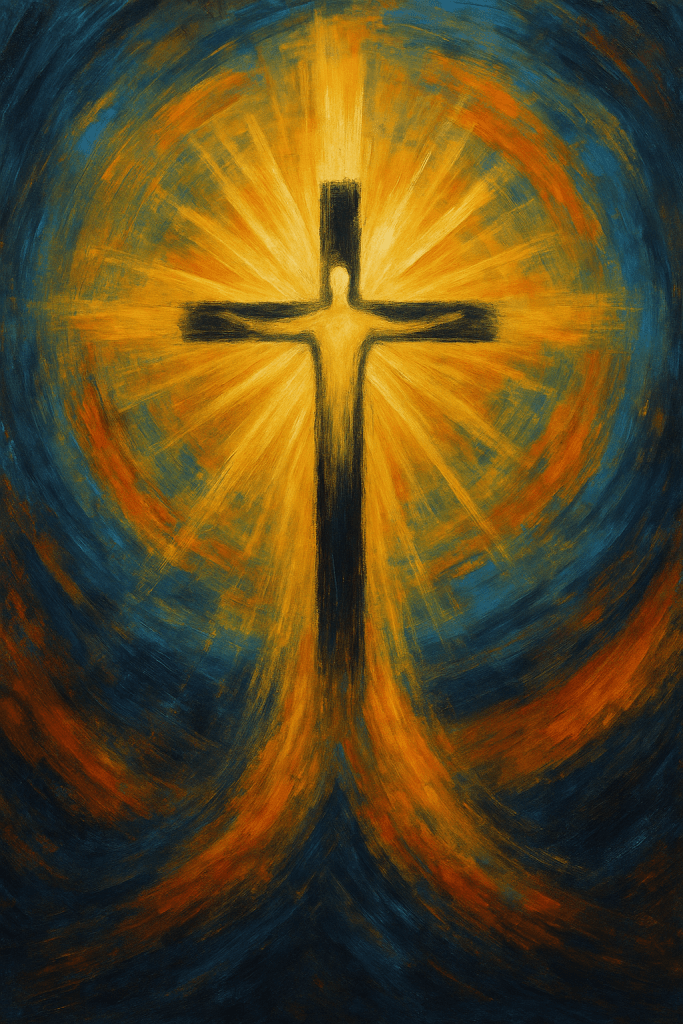
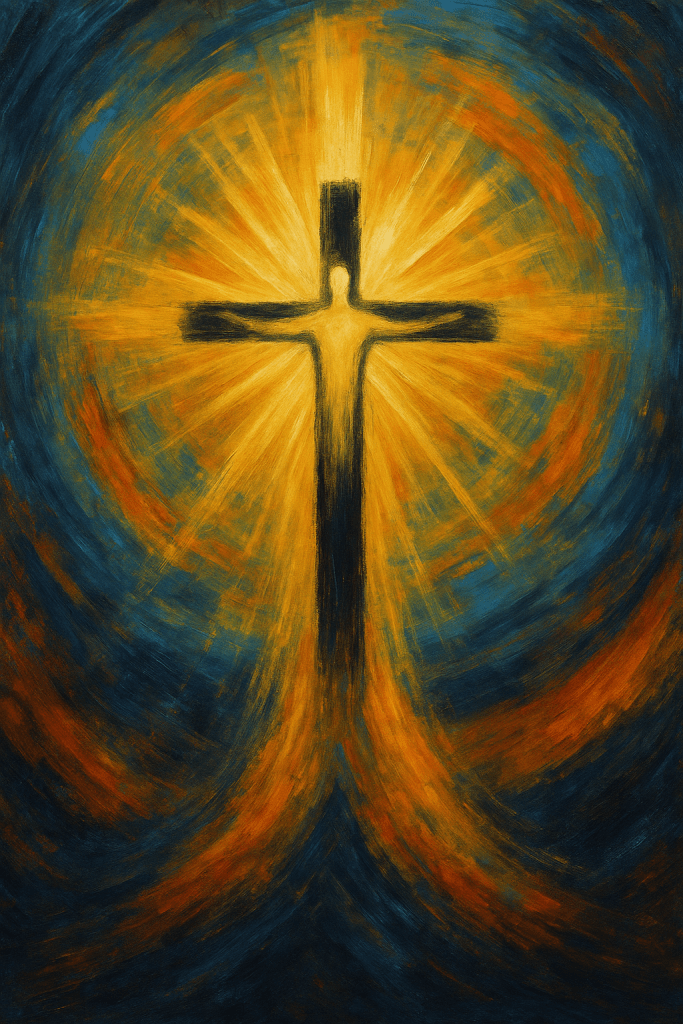
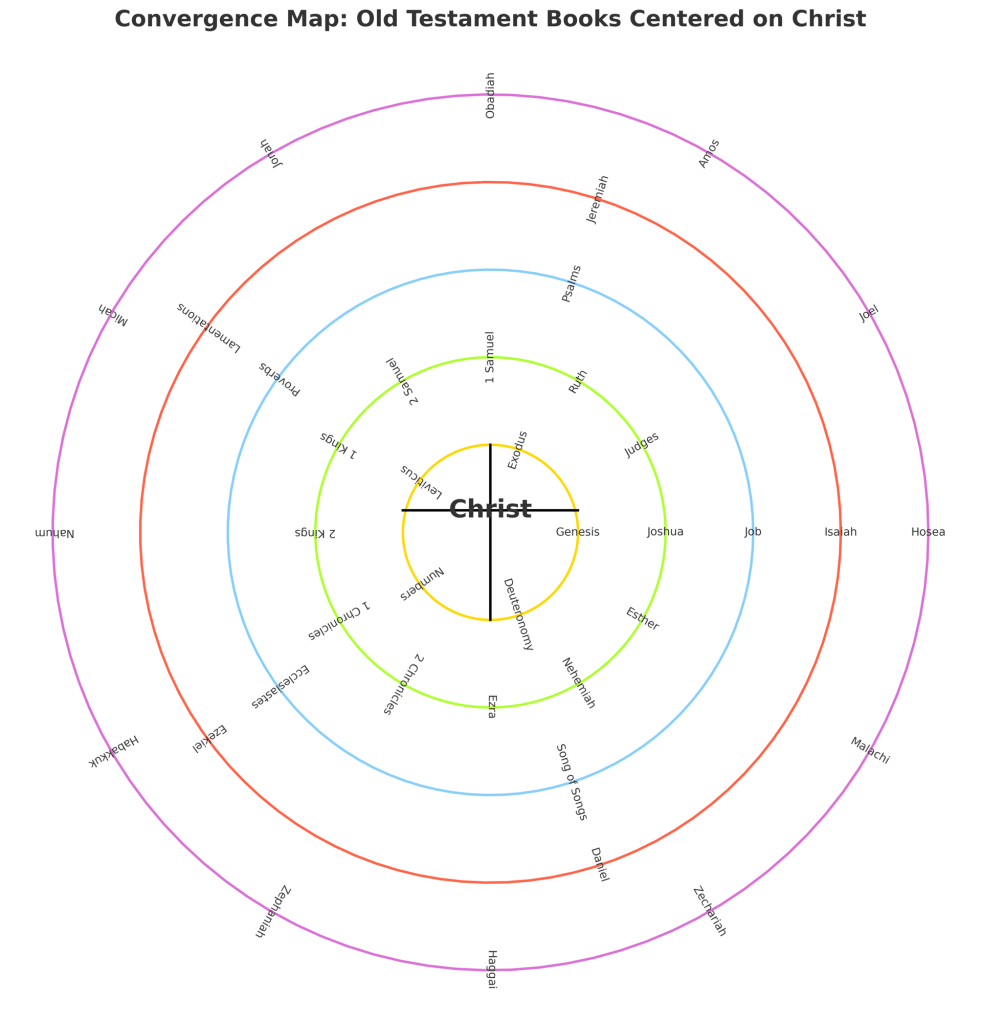
    John Behr retoma esta intuición patrística al afirmar que la Biblia debe leerse con Cristo en el centro, con la cruz como eje que atraviesa el texto de abajo arriba y de izquierda a derecha, y círculos concéntricos formados por cada libro en torno a ella. En esa disposición, el Antiguo y el Nuevo Testamento, en su diversidad y en su unidad, confluyen en una misma figura: Cristo, que da coherencia, profundidad y sentido último a cada versículo, desde el primero hasta el último, haciendo de toda la Escritura un único testimonio que proclama la buena nueva de Dios hecho hombre.

    Nota histórica:

    El credo de 1 Corintios 15, probablemente formulado para la recitación litúrgica en las primeras comunidades, antecede a todos los Evangelios escritos y pertenece a un tiempo en que la mayoría de los testigos de la resurrección aún vivían. Su carácter memorizable y su estructura tripartita (muerte, sepultura, resurrección, cada una “según las Escrituras”) aseguran la transmisión fiel del núcleo de la fe. Esto demuestra que el cristianismo nació ya plenamente cristológico y pascual, no como el resultado tardío de un desarrollo teológico, sino como la proclamación original de los apóstoles, sellada y sostenida por la acción del Espíritu Santo

    Christ at the Heart of All Scripture: Apostolic Witness, Tradition, and Patristic Reading

    Among the first to write about Christ, the Apostle Paul is, in all likelihood, the voice closest in time to the Lord’s death and resurrection. In his First Letter to the Corinthians (1 Cor 15:3–8), Paul delivers a proclamation he did not invent, but which he himself “received” (παρέλαβον, parelabon), using the technical term from rabbinic tradition for the authorized oral transmission of teaching. The text reads:

    “For I delivered to you as of first importance what I also received: that Christ died for our sins according to the Scriptures; that He was buried, and that He was raised on the third day according to the Scriptures; that He appeared to Cephas, then to the Twelve; then He appeared to more than five hundred brothers at one time, most of whom are still alive, though some have fallen asleep. Then He appeared to James; then to all the apostles; and last of all, as to one untimely born, He appeared also to me.”

    Most modern exegetes (James D. G. Dunn, Jesus Remembered, 2003; Larry Hurtado, Lord Jesus Christ, 2003; N. T. Wright, The Resurrection of the Son of God, 2003) recognize in this passage the formulation of a primitive Christian creed, with parallel structure, memorizable rhythm, and a fully articulated paschal theology. Joachim Jeremias and C. H. Dodd agree in situating this creed in Jerusalem, passed on to Paul during his first visit (Gal 1:18–19), that is, three to five years after the crucifixion. Its temporal proximity, together with the fact that most eyewitnesses were still alive, makes it the earliest documentary fragment of Christianity.

    This kerygmatic nucleus shows that from the very beginning, faith in Jesus’ death and resurrection was not the result of a slow literary evolution, but the unalterable foundation of apostolic preaching. Indeed, Paul presents it as “of first importance” (ἐν πρώτοις), both in the order of transmission and in doctrinal hierarchy.

    It is difficult, even for the modern imagination, to conceive that a group of Galilean fishermen, accompanied by a doctor of the Law like Paul, could have deliberately fabricated such a vast and coherent network of connections between the Old Testament and the life of Jesus. Still more difficult when one considers the context: they lacked technical resources, they were engaged in the expansion of a movement which, within a few decades, reached Asia Minor, Syria, North Africa, and—according to tradition—Hispania itself (cf. Romans 15:24, 28), all while enduring persecution, traveling, and founding communities.

    Yet in a very short span of time, the entire Old Testament canon began to be read as a map leading to the Messiah: from Job and Genesis, through Deuteronomy, Kings, and Judges, to the Psalms, the Song of Songs, and the Wisdom of Solomon. This was not a retrospective literary exercise, but a new understanding illuminated by the paschal event. As St. Irenaeus would affirm centuries later:

    “Quoniam enim una eademque est dispositio salutis Dei, semper idem et idem est Deus, qui et legem dedit, et Evangelium instituit, et legem in Evangelio, et Evangelium in lege praedicavit” (Against Heresies IV, 9, 3).

    “For there is one and the same plan of salvation of God; the same God who gave the Law also established the Gospel, who proclaimed the Law in the Gospel and the Gospel in the Law.”

    Origen, in his Homily on Joshua (Hom. Jos. 2, 1), expressed the same hermeneutical principle:

    “The whole of divine Scripture speaks of Christ, and the whole of Scripture is fulfilled in Christ.”

    The Fathers understood that a Christ-centered reading of all Scripture was not an imposition from the future, but the revelation of a meaning already present, now fully manifest. Eusebius of Caesarea, in his Demonstratio Evangelica (II, 6), summarizes this vision, stating that the economy of Christ is “the center towards which all prophecies and figures converge, like radii to a single point.”

    The magnitude of this work—integrating the Old Testament books with the apostolic writings up to the Apocalypse—carried out in such a short time and under adverse human circumstances, can only be understood, as tradition affirms, through the action of the Holy Spirit. There were no printing presses, no centralized communication networks; there were only men and women animated by unshakable certainty, convinced that the cross and resurrection of Christ were the very center of history.

    John Behr recaptures this patristic insight when he says that the Bible must be read with Christ at the center, with the cross as the axis running through the text from bottom to top and from left to right, and concentric circles formed by each book around it. In this arrangement, the Old and New Testaments, in their diversity and unity, converge in the same figure: Christ, who gives coherence, depth, and ultimate meaning to every verse, from the first to the last, making all of Scripture a single testimony proclaiming the Good News of God made man.

    Historical Note:

    The creed in 1 Corinthians 15, probably formulated for liturgical recitation in the earliest communities, predates all the written Gospels and belongs to a time when most witnesses to the resurrection were still alive. Its memorizable character and tripartite structure (death, burial, resurrection, each “according to the Scriptures”) ensured the faithful transmission of the faith’s core. This demonstrates that Christianity was born fully Christological and paschal—not as the late result of theological development, but as the original proclamation of the apostles, sealed and sustained by the action of the Holy Spirit.

  • El rostro de la misericordia: Julian de Norwich, Santa Faustina y el desafío del cristianismo contemporáneo

    🇪🇸🇬🇧Spanish and English version

    Israel Centeno

    En la octava revelación de Revelaciones del divino amor, Julian de Norwich contempla el rostro de Cristo en su agonía. Lo ve desfigurado, cubierto de sangre y dolor, pero sin rastro de ira. En su mirada sólo hay compasión, ternura y un ardiente deseo de salvar. Para Julian, la sangre no es signo de derrota, sino de vida; cada gota habla de un amor que se entrega sin reservas. Ese Cristo sufriente y, al mismo tiempo, victorioso no acusa ni reprocha: abraza. La visión la conduce a una certeza radical para su época —y para la nuestra—: en Dios no hay cólera, sino amor constante, incluso frente al pecado más grave.

    Esta intuición, nacida en el silencio de una celda medieval, resonará siglos después en las páginas del Diario de Santa Faustina Kowalska. Allí, el Corazón de Jesús se abre como un océano de misericordia que alcanza a todos, sin excluir a nadie, pero que reclama una respuesta libre: la confianza y el arrepentimiento. En Julian y Faustina, la misericordia no es un sentimiento vago ni un concepto filosófico, sino Cristo mismo, Hijo eterno del Padre, que se entrega para reconciliar al mundo con Dios.

    Aquí radica una distinción que hoy es más necesaria que nunca. Su mensaje no es un universalismo indiferenciado. Ambas místicas afirman que el amor de Dios es más grande que cualquier pecado, pero nunca diluyen el núcleo del cristianismo: la encarnación, la cruz y la resurrección. En su visión no hay lugar para un “Cristo universal” intercambiable con Buda, Krishna o algún maestro anónimo; su Cristo es único, histórico y eterno.

    Cuando me acerqué por primera vez a los místicos cristianos en Estados Unidos, encontré un camino apasionante a través de autores como Thomas Merton y Thomas Keating. Había en ellos una profundidad auténtica, un arraigo en la tradición contemplativa cristiana que podía dialogar con el mundo moderno sin perder su alma. Pero poco a poco, tras la muerte de estas figuras centrales de la contemplación cristiana americana, comencé a ver cómo el movimiento que habían inspirado era sustituido por algo que la época y el mundo parecían exigir: una espiritualidad que mezclaba Oriente y Occidente, alejándose cada vez más de la tradición católica y de cualquier tradición cristiana seria, ortodoxa, incluso en otras denominaciones. Lo que había nacido como una renovación dentro del cristianismo corría el riesgo de disolverse en un movimiento espiritual genérico, desconectado del núcleo vivo de la fe.

    En nuestros días, en ciertos ámbitos de “espiritualidad contemplativa”, se da una deriva peligrosa. Partiendo de una legítima sed de silencio y oración, algunos terminan reemplazando la confesión cristiana por una “no-dualidad” sin rostro ni cruz, donde Jesús se convierte en un maestro iluminado más. The Center for Action and Contemplation lo describe con claridad: no es una expansión de la fe, sino su deconstrucción. Lo que queda ya no es la Trinidad viva, sino una amalgama de “dioses”, “fuerzas” o “energías” universales.

    Este vaciamiento golpea sobre todo a la segunda Persona de la Trinidad. Cuando se diluye el Hijo, el Verbo eterno, la misma Trinidad se desfigura hasta convertirse en un panteón difuso. Y sin el Logos —tal como lo entendió la tradición cristiana: fuente de toda vida y de toda realidad— no hay cristianismo, sólo panteísmo o panenteísmo que pierde la revelación histórica. “En el principio era el Logos” no significa que “todo” sea indistintamente el Logos, sino que todo fue creado por Él y para Él.

    El cristocentrismo de Julian y Faustina, en cambio, es claro y no negociable. Reconoce la diversidad humana, pero llama a la conversión: “El Reino de los Cielos está cerca” no es una metáfora complaciente, sino la proclamación de que “Yo soy el Camino, la Verdad y la Vida; nadie va al Padre sino por mí”. La misericordia que anuncian tiene un nombre y un rostro: Jesucristo, Hijo de Dios vivo. No es una energía cósmica, sino la sangre derramada para reconciliar al mundo con el Padre.

    En una época en que el anticristo ya no viene maldiciendo a Jesús, sino imitándolo y reescribiéndolo, quitándole su rango de Verbo eterno y poniéndolo al lado de figuras cuya existencia o enseñanza carecen de pruebas históricas, el testimonio de Julian y Faustina nos recuerda que la auténtica contemplación cristiana no diluye a Cristo, sino que lo coloca en el centro. Sus visiones no nos invitan a disolvernos en lo impersonal, sino a dejarnos habitar por el “Cristo-self” que sana la fractura del ser, esa herida que la tradición llama pecado original.

    Hoy, más que nunca, necesitamos esta claridad: ni panteísmo, ni panenteísmo, ni misticismo superficial. Sólo el encuentro con el Logos encarnado, el Cordero inmolado y resucitado, puede convertir el dolor en paz, la herida en gloria y la historia humana en comunión eterna con Dios

    The Face of Mercy: Julian of Norwich, Saint Faustina, and the Challenge of Contemporary Christianity

    In the eighth revelation of Revelations of Divine Love, Julian of Norwich contemplates the face of Christ in His agony. She sees it disfigured, covered in blood and pain, yet with no trace of anger. In His gaze there is only compassion, tenderness, and an ardent desire to save. For Julian, the blood is not a symbol of defeat but of life; every drop speaks of a love that gives itself without reserve. This suffering and victorious Christ does not accuse, does not reproach—He embraces. The vision leads her to a conviction radical for her time—and for ours: in God there is no wrath, but constant love, even in the face of the gravest sin.

    This intuition, born in the silence of a medieval cell, would echo centuries later in the pages of Saint Faustina Kowalska’s Diary. There, the Heart of Jesus opens as an ocean of mercy that reaches everyone, without excluding anyone, but which calls for a free response: trust and repentance. In Julian and Faustina, mercy is not a vague feeling or a philosophical concept; it is Christ Himself, the eternal Son of the Father, who gives Himself to reconcile the world to God.

    Here lies a distinction that is more necessary than ever today. Their message is not indiscriminate universalism. Both mystics affirm that God’s love is greater than any sin, but they never dilute the core of Christianity: the Incarnation, the Cross, and the Resurrection. In their vision, there is no place for a “universal Christ” interchangeable with Buddha, Krishna, or some anonymous sage; their Christ is unique, historical, and eternal.

    When I first approached the Christian mystics in the United States, I found a compelling path through authors like Thomas Merton and Thomas Keating. There was a genuine depth there, a rootedness in the Christian contemplative tradition that could engage the modern mind without losing its soul. But gradually, after these key figures of American Christian contemplation passed away, I began to see how the movement they had inspired was being replaced by something the age and the world seemed to demand—a spirituality blending East and West, often moving further away from the Catholic tradition, and indeed from any serious, orthodox Christian tradition, even among other denominations. What had been born as a renewal within Christianity risked dissolving into a generic spiritual movement, detached from the living core of the faith.

    In our own day, within certain “contemplative spirituality” circles, there is a dangerous drift. Beginning with a legitimate thirst for silence and prayer, some end by replacing the Christian confession with a faceless, crossless “non-duality” in which Jesus becomes just one more “enlightened master.” The Center for Action and Contemplation describes it clearly: this is not an expansion of faith, but its deconstruction. What remains is no longer the living Trinity, but an amalgam of “gods,” “forces,” or “universal energies.”

    This emptying strikes above all at the second Person of the Trinity. When the Son, the eternal Word, is diluted, the Trinity itself dissolves into a vague pantheon. And without the Logos—as understood in the Christian tradition, the source of all life and reality—there is no Christianity, only pantheism or panentheism that loses the historical revelation. “In the beginning was the Logos” does not mean that “everything” is indistinctly the Logos; it means that all was created through Him and for Him.

    The Christocentrism of Julian and Faustina is, by contrast, clear and non-negotiable. It recognizes human diversity but calls to conversion: “The Kingdom of Heaven is near” is not a soothing metaphor, but the proclamation that “I am the Way, the Truth, and the Life; no one comes to the Father except through Me.” The mercy they announce has a name and a face: Jesus Christ, the Son of the living God. It is not a cosmic energy, but the blood shed to reconcile the world to the Father.

    In an age when the Antichrist no longer comes cursing Jesus, but imitating and rewriting Him, stripping Him of His rank as the eternal Word and placing Him alongside figures whose existence or teaching lacks historical proof, the witness of Julian and Faustina reminds us that authentic Christian contemplation does not dilute Christ but places Him at the center. Their visions invite us not to dissolve into the impersonal, but to be inhabited by the “Christ-self” that heals the fracture of being—what the tradition calls original sin.

    Today, more than ever, we need this clarity: no pantheism, no panentheism, no superficial mysticism. Only the encounter with the incarnate Logos, the Lamb who was slain and is risen, can turn pain into peace, the wound into glory, and human history into eternal communion with God.

  • Israel Centeno

    The Vocation of Woman in the Order of Nature and Grace: An Integrated Reading of Edith Stein

    Israel Centeno

    In The Vocation of Man and Woman According to the Order of Nature and Grace, Edith Stein — Saint Teresa Benedicta of the Cross — laments that the word “vocation” has been reduced to a mere professional choice. In common usage, it means little more than deciding what career to pursue or what job to take, but for Stein, vocation is a personal and objective call that comes from God, recognizing our natural capacities and orienting them toward a supernatural end. It is never simply an individual project; it is the intersection between received nature and the grace that calls.

    Her reflection is rooted in the opening chapters of Genesis, where man and woman together receive the mission of being God’s image and of caring for creation. Woman is presented as a “suitable helper,” a phrase that for Stein does not imply subordination, but rather active collaboration of equal dignity. After the fall, this vocation is wounded: man’s work becomes toilsome, motherhood is linked with pain, and the relationship between the sexes loses its original harmony. Yet in the midst of the curse comes a promise: victory over the serpent will come through the woman’s offspring. From that moment, the female figure is inscribed at the very center of the plan of salvation.

    For Stein, the original vocation of both man and woman is lived in a complementarity that does not erase difference. Man, more oriented toward conquest and mastery over the earth, is called to protect, defend, and guard; woman, more inclined toward welcoming and preserving life, is endowed with a special sensitivity for what is organic, for the growth of what is concrete and personal, ensuring that what exists may become what it is meant to be. This distinction is not hierarchical but reciprocal: both sets of gifts are created for mutual service, so that man, through the harmonious development of the feminine strengths, may be freed from one-sidedness, and woman, by collaborating in outward and creative tasks, may overcome her own tendency toward enclosure.

    When this complementarity is broken by sin, the relationship degenerates into domination and submission. Man, forgetting that his gifts exist for the other’s development, may use them as an instrument of his own concupiscence, becoming a despot; woman, relinquishing her role as companion, may fall into voluntary servitude, reducing her life to instincts and possession. The degeneration is not only emotional: in both sexes there can emerge the tendency toward violent possession of things and persons, falsifying reality and destroying the harmony entrusted to them.

    In woman, the particular danger is to reduce her mission to merely preserving what she possesses, becoming combative against all change, or to cling to her children as property, curtailing their freedom in the name of a misunderstood love. Thus, instead of putting her gifts at the service of the growth of others and the glory of God, she stifles progress and undoes happiness. Stein locates the root of this evil in the perversion of the relationship with God: in the biblical narrative, the woman, seduced, rises against Him and draws man into disobedience, and the resulting penalty is subjection to male power. The sin to which woman is more exposed, Stein says, is sensuality, and whenever she acts as seductress, she becomes, paradoxically, an instrument of that very evil against which she was entrusted to fight.

    This reading is not, for Stein, a condemnation, but a call to recover the original vocation, healed and elevated in Christ. In the Gospels, Jesus acts in ways that contradict the restrictive culture of His time: He speaks and teaches women, makes them participants in His mission, entrusts Mary Magdalene with the paschal announcement, and, in a gesture without parallel, reveals to the Samaritan woman — openly and without evasion — that He is the Messiah. In that encounter, the woman becomes an apostle to her people, bearer of a revelation that neither Peter nor the other disciples had received so directly.

    The tension that appears in some of Paul’s letters, especially in 1 Timothy where women are restricted from public teaching, Stein interprets as pastoral norms shaped by local circumstances, not as universal laws. The Pauline affirmation that in Christ “there is neither male nor female” is, for her, the interpretive key that harmonizes apostolic practice with the model of Jesus. If Christ entrusts women with both word and mission, the Church is called to acknowledge their full participation in the work of salvation.

    In this perspective, the vocation of woman, in nature, is to welcome, guard, and nurture life; in grace, it is to cooperate with Christ in redemption; and in the present mission, it is to be a sign of God’s tenderness and fidelity in the family, in the Church, and in society. To reduce her to a secondary role is to betray both the Gospel and the dynamic of the Spirit’s gifts. From Eve to the Samaritan woman, from Mary to the women disciples of the Resurrection, Scripture bears witness that woman is a privileged channel of divine action. For Stein, recalling this is not merely an act of memory, but an urgent summons to reactivate the full participation of women in the Church’s mission, in accordance with the dignity and grace given to them from the beginning.

  • The Fracture and the Return: Original Sin, the Myth of Progress, and the Quest for the All Good

    One does not need to be a theologian to sense the truth of original sin. History itself bears witness. Time and again, with the best of intentions, human beings have gathered in groups, tribes, villages, nations, empires—seeking peace, longing to build a kingdom of justice. And yet, again and again, the same pattern emerges: the dream turns to ruin.

    In the twentieth century, humanity sought to bring history to its final conclusion, to end the historical dialectic once and for all. Through historical materialism, some aimed to abolish classes; through Nazism, others sought to abolish all but one “superior” race, destined to rule over the planet. Both were aberrations. In the democracies, the experiment took a different form: the construction of a middling society, content with a median happiness, sustained by the shared rhythm of consumerism. Now, in the aftermath, we find ourselves in an age of excess—excess of diversification, of divergence, of stratification; of identity politics hardened into tribalism, or nationalism driven to its extremes.

    Beneath all this lies the same ancient wound. Atonement means “to be at one with.” As Eleonore Stump notes, when humanity lost its union with the Absolute, it became mortal. A fracture entered the soul—one that drives us toward barbarity, makes us both victim and victimizer, predator and prey, allows the animal within to overpower what calls us to transcendence.

    We have been told, in countless ways, that progress is the road to salvation. The narrative is seductively simple: humanity is on an upward path toward some final aim, a superior state of life. But if we are honest, the road so often ends not in paradise, but in hell—or in endless circles, where each turn leaves us more lost than before. Progress alone does not save.

    Stagnation is no better. It is a slow decay disguised as safety. And the dream of returning to some primal innocence is an illusion; what is behind us is not Eden, but a history already marked by the wound.

    The true path is something else entirely. It is the search for union—not with an idea, not with a system, but with God Himself. To be one with God, to be drawn back into the unity from which we came. This is no easy journey, because it passes through the cross.

    The cross is not merely a symbol of suffering; it is the portal through which humanity is gathered and made one. To take up the cross is to accept that our reconciliation will cost us ourselves. In its wood we discover the meeting point of heaven and earth, the axis where the fracture in our being is healed.

    Only in the One do we find what every heart craves: the All Good, the All Love, the All Goodness, and the All Beauty. Without that union, even our noblest projects turn to ashes. With it, the true story begins: the story not of our striving, but of our return; not of our power, but of the One who makes all things one.

    If you like, I can now prepare a shorter, poetic prelude to place before this text — so the reader steps into it as if entering a sacred meditation before the main reflection begins. That would pair beautifully with your abstract image.

  • Eleonore Stump on Atonement 

    The Substance of Faith

     May 5, 2017, at Baylor ISR . The speaker also mentions previously meeting Eleonore Stump at Liberty University in Lynchburg, Virginia, and later at Virginia Tech (3:16) in 1990, and the University of Missouri, Columbia during his undergraduate studies, before she moved to St. Louis University

    Here we go, with the subject of atonement

    At the outset, let’s note that the doctrine that Christ has saved human beings from their sins—with all the implications of salvation—stands as the distinctive doctrine of Christianity. In this book, I want to consider this theological doctrine with philosophical care, within the context of a vast history of interpretation. So, this is an exercise in philosophical theology. 

    This doctrine has the power to move people, whether to heart-melting love or to serious repudiation and rejection. To evaluate those different attitudes, one must understand the doctrine. What actually is this doctrine that is so distinctive of Christianity? Understanding it is not an easy matter. 

    Looking over the history of Christianity, you’ll see that each era had its own questions to consider. The early periods wrestled with the Incarnation, the Trinity, and so on. In the age of high scholasticism, other issues emerged, especially as Islam, Judaism, and Christianity interacted. Yet, until recently, the question of what the atonement actually is never became a burning issue in the prevailing culture. But in our time, it has become precisely that. For some, this doctrine is the primary reason to reject Christianity, so it is time for us to turn our attention to it. 

    For many, the word “atonement” conjures up the idea of placating an offended God through bloody sacrifice. That is not how I intend to use the word. But we do need a word to describe the nature and effects of Christ’s passion, death, and resurrection—or more broadly, Christ’s life, passion, death, and resurrection. “Atonement,” despite its baggage, seems to carry the least theological baggage of all possible terms. So although many contemporary people think it refers narrowly to Christ’s crucifixion making things right with God, I want the word to be more neutral and broad. This is worth remembering as we proceed. 

    The doctrine of atonement differs from other major Christian doctrines—like the doctrine of the Incarnation—in that it has no formula specifying its interpretation. For the Incarnation, there’s the Chalcedonian formula: Christ is one person with two natures, fully human and fully divine. No analogous formula exists for the atonement. There are creedal or conciliar statements that rule out certain interpretations—like docetism, which says Christ didn’t really suffer—but no statement that precisely specifies how we are to understand the atonement. That’s important because it allows for highly divergent interpretations, all of which can count as orthodox. 

    In this book, I’ve tried to learn from the history of interpretations of the doctrine. There are many, but I haven’t adopted any one of them wholesale. Instead, I’ve started by considering the problem: clearly, the atonement is a solution to a problem. There’s little controversy over that in the tradition. But what is the problem? 

    The word “atonement” itself was coined to express the idea of making one—atonement—between God and human beings, who were not previously at one. The problem atonement is meant to solve is the absence of unity between God and humanity, which, as the tradition sees it, stems from the human proneness to wrongdoing—what I will use interchangeably with “sin.” From Augustine onward, the tradition sees the absence of unity as rooted in the human will, which is inclined toward sin. 

    If you think about the problem that way, it becomes clear that the solution must address multiple components. Human beings tend to prefer their own power or pleasure over greater goods. They’re not doomed to do so, but are inclined that way. Inevitably, in the life of any person, this tendency is actualized. Every human being will at some point act on this proneness to sin. That’s the forward-looking aspect of the problem: we know the future will bring such actualizations. There’s also a backward-looking aspect: except for Christ (and, in Catholicism, Mary), every person past the age of reason has committed morally wrong acts in the past. Thus, every person can look back on actions contrary to the will of God—there is guilt for what is past and the knowledge of future wrongdoing. 

    And then, on top of guilt, there is shame. One can feel shame for one’s own wrongdoing, but also for things done to them, for defects of nature, or for being part of a group. For example, the children of high-ranking Nazis, innocent of their parents’ crimes, have felt shame just for belonging to that family. There is shame simply in being a member of the human species, given the moral horrors, cruelty, and destruction humans have perpetrated. If you imagine a morally perfect species, facing them as one of us would be unbearable. 

    If atonement is to be a full solution to the problem of human sinfulness, it must address all varieties of shame as well. Atonement is meant to undo what went wrong in the Fall, and all these things—guilt, shame, moral wrongdoing—are consequences of that. 

    So, the components of the problem that atonement is meant to solve can be outlined as follows: 

    1. Current disposition to moral wrongdoing—the inclination to prefer lesser goods, which brings the liability to future sinful acts. 
    1. Guilt—the fact of having actually committed morally wrong acts in the past. 
    1. Impairments in the psyche of the wrongdoer—the damage wrongdoing causes within the self. 
    1. Ill effects of wrongdoing in the world—the harm caused to others and to the broader order. 
    1. Shame—arising not only from one’s own acts, but also from the actions of others, natural defects, or belonging to a group. 

    To see these elements clearly, consider a notable moral monster—Eichmann, for instance. Before his execution in Jerusalem, a Lutheran chaplain asked Eichmann if he would like to confess. Eichmann replied, “Why would I confess? I’ve never done anything wrong.” This illustrates the ill effects of wrongdoing on the wrongdoer’s psyche: the will and intellect are corrupted to the point that self-understanding is lost. The harm done to the world—Eichmann was responsible for millions of deaths—is clear. Yet, guilt and shame are universal; not only “monsters” have to deal with them, but all of us. 

    So, these aspects—proneness to wrongdoing, guilt, impairment, external harm, and shame—create a distance between God (perfectly good) and humanity, a distance atonement is supposed to remedy. 

    Interpretations of Atonement 

    In the history of doctrine, there are three major types of interpretation: 

    1. Patristic (early church fathers) 
    1. Anselmian 
    1. Thomistic (Aquinas) 

    Let me try to be concise. The patristic interpretation focuses on a cosmic drama involving Satan. Anselm, however, regarded this as a misguided or “stupid” interpretation. Many today have tried to rehabilitate the patristic view, but I still find it difficult to understand and so, with reluctance, set it aside—not because I think the church fathers were stupid, but because, at present, I don’t know how to make sense of their view, and neither, it seems, does anyone else. So, I bracket the patristic approach, though I am sure I lose something by doing so. 

    That leaves us with the Anselmian and Thomistic kinds. Each of these is really a family of theories. Broadly, all interpretations can be divided based on what they see as the obstacle to reconciliation between God and humanity. The Anselmian type locates the obstacle in something about God—God’s honor, justice, or goodness. The Thomistic type sees the obstacle as lying in something about human beings. 

    Now, some might assume that the Anselmian kind is “Protestant” and the Thomistic is “Catholic,” but this isn’t accurate. There are Catholic versions of Anselmian theories and potentially Protestant versions of Thomistic theories. The distinction is not strictly denominational. 

    My point is this: although there is much to learn from both the Anselmian and Thomistic kinds, neither is wholly satisfactory. At best, each is missing something; at worst, each is fundamentally misguided. So, I have tried to rethink the doctrine, with respect for the tradition, but seeking a more coherent, morally acceptable interpretation—one that is consistent with biblical texts and other theological doctrines. I argue that such an interpretation is possible. 

    The Heart of the Account: Love 

    The core of my account centers on the nature of love. I use Aquinas’s account, which, in my view, is the best philosophical account of love available. It explains cases that other theories cannot. In a nutshell, love consists of two interrelated desires: a desire for the good of the beloved, and a desire for union with the beloved. The “good” is what is truly good for the beloved, not merely what they want. And “union” is not just companionship, but being truly “at one” with the beloved—even, sometimes, in ways that look like separation. 

    To illustrate, imagine a two-year-old at the dinner table. His mother says, “If you throw your pizza on the floor again, dinner is over.” He does it; she sends him to his room. Both are denied what they want (he wants pizza and companionship, she wants a peaceful meal). Yet, she still loves him, desiring his good and union with him—her actions flow from love, even if union looks like separation at that moment. 

    So, an acceptable interpretation of atonement must show how it solves the problems of guilt and shame, and love is central to this. In terms of Aquinas’s account, guilt is connected to the anticipation that others will desire what is not your good (because of your wrong), and shame to the anticipation that others will reject you. The guilty person focuses on the good, the ashamed person on union. 

    Critique of the Anselmian Interpretation 

    Where most people get stuck in my manuscript is at my rejection of the Anselmian kind of interpretation. For nearly everyone, this type of interpretation is the one we have been steeped in—whether as critics or believers. So, for many, my argument that the Anselmian interpretation fails sounds like a repudiation of Christianity itself. But that is not my intention. My goal is to defend the doctrine of atonement by showing a better interpretation. 

    My central objection to the Anselmian view is this: it is incompatible with the doctrine that God is loving. And that incompatibility, in my judgment, cannot be repaired. The bottom line is this: the point of Christ’s incarnation, life, passion, death, and resurrection is not to win clemency or pardon from God. All the many versions of the Anselmian theory share the idea that Christ’s work removes some obstacle on God’s side, thus making union between God and humanity possible. 

    I argue that this is mistaken. The better way to understand the atonement is as addressing the obstacle within human beings, not within God. 

    Rethinking the Doctrine 

    So, what does Christ do in the atonement? My project centers on the idea that Christ brings about two metaphysical alterations: one in his own human nature, and one in the psyches of all human beings of faith. These alterations make mutual indwelling possible. 

    I take seriously Christ’s prayer in the Gospel of John: “Father, let them be one as we are one—I in them and you in me.” Mutual indwelling is what union between God and human beings is supposed to be. 

    When two humans are united, it is their thoughts, feelings, or histories that are joined, given their metaphysical smallness. But when God is one of the relata, what can be united is whole persons. The union is deeper, more comprehensive—mutual indwelling, not merely shared life. 

    I examine the “cry of dereliction” on the cross—Christ’s words, “My God, my God, why have you forsaken me?”—and try to make sense of it in a way that fits with other doctrines. When the biblical texts say Christ “became sin for us” or “bore our sins,” I take this to mean that on the cross, Christ opens himself to receive the psyches of all sinful human beings. His human psyche is flooded by their presence—not as an invasion, but as a welcome. 

    If you know stories from popular culture (like science fiction, where aliens invade and take over a human), you know the horror of a psyche being overtaken by something foreign. But here, Christ voluntarily and lovingly welcomes into his psyche the full weight of sinful humanity, with all its shame, guilt, and revulsion. It is something like the “mind-meld” scenes in Tolkien, where the experience is overwhelming. This is what happens as human beings, in their brokenness, are received into Christ’s perfectly holy psyche. 

    That’s one half of mutual indwelling—humanity dwelling in Christ. The other half is the Holy Spirit indwelling human beings of faith. The moment someone comes to faith, there is agreement across Christian doctrine: the Holy Spirit comes to dwell within that person. 

    But if the indwelling of the Spirit is not to be like an alien invasion—if it is to be union rather than takeover—there must also be welcome on the part of the human. And that is hard to achieve. Every human being desires to love and be loved, but there is resistance, closure, failure to commit—hence the entire counseling profession. 

    You go to a counselor knowing you have problems with love, with commitment. And yet, even when you want to be healed, you also resist it. If God simply zapped integration into you, it would be God’s will, not yours, and there would be no true union—because union requires two wills, not just one. 

    So, what can be done? When a person ceases resisting God’s love, when they surrender, then the Holy Spirit can come in. God’s grace can produce the act of faith that welcomes the Spirit, and the union begun by Christ on the cross is now completed. 

    The Human Struggle to Surrender 

    But why is it so hard for human beings to surrender to God’s love, even when we want to love and be loved? Partly, it is because true union threatens our autonomy and self-image. If you commit yourself to another, that person’s desires and judgments matter for your life. You see yourself through their eyes, and you may not like what you see. There is a risk of rejection—of being found wanting and abandoned. 

    There is also, in some, a tendency to self-assertion and rebellion. John Stuart Mill said, in effect, “If there is a God who can send me to hell for not worshipping him, then to hell I will go.” This stance—defiance as tragic hero—may seem noble. But what does it mean to defy a God who comes not as a conqueror but as one who is naked, tortured, and dying, humiliated on a cross? How threatening, really, is such a God? What does it mean to rebel against one who invites you with utter vulnerability? 

    If there is any way to persuade human beings that it is safe to surrender—to let go, and accept God’s love—it is the story of Christ on the cross: God in love, suffering and dying in humiliation. What cannot be achieved by divine fiat, and what humans are too broken to do on their own, God prepares for, encourages, and makes possible through Christ’s atonement. 

    When that surrender finally comes, the Holy Spirit enters in, and now we have mutual indwelling: as the Father is in the Son and the Son in the Father, so human beings are in Christ, and Christ’s Spirit is within them. This is the beginning of union—not the end, but the start of a new reality. 

    Concluding Summary 

    In the remainder of my presentation (which I’m leaving aside for now), I would discuss what happens after this beginning of union. But this is enough to show how I am thinking of the atonement in a non-Anselmian way. 

    To summarize: 

    • The atonement does not remove an obstacle in God, but addresses the obstacle in human beings. 
    • Love, as Aquinas describes it—the desire for the good of the beloved and for union with the beloved—is central. 
    • Christ, on the cross, opens himself to all our sin and shame, welcoming us in our brokenness. 
    • Human beings, in turn, are enabled (not coerced) to surrender, so that the Holy Spirit can dwell within them. 
    • Mutual indwelling, the deep union of wills, is begun—God in us, and we in God. 

    This, I believe, offers a more coherent and morally satisfying interpretation of the Christian doctrine of atonement—one that does justice to the biblical texts, the tradition, and the reality of human need. 

  • Thirst for Fullness

    The Nonbeliever’s Journey Toward the Mystery

    In an age marked by spiritual fragmentation, cultural disorientation, and the exhaustion of absolute narratives, a subtle yet persistent longing still pulses within the human heart: the thirst for fullness. This is not merely a religious impulse in the conventional sense, but a deeper, more primal yearning—one that precedes belief systems and creeds. It is the question that burns without a name, the inner movement that seeks meaning even when surrounded by night.

    This thirst recognizes no ideological allegiance. It can dwell in the soul of the agnostic, the skeptic, or even the self-declared atheist. It may arise in the silent awe of a scientist contemplating the order of nature, in the trembling of an artist before unexpected beauty, or in the weariness of a volunteer who gives their days to care for the forgotten. There is no need to utter the name of God to feel summoned by something that exceeds all utility, something that calls without words from the center of one’s being.

    Saint Augustine sensed this mystery with the wisdom of one who had wandered far and returned, wounded and changed: “You have made us for Yourself, O Lord, and our hearts are restless until they rest in You.” Restlessness of heart is not a flaw but a sign. An interior compass indicating that the world’s promises—power, pleasure, consumption, ideology—cannot quench the soul’s thirst. Because what the heart longs for is not another possession, but communion; not a formula, but a truth that embraces one’s entire existence.

    Simone Weil, with the unusual clarity of one who sees from the margins, understood that the path toward the Mystery can begin with an act of attention. “Absolutely unmixed attention is prayer,” she wrote. That gaze which does not seek to possess or reduce the other to function or use is already a religious act, even when unnamed. Without dogma or baptism, Weil insisted that the human soul is summoned to respond to the suffering of others—even if that means walking alone and bearing the weight of the world. Pure attention to reality can be a form of prayer, a door to the divine.

    Beauty, too—so often trivialized in a culture of spectacle—can be a sacred wound. When someone is moved by a sunrise, a melody, a work of art, or the smile of a child, something deep within is broken open. This stirring is more than aesthetic delight; it is a participation in the harmony that sustains the world. Edith Stein, philosopher and mystic, affirmed that “true beauty arises from a pure heart and an illumined mind.” Beauty, then, does not decorate life: it reveals it. It becomes a threshold. As Hans Urs von Balthasar wrote in his Glory, authentic beauty has form—and that form is Christ. Thus, one who honestly follows the traces of beauty may, without realizing it, stumble into Truth.

    Service to others, especially to the suffering, is another quiet path toward the Mystery. No creed is needed to wash the feet of the elderly, to listen to the sick, to accompany a migrant, or to comfort a child. In each of these acts, the compassion of Christ is made flesh. “Whatever you did for one of these little ones, you did for me,” says the Gospel. Edith Stein translated this into her own words: “True love consists in giving back to the other their own existence, their own dignity, untouched.” To love in this way—without seeking recognition—is to embody a faith that perhaps the lips cannot yet articulate.

    There are souls who walk without a map but not without direction. Who do not recite creeds, yet love justice. Who never kneel in a church, yet tremble before beauty. Who do not read Scripture, yet open their homes to those in need. They are seekers. Thirsting ones. Children of longing. And that longing—when sincere and unmasked—is already a form of openness to the divine. For only fullness can quench the soul’s thirst. And fullness, at its highest, has a face: the face of Christ, who comes to meet us even in the night of unknowing.

    This essay does not seek to draw lines between believers and nonbelievers. On the contrary, it aims to recognize in every honest heart a spark of that light which never goes out. To show that the journey toward Goodness, Truth, and Beauty—however slow, ambiguous, or uncertain—is already a living prayer. And that those who love justice, tend to the suffering, cultivate beauty, and seek truth with courage are already very near the Kingdom. Even if they do not know it. Even if they cannot name it. Even if they walk with thirst and without map. For the Mystery does not require comprehension to reach the soul. It only needs to find a heart that is open.

  • The Return of the Soul:Brandon Rickabaugh and J.P. Moreland and The Substance of Consciousness

    Israel Centeno


    Brandon Rickabaugh and J.P. Moreland have written a book that is both a refined rebuttal and a meticulous provocation. The Substance of Consciousness is not merely another defense of substance dualism; it is a contemporary rearticulation of an intuition that has long been buried—not refuted—under the weight of philosophical, ideological, and scientific prejudice. The thesis is clear: consciousness resists reduction, and the self, as the subject of experience, cannot be dissolved into brain functions or physical correlates without betraying the very nature of experience itself.

    From the opening pages, the reader is confronted with striking admissions. Notable materialists, like William Lycan, openly confess the insufficiency of the arguments for materialism. Russellian monists like José Gusmão Rodrigues lament the anti-dualist assumptions rampant in philosophical literature. Figures like Chalmers and Searle suggest that the rejection of dualism has more to do with fear than with reason—a fear of sounding religious, a fear of reviving Descartes, a fear of the soul. In this sense, the book is not merely arguing with theories, but with a cultural atmosphere that has pathologized certain questions. Why do we reject dualism? Is it conviction, or is it philosophical habit?

    Rickabaugh and Moreland do not fall back on easy arguments. They do not rescue dualism with nostalgia or mere appeals to intuition. Instead, they engage with precision, blending analytic philosophy, the history of metaphysics, cognitive science, and philosophical theology. By reminding us that dualism is not exclusive to theism—as shown by atheists like Popper, Huemer, and Fales—the authors dismantle the assumption that every defense of the soul is religious propaganda. At the same time, they demonstrate how theism provides a richer and more coherent framework for understanding what consciousness reveals about reality.

    One of the book’s most notable contributions is its critique of the disappearance of the “self” from 20th-century analytic philosophy. As philosophers grew obsessed with mental states, functions, and qualia, they lost sight of the subject who experiences them. Rickabaugh and Moreland recover the self—not as a vague construct, but as the ontological center of consciousness. They do so with philosophical rigor and without surrendering to scientism or metaphysical panic. The self returns, and with it, the mystery of the human.

    In an era where physicalism struggles to resolve the hard problem of consciousness—and theories like panpsychism and Russellian monism gain traction—the authors make their stance clear. This is not a syncretic compromise; it is a radical recovery. There are substances, and among them, at least one that thinks. The soul is not an illusion, not an epiphenomenon. It is the very condition of possibility for experience.

    Far from being an outdated apology, The Substance of Consciousness is a philosophical manifesto for our time. It dares. It refuses to flatter intellectual trends. And it reminds us that some truths, though denied, remain—waiting to be thought again, with courage.

  • Dios en el Fade Out

    Israel Centeno

    Estuve pensando en Roberto Roena toda la tarde. No fue nostalgia. Fue otra cosa. Un sacudón por dentro. Un bajo, desde lo más hondo, se activaba y empezaba a remover cosas viejas. Y en medio de esa sensación aparecieron los recuerdos del 79, 80. Yo con 19 o 20 años. Saliendo de la adolescencia pero todavía sin escudo. Medio ñángara, medio malandro, en ese punto en que uno quiere cambiar el mundo y, al mismo tiempo, se derrumba si la mujer que quiere lo ignora.

    Vivía en el oeste de Caracas. Y allá la salsa no era una estética ni una pose. No era para turistas que visitan “El maní es así”, ni para la clase media haciendo su ronda emocional en Sabana Grande. Era nuestra manera de hablar del dolor sin quedar en ridículo. Era la manera de sentir sin tener que explicar tanto. Y en esa banda sonora, Roberto Roena tenía un lugar central. No era ídolo: era clave. Sus discos no eran colección de éxitos. Eran fragmentos de una verdad no revelada.

    Y claro, estaba Denise. La Negra. Una flaca hermosa y terrible. Se movía en sol mayor y en carne viva. Estaba perfecta. Pero no era para mí. Aunque a veces, por momentos, parecía que sí. En otra fiesta, semanas antes, me cayó a besos con maldad. Parecía una corroncha. Me dejó el cuello marcado. Al día siguiente todo el mundo jodiendo: “A ti te chupó un mosquito bembón”, “¿Tú eres marico?”, “¿Donaste sangre o qué?” Y uno ahí, entre la burla y la satisfacción de haber sido mordido por la negra, queriendo defender algo que ni siquiera entendía. Porque el amor, cuando no es claro, es una trampa que uno se pone solo.

    Y luego, aquella tarde en casa de Kike. No había rastro de besos ni de corronchería. Solo distancia y dialectica. Denise me bailó un par de temas, sonreía no debía nada, y de pronto se lanzó a la pista con otro. Uno más suelto, más calle, más decidido. Yo me quedé quieto, con el vaso en la mano, la lengua seca y el pecho abollado.

    Y entonces sonó “Mi Desengaño”. La percusión entró seca, el bajo pesado. Tito Cruz no cantaba. Declaraba. “Cuando despierte, diré… mi desengaño.”  la melopea de lo que yo no aceptaba. El Apollo Sound no fallaba. Era exacto. Era música y percusión con precisión asesina. Roena sabía dar espacio. Sabía cuándo dejar que las palabras hicieran daño y cuándo meter los metales para levantar al muerto.

    Y entró “Marejada Feliz”. Más melódica, más suave. Pero no por eso menos feroz. “La playa de mi cariño…” decía, y yo entendí que la felicidad era una banalidad del mal. Viene como un regalo, castiga y se va. Yo la miraba. A Denise. Girando, riendo, soltándose. Su cuerpo me descargaba y me decía: qué va, mi amor, contigo ni pa’ la esquina. Música, y Roena predicando. Era el pastor del fin de mis tiempos.

    Y ahí pasó algo que no entendí del todo. No fue iluminación ni milagro. Fue más bien una certeza sin forma. Alguien se sentó al lado mío, invisible  y no dijo nada. Solo era presencia. Un silencio que no juzga. Un acompañamiento mudo. Y supe —o creí saber— que Dios estaba ahí. No el Dios de las templos del reino, no el de los sermones. Uno más callado. Más discreto. Uno que viene y se sienta contigo cuando no queda nada y espera a que respires de nuevo. 

    La fiesta seguía, pero para mí ya todo estaba en bajada, era El guagancó del Adiós. El sonido se iba apagando. Roena entraba en fade out. Denise se alejaba. El timbal sonaba, marcaba el final de lo que nunca había comenzado pero estaba ahí, pulsátil; una hinchazón de encía. Y en medio de ese apagón lento, supe que era todo. No había más vuelta. La Negra no era mía. El amor no se fuerza. La música puede enseñarte cosas que ni los libros ni los amigos saben.

    Y cuando todo calló, cuando quedó solo la vibración en el cuerpo, yo sentado permanecí tranquilo con las remoras del alcohol, escuchando el silencio de una última nota. Y sentí que había algo más. Algo pasivo. Aunque Denise ya no estuviera, aunque el momento se hubiese perdido, aunque las bromas de los panas siguieran flotando como zancudos en la memoria, algo adentro pulsaba.

    Y era eso.

    Era el fade out.

    Era Dios.

    Sin palabras.

    Sin redoble.

  • Pop Culture and the Romanticization of Evil: Between Powder Icons and Empty T-Shirts

    Israel Centeno

    There is something profoundly unsettling in the way pop culture turns those who should horrify us into icons. The United States —and by extension, much of the Western world— seems to have a lasting fascination with figures who, in various ways, have embodied crime, violence, and moral transgression. From mobsters like John Dillinger to corporate killers, from Bonnie and Clyde to the Boston Marathon bomber, what unites these figures is not just the blood they spilled but the cult that media culture has built around them.

    It’s not simply that they are remembered. They are turned into characters in series, protagonists in songs, covers of iconic magazines like Rolling Stone. The logic is always the same: the aura of the outlaw, the seduction of the rebel, the narrative of someone who defies the system and pays a price for it. On social media, the man who killed a corporate executive was labeled a new Robin Hood. Moral judgment dissolves with every repost, every viral video, every comment that justifies him — “because insurance companies kill too.” And so, in a kind of digital mirage, there are no longer victims. Only trending topics.

    But what about the victims? Where do the victims go? They’re made invisible. Erased from the narrative. Their names are forgotten, their stories don’t matter, their deaths are trivialized. In this culture of spectacle, real victims are inconvenient to the antihero’s story.

    Then comes the romanticized figure of the guerrilla fighter. Take Che Guevara, whose face appears on the T-shirts of teens who have probably never read his campaign diaries, let alone his infamous quote: “Hatred is an element of struggle… The revolutionary must become a cold killing machine.” They wear him like a pop superhero. They ignore his machismo, his homophobia, his authoritarianism. Because the system no longer educates—it manufactures images. And images, if they’re captivating enough, become merchandise.

    The same happens with certain members of Latino gangs, like MS-13 or Barrio 18. Many of them have been deported or labeled international criminals, yet among some youth they are viewed as living legends. Street narratives elevate them as martyrs of the hood, symbols of resistance against institutional neglect. Social media and urban music feed the myth, distorting the violent realities they represent.

    Why does this culture need such twisted idols? Why does it turn horror into content? The answer may lie in the vacuum left behind after the collapse of moral hierarchy. When there is no higher truth, when God is removed from the center of meaning, what remains is spectacle. And spectacle needs fuel. Nothing ignites faster than violence dressed up as rebellion.

    René Girard explained it well: desire is mimetic. We imitate what others desire. And when there is no guiding principle to channel those desires, rivalry and conflict ensue — and a sacrifice is required. Today, those sacrifices are made on the altar of the screen. Yesterday it was the killer. Today it’s the victim. Tomorrow it might be you, if the script demands it.

    Both the left and the right bear responsibility for this distortion. The left, by idealizing certain criminals as political rebels, while ignoring their atrocious acts. The right, by glorifying authoritarian figures under the banner of “law and order” or pure nationalism. Both sides have weaponized evil to fit their narratives, ignoring the cultural damage that ensues.

    What’s worse is that people profit from it. There are shows, documentaries, books, merchandise. Influencers gain followers by spinning morbid crime stories. Brands jump on the bandwagon to sell shirts with ambiguous slogans. And students, without knowing exactly why, wear Che’s face like they would a sneaker brand — not with conviction, but with style.

    We’re living in a time where evil is not hidden — it’s monetized. And what should terrify us most is not that some people are capable of atrocities —that’s always been part of the human condition— but that millions are willing to turn them into entertainment, to applaud, romanticize, and use them as identity symbols.

    The culture of spectacle has defeated the culture of meaning. And when that happens, evil no longer looks like evil. It becomes interesting. Viral. Desirable.

    And then there is no justice. Only fans.

    Cultura pop y la romantización del mal: entre ídolos de pólvora y camisetas vacías

    Hay algo profundamente inquietante en el modo en que la cultura popular convierte en íconos a quienes deberían causarnos horror. Estados Unidos —y por extensión buena parte del mundo occidental— parece tener una fascinación constante por personajes que han encarnado, en distintos grados, el crimen, la violencia y la transgresión moral. Desde mafiosos como John Dillinger, hasta los asesinos de altos ejecutivos, desde Bonnie y Clyde hasta el atentado del Maratón de Boston, lo que une a estas figuras no es solo la sangre que dejaron atrás, sino el culto que la cultura mediática ha erigido en torno a ellos.

    No es simplemente que se les recuerde. Es que se les convierte en personajes de series, en protagonistas de canciones, en portadas de revistas icónicas como Rolling Stone. La lógica es la misma: el aura del “fuera de la ley”, la seducción del rebelde, la narrativa del que rompe el sistema y paga un precio por ello. En redes sociales, el asesino del ejecutivo de seguros fue descrito como un nuevo Robin Hood. El juicio moral se diluye con cada compartido, con cada video viral, con cada comentario que lo justifica “porque las aseguradoras también matan”. Y entonces, como en una especie de espejismo digital, ya no hay víctimas. Solo trending topics.

    ¿Y las víctimas? ¿Dónde quedan las víctimas? Las invisibilizan. Desaparecen del relato. Sus nombres se olvidan, sus historias no importan, sus muertes se trivializan. En esta cultura del espectáculo, la víctima real es un estorbo para la narrativa del antihéroe.

    A esto se suma la figura romántica del guerrillero. El Che Guevara, por ejemplo, aparece impreso en camisetas de adolescentes que probablemente jamás leyeron su diario de campaña ni conocen su frase infame: “Al enemigo hay que odiarlo, no dejarlo en paz ni un instante, hacerlo sentir miedo incluso en su hogar”. Lo visten como si fuera un superhéroe pop. Ignoran su machismo, su homofobia, su autoritarismo. Porque el sistema no educa, solo produce imágenes. Y esas imágenes, si son lo suficientemente llamativas, se convierten en mercancía.

    Lo mismo sucede con algunos miembros de mafias latinas o pandillas como la MS-13 o Barrio 18. Muchos de ellos han sido deportados o criminalizados internacionalmente, pero en ciertos sectores juveniles son vistos como leyendas vivas. La narrativa callejera los eleva a la categoría de mártires del barrio, símbolos de resistencia frente al abandono institucional. Las redes sociales y la música urbana alimentan ese relato, desvirtuando la realidad violenta que generan.

    ¿Por qué esta cultura necesita estos ídolos torcidos? ¿Por qué elige convertir el horror en contenido? La respuesta puede estar en el vacío que dejó la caída de toda jerarquía moral. Cuando ya no hay una verdad superior, cuando Dios ha sido exiliado del centro del sentido, lo que queda es el espectáculo. Y el espectáculo necesita combustible. Y no hay nada que encienda más rápido que la violencia disfrazada de rebeldía.

    René Girard lo explicó con claridad: el deseo es mimético. Imitamos lo que otros desean. Cuando no hay un principio ordenante que canalice esos deseos, se genera rivalidad, conflicto y necesidad de sacrificios. Hoy, esos sacrificios se hacen sobre el altar de la pantalla. Ayer fue el asesino. Hoy es la víctima. Mañana serás tú, si conviene al guion del momento.

    La izquierda y la derecha comparten responsabilidad en esta distorsión. La izquierda, al idealizar a ciertos criminales como rebeldes políticos, sin reconocer sus actos atroces. La derecha, al glorificar figuras autoritarias bajo el discurso de “ley y orden” o nacionalismo puro. Ambas corrientes han instrumentalizado el mal según su conveniencia, ignorando las consecuencias culturales de ese juego.

    Lo peor es que se hace dinero con ello. Hay series, documentales, libros, merchandising. Hay influencers que ganan seguidores analizando crímenes con morbo. Hay marcas que se suben a la ola para vender camisetas con eslóganes ambiguos. Y hay estudiantes que, sin saber bien por qué, llevan la cara del Che como quien se pone una marca de zapatillas: sin convicción, pero con estilo.

    Estamos viviendo una época donde el mal no se esconde: se monetiza. Y si algo debería hacernos temblar no es que haya personas capaces de cometer atrocidades —eso, en el fondo, siempre ha sido parte de la condición humana—, sino que haya millones dispuestos a convertirlas en espectáculo, aplaudirlas, romantizarlas y usarlas como símbolo de identidad.

    La cultura del espectáculo ha vencido a la del sentido. Y cuando eso ocurre, el mal deja de parecer mal. Se vuelve interesante. Viral. Deseable.

    Y entonces ya no hay justicia. Solo fans.

  • The Word as Threshold of Being

    Israel Centeno

    bilingual 🇬🇧/🇪🇸.

    Language is not a tool; it is a threshold. A fracture between silence and presence, between being that has no need to speak and being that cries out for meaning. What we have discussed today revolves around this tension: the word as eternity and the word as a sign worn down by time, crucified in repetition, emptied by postmodernity.

    The scholastic tradition, with Thomas Aquinas as its beacon, understood that being precedes all speech. Being is not defined; it reveals itself. And this revelation occurs in language when it does not impose itself but opens, like a flower to the sun. Edith Stein, inheriting and renewing this line of thought, intuited that phenomenology was insufficient unless oriented toward the eternal. Being is not only given; it is given to be loved, and that gift demands a language that is also an act of love.

    Yet we inhabit a time in which words are regarded with suspicion. “Woman,” “freedom,” “truth,” “love”—these are signs that no longer signify, having been hijacked by rhetoric or cynicism. As Barthes observed, the discourse of love has been eroded by soap opera stereotypes and commercial sentimentality. The sign no longer connects with the real but with its caricature. Simone Weil saw it too: language is profaned when used for power rather than for truth.

    And still, we speak. Like Adam in Genesis, we continue the sacred task of naming—of seeking the true names of things. The word must not possess reality; it must reveal it. In this sense, language becomes a sacrament—not liturgically, but as an efficacious sign of being.

    Heidegger intuited as much when he said that language is the house of being, though he stopped short of embracing the Person who speaks. Nietzsche pushed language to its scream but did not find the silent God. Only Simone Weil and Edith Stein, in their hunger and fire, dared to empty themselves enough for the word to become luminous again. And Thomas, centuries before them, knew: only one who is empty can receive the pure act.

    Throughout our extended and fervent conversation, we have seen that thinking is not hoarding concepts, but caring for signs. Writing is not embellishment but unveiling. Freedom is not absolute self-assertion but the truthful response to the gift of existence.

    This is not about defining being, but allowing it to manifest. Not about using language, but serving it. For in the end, all is gift—and every gift expresses itself in words that burn without consuming, like the bush of Moses.

    In the aftermath of the devastation of metaphysical confidence by the Enlightenment and later by the horrors of the 20th century, existentialist philosophers emerged, seeking to restore human freedom amid absurdity. Yet their answers often trembled on the edge of despair. Sartre, refusing God, tried to anchor dignity in the radical autonomy of the self, only to find himself attracted to political idols—Stalin, Mao, Fidel—who embodied the very tyranny he feared. Camus, nobler in silence, explored rebellion without revelation. The self became absolute—but adrift. “Freedom” was no longer grace, but burden.

    In parallel, the analytic precision of the Vienna Circle sought to strip philosophy of metaphysical excess, reducing meaning to verifiability. For them, only statements grounded in logic or empirical observation were meaningful; all else—God, ethics, beauty—was dismissed as pseudo-problems. Language became a scalpel, not a chalice. Yet in their zeal for clarity, they risked amputating the very mystery that gives speech its soul. Wittgenstein, born from that same milieu, would later retreat from their austerity. In his Tractatus, he confined language to the limits of what can be said—but ended with a mystical silence: “Whereof one cannot speak, thereof one must be silent.” And yet, in his Philosophical Investigations, he turned again—toward the everyday, toward the forms of life where language lives and breathes beyond rules.

    Meanwhile, in Munich, Edmund Husserl sought not to eliminate subjectivity, but to refine it. His phenomenology aimed to return “to the things themselves”—not as atoms or predicates, but as lived realities, appearing to consciousness in their givenness. It was a reverent philosophy, one that trusted in the power of intentionality to bridge inner life and outer world. From this vision, thinkers like Edith Stein would carry phenomenology toward a metaphysics of the person, and Heidegger would diverge into a more ontological path. But already in Husserl, the seed was planted: meaning is not constructed, but unveiled.

    We stand now, amid noise and fragmentation, faced with the task of speaking meaningfully. The postmodern world, armed with thick dictionaries and thin convictions, has reduced language to performance, irony, or powerplay. But the soul cannot live on irony. We need sacredness, reverence, weight. We need the kind of speech that listens as it names.

    Let us recover the lost grammar of Being—not to dominate it, but to dwell in it. Let us name again, like Adam, not with grasping hands but with open palms. Let us guard the Word, not because it is fragile, but because it is holy.

    This is not a conclusion, but an invocation: that the sign may again be sacred. That the word may again be threshold. That thought may again be praise

    (more…)