Category: Uncategorized

  • Novena Meditación con Santa Isabel de la Trinidad

    Primer oración (31–34)

    “Dios nos ha predestinado a la adopción de hijos por Jesucristo, en unión con Él, según el decreto de su voluntad, para hacer resplandecer la gloria de su gracia, por la cual nos ha justificado en su Hijo amado. En cuya sangre tenemos redención, la remisión de nuestros pecados, según las riquezas de su gracia, que ha sobreabundado en nosotros en toda sabiduría y prudencia…”

    “El alma, ahora verdadera hija de Dios, es, en palabras del Apóstol, movida por el Espíritu Santo mismo: ‘Todos los que son guiados por el Espíritu de Dios son hijos de Dios’. Y de nuevo: ‘No hemos recibido un espíritu de esclavitud para volver a tener temor, sino el espíritu de adopción como hijos en el cual clamamos: ¡Abba, Padre! El Espíritu mismo da testimonio a nuestro espíritu de que somos hijos de Dios. Y si somos hijos, también somos herederos; herederos de Dios y coherederos con Cristo, si sufrimos con Él para ser glorificados con Él’.”

    “Es para llevarnos a este abismo de gloria que Dios nos ha creado a su imagen y semejanza. Ved, dice san Juan, qué amor tan grande nos ha dado el Padre: que seamos llamados hijos de Dios; ¡y lo somos! Ahora somos hijos de Dios, y aún no se ha manifestado lo que seremos. Sabemos que cuando Él aparezca, seremos semejantes a Él, porque lo veremos tal cual es. Y todo el que tiene esta esperanza en Él se purifica a sí mismo, así como Él es puro.”

    “Esta es la medida de la santidad de los hijos de Dios: ser santos como Dios, santos con la santidad de Dios; y lo hacemos viviendo cerca de Él en lo más profundo del abismo interior. Entonces el alma parece asemejarse a Dios, quien aunque se complace en todas las cosas, no se deleita en ellas tanto como en sí mismo, pues posee dentro de sí un bien supereminente ante el cual todos los demás desaparecen. Así, todas las alegrías que recibe el alma son recordatorios que la invitan a preferir aquel bien que ya posee y con el cual nada se compara. ‘Padre nuestro que estás en el cielo…’. Es en ‘este pequeño cielo’ que Él ha hecho en el centro de nuestra alma donde debemos buscarlo y, sobre todo, donde debemos permanecer.”

    “Cristo dijo un día a la samaritana que el Padre busca verdaderos adoradores en espíritu y en verdad. Para dar alegría a su Corazón, seamos esos verdaderos adoradores. Adorémoslo en espíritu, es decir, con nuestros corazones y pensamientos fijos en Él, y nuestra mente llena de su conocimiento impartido por la luz de la fe. Adorémoslo en verdad, es decir, por nuestras obras, porque es sobre todo con nuestras acciones que demostramos ser verdaderos. Esto es hacer siempre lo que agrada al Padre, de quien somos hijos. Y finalmente, adoremos en espíritu y en verdad, es decir, por Jesucristo y con Jesucristo, porque solo Él es el verdadero adorador en espíritu y en verdad.”

    “Entonces seremos hijas de Dios; conoceremos con conocimiento experiencial la verdad de estas palabras de Isaías: ‘Serás llevada al pecho y Él te acariciará en sus rodillas’. De hecho, Dios parece estar enteramente ocupado en colmar al alma de caricias y muestras de afecto, como una madre que cría a su hijo y lo alimenta con su propia leche. ¡Oh! Estemos atentos a la misteriosa voz de nuestro Padre: ‘Hija mía, dame tu corazón’.”

    Segunda oración (35–37)
    “Dios, que es rico en misericordia, movido por su inmenso amor, aun cuando estábamos muertos por nuestros pecados, nos ha devuelto a la vida en Cristo Jesús… Porque todos pecaron y necesitan de la gloria de Dios, son justificados gratuitamente por su gracia, mediante la redención que está en Cristo, a quien Dios ha presentado como propiciación por los pecados, mostrando que Él es justo y que justifica al que tiene fe en Él.”

    “El pecado es un mal tan terrible que, para buscar cualquier bien o evitar cualquier mal, no debe cometerse jamás un pecado. Y, sin embargo, hemos cometido muchísimos. ¿Cómo no desmayar en adoración al sumergirnos en el abismo de la misericordia y fijar los ojos de nuestra alma en este hecho: Dios ha quitado nuestros pecados? Él mismo lo dijo: ‘Borraré todas sus iniquidades y no me acordaré más de sus pecados’. El Señor, en su misericordia, quiso volver nuestros pecados contra sí mismos para nuestro beneficio; encontró la manera de hacerlos útiles para nosotros, de convertirlos en nuestras manos en un medio de salvación. Pero esto no debe disminuir de ningún modo nuestro horror de pecar ni nuestro dolor por haber pecado. Más bien, nuestros pecados se han convertido en fuente de humildad para nosotros.”

    “Cuando el alma considera en lo profundo de sí misma, con los ojos ardiendo de amor, la inmensidad de Dios, su fidelidad, las pruebas de su amor, sus favores que no añaden nada a su felicidad; y luego, al mirarse a sí misma, ve sus crímenes contra este Señor inmenso, se vuelve a su propio centro con tal desprecio de sí que no sabe cómo soportar su horror. Lo mejor que puede hacer es quejarse ante Dios, su Amigo, de la fuerza de su amor propio que la traiciona al no dejarla colocarse tan bajo como quisiera. Se resigna a la voluntad de Dios, y en la abnegación encuentra la verdadera, invencible y perfecta paz que nada puede perturbar. Porque se ha sumergido en un abismo tan profundo que nadie la buscará allí.”

    “Si alguien afirmara que encontrar el fondo del abismo es estar inmerso en la humildad, no lo contradeciría. Sin embargo, me parece que ser sumergido en la humildad es ser sumergido en Dios, porque Dios es el fondo del abismo. Por eso la humildad, como la caridad, es siempre capaz de crecer. Y puesto que un corazón humilde es el vaso necesario, el vaso capaz de contener la gracia que Dios quiere derramar en él, seamos humildes. Los humildes nunca pueden colocar a Dios lo suficientemente alto ni a sí mismos lo suficientemente bajo. Pero aquí está la maravilla: su debilidad se convierte en sabiduría, y la imperfección de sus actos, siempre insuficientes a sus ojos, será el mayor deleite de su vida. Quien posee humildad no necesita de muchas palabras para ser instruido; Dios le dice más cosas de las que puede aprender; así fue en el caso de los discípulos del Señor.”

    Esta novena meditación nos introduce en el corazón mismo de la fe: somos hijos en el Hijo, predestinados a la gloria. Santa Isabel insiste en la filiación como misterio de identidad y destino: no somos esclavos, sino herederos; no vivimos bajo el miedo, sino bajo la confianza filial.

    La santidad aquí no se mide por méritos humanos, sino por la capacidad de vivir arraigados en el “pequeño cielo” del alma, donde Dios habita. La adoración verdadera se expresa tanto en el recogimiento del espíritu como en la coherencia de las obras: espíritu y verdad, interioridad y acción, unidos en Cristo.

    La meditación desciende después hacia la humildad. El alma, consciente de sus pecados, no se hunde en la desesperación, sino en el abismo de la misericordia. El pecado, al ser reconocido, se convierte en fuente de humildad, y la humildad abre espacio para la gracia. El fondo del abismo —nos dice Isabel— es Dios mismo: sumergirse en humildad es sumergirse en Él.

    El itinerario es claro: filiación, adoración, humildad. Así, el alma se descubre amada, sostenida y llamada a reflejar la santidad misma de Dios.

    Padre del Cielo,
    nos has llamado a ser tus hijos, herederos con Cristo,
    y nos has sellado con el Espíritu de adopción.
    Enséñanos a vivir en tu amor,
    a adorarte en espíritu y en verdad,
    y a caminar humildemente en la luz de tu misericordia.
    Por Cristo nuestro Señor. Amén.

    Ninth Meditation with Saint Elizabeth of the Trinity

    First Prayer (31–34)
    “God has predestined us to the adoption of children through Jesus Christ, in union with Him, according to the decree of His will, to make the glory of His grace blaze forth, by which He has justified us in His beloved Son. In whose blood we have redemption, the remission of our sins, according to the riches of His grace, which has abounded beyond measure in us in all wisdom and prudence…”

    “The soul, now a true daughter of God, is, in the words of the Apostle, moved by the Holy Spirit Himself: ‘All who are led by the Spirit of God are children of God.’ And again: ‘We have not received a spirit of slavery to be still led by fear, but the spirit of adoption as children in which we cry out: Abba, Father! The Spirit Himself gives witness with our spirit that we are children of God. But if we are children, we are heirs as well; I mean heirs of God and co-heirs with Jesus Christ if only we suffer with Him so as to be glorified with Him.’”

    “It is to bring us to this abyss of glory that God has created us in His image and likeness. ‘See,’ says St. John, ‘what manner of love the Father has bestowed on us, that we should be called children of God; and such we are. Now we are the children of God, and we have not yet seen what we shall be. We know that when He appears, we shall be like Him, for we shall see Him just as He is. And everyone who has this hope in Him makes himself holy, just as He Himself is holy.’”

    “This is the measure of the holiness of the children of God: to be holy as God, to be holy with the holiness of God; and we do this by living close to Him in the depths of the bottomless abyss within. Then the soul seems in some way to resemble God who, even though He delights in all things, yet does not delight in them as much as He does in Himself, for He possesses within Himself a supereminent good before which all others disappear. Thus all the joys which the soul receives are so many reminders inviting her to enjoy by preference the good she already possesses and to which nothing else can compare. ‘Our Father who art in Heaven…’. It is in this ‘little heaven’ that He has made in the center of our soul that we must seek Him and above all where we must remain.”

    “Christ said one day to the Samaritan woman that ‘the Father seeks true adorers in spirit and truth.’ To give joy to His Heart, let us be these true adorers. Let us adore Him in spirit, that is, with our hearts and our thoughts fixed on Him, and our mind filled with His knowledge imparted by the light of faith. Let us adore Him in truth, that is, by our works, for it is above all by our actions that we show we are true. This is to do always what is pleasing to the Father whose children we are. And finally, let us adore in spirit and in truth, that is, through Jesus Christ and with Jesus Christ, for He alone is the true Adorer in spirit and truth.”

    “Then we will be daughters of God; we will know with an experiential knowledge the truth of these words of Isaiah: ‘You will be carried at the breast and He will caress you on His knees.’ In fact, God seems to be wholly occupied with overwhelming the soul with caresses and marks of affection like a mother who brings up her child and feeds it with her own milk. Oh! Let us be attentive to the mysterious voice of our Father: ‘My daughter, give me your heart.’”

    Second Prayer (35–37)
    “God who is rich in mercy, impelled by His exceeding love, even when we were dead because of our sins, has brought us back to life in Christ Jesus… Because all have sinned and have need of the glory of God, they are justified freely by His grace, through the redemption which is in Christ, whom God has set forth as a propitiation for sins, showing both that He is just and that He makes just him who has faith in Him.”

    “Sin is such a terrifying evil that in order to seek any good whatsoever, or to avoid any evil whatsoever, no sin should be committed. And yet, we have committed very many. How can we keep from fainting in adoration when we plunge into the abyss of mercy and the eyes of our soul are fixed upon this fact: God has taken away our sins? He said so Himself: ‘I will blot out all their iniquities and I will no longer remember their sins.’ The Lord, in His mercy, willed to turn our sins against themselves to our advantage; He found a way to make them useful for us, to convert them in our hands into a means of salvation. But do not let this diminish in any way our horror of sinning, nor our sorrow for having sinned. Rather, our sins have become a source of humility for us.”

    “When the soul considers deep within itself, its eyes burning with love, the immensity of God, His fidelity, the proofs of His love, His favors which can add nothing to His happiness; then, looking at itself it sees its crimes against this immense Lord, it turns to its own center with such self-contempt that it does not know how it can endure its horror. The best thing for it to do is to complain to God, its Friend, of the strength of its self-love which betrays it by not letting it place itself as low as it would wish. It resigns itself to the will of God, and in self-abnegation, finds true, invincible, and perfect peace, which nothing can disturb. For it has plunged into such a deep abyss that no one will seek it there.”

    “If anyone should affirm to me that to find the bottom of the abyss is to be immersed in humility, I would not contradict him. However, it seems to me that to be plunged into humility is to be plunged into God, for God is the bottom of the abyss. That is why humility, like charity, is always capable of increasing. Since a humble heart is the vessel needed, the vessel capable of containing the grace God wants to pour into it, let us be humble. The humble can never rank God high enough nor themselves low enough. But here is the wonder: their weakness turns into wisdom, and the imperfection of their acts, always insufficient in their eyes, will be the greatest delight of their life. Whoever possesses humility has no need of many words to be instructed; God tells him more things than he can learn; such was the case with the Lord’s disciples.”


    Curated Reflection

    This ninth meditation brings us to the very center of Christian faith: we are children in the Son, predestined for glory. Elizabeth insists on divine sonship as identity and destiny: no longer slaves but heirs; not ruled by fear but led by filial trust.

    Holiness is measured not by external achievements but by the ability to live rooted in the “little heaven” within, where God Himself dwells. True adoration is expressed in both contemplation and action: to adore in spirit and in truth is to unite inner recollection with faithful deeds, through and with Christ, the perfect Adorer.

    The meditation then descends into humility. The soul, confronted with its sins, does not despair but falls into the abyss of mercy. Sin, once confessed, becomes a source of humility; and humility becomes the vessel that holds grace. At the bottom of this abyss, Elizabeth says, is God Himself: to be plunged into humility is to be plunged into God.

    The journey unfolds in three movements: sonship, adoration, humility. In this path, the soul discovers itself deeply loved, held in mercy, and called to mirror the very holiness of God.

    Heavenly Father,
    you have called us to be your children, heirs with Christ,
    and you have sealed us with the Spirit of adoption.
    Teach us to live in your love,
    to adore you in spirit and in truth,
    and to walk humbly in the light of your mercy.
    Through Christ our Lord. Amen.

  • Meditemos con Isabel de la Trinidad – Día 8

    Primera oración

    “A los que Dios conoció de antemano, también los predestinó a ser conformes a la imagen de su Hijo… Y a los que predestinó, también los llamó; a los que llamó, también los justificó; y a los que justificó, también los glorificó. ¿Qué diremos después de esto? Si Dios está con nosotros, ¿quién contra nosotros?… ¿Quién podrá separarme del amor de Cristo?”

    Así se revela el misterio de la predestinación y de la elección divina a los ojos del Apóstol. “A los que conoció de antemano”. ¿No estamos nosotros entre ese número? ¿No puede Dios decirle a nuestra alma lo que dijo una vez por boca del profeta: “Pasé junto a ti y te vi. Vi que había llegado la hora de ser amada. Extendí mi manto sobre ti. Te juré protegerte, hice alianza contigo, y tú fuiste mía”?

    Sí, por el bautismo hemos llegado a ser suyos. Esa es la llamada de la que habla Pablo: el sello de la Trinidad impreso en nosotros. Con san Pedro podemos decir que hemos sido hechos “partícipes de la naturaleza divina”, que hemos recibido “un principio de su misma existencia”.

    Él nos justificó por medio de los sacramentos, con esos toques directos de gracia que alcanzan las profundidades del alma; también por la fe, según la medida en que nos unimos a la redención de Cristo.

    Y finalmente quiere glorificarnos. Por eso, dice Pablo, “nos ha hecho dignos de compartir la herencia de los santos en la luz”. Pero esa gloria será en la medida en que nos hayamos conformado a la imagen de su Hijo.

    Contemplemos, pues, esa Imagen adorada. Permanezcamos bajo su resplandor, dejemos que ella se imprima en nosotros. Acerquémonos a todo con la disposición interior de nuestro Maestro. Entonces realizaremos el gran designio por el cual Dios ha querido “recapitular todas las cosas en Cristo.”

    Segunda oración

    “Todo lo considero pérdida a causa del incomparable conocimiento de Cristo Jesús, mi Señor. Por él lo perdí todo y lo tengo por basura con tal de ganar a Cristo… Lo que quiero es conocerlo a él, experimentar la fuerza de su resurrección, participar en sus sufrimientos, configurarme con su muerte… Corro hacia la meta, hacia el premio al que Dios me llama desde lo alto en Cristo Jesús.”

    Ese es el deseo de Pablo: identificarse totalmente con Cristo, poder decir: “Mihi vivere Christus est” – “Cristo es mi vida.” Toda la intensidad de su alma se desborda en esas líneas.

    Y este retiro tiene justamente ese fin: hacernos semejantes a nuestro Maestro, hasta poder repetir con él: “Ya no vivo yo, es Cristo quien vive en mí. Y la vida que ahora vivo en este cuerpo de muerte, la vivo en la fe en el Hijo de Dios, que me amó y se entregó por mí.”

    Desde su entrada en el mundo, Cristo declara: “Ya no te complaces en sacrificios ni holocaustos; por eso me diste un cuerpo, y aquí estoy, oh Dios, para hacer tu voluntad.” Esa voluntad fue su alimento cotidiano durante treinta y tres años, hasta poder decir al entregar su alma al Padre: “Todo está cumplido… yo te he glorificado en la tierra.”

    Su alimento fue siempre cumplir la voluntad del que lo envió. Por eso podía afirmar: “No estoy nunca solo; el que me envió está siempre conmigo, porque hago siempre lo que le agrada.”

    También nosotros hemos de comer con amor este pan de la voluntad de Dios. Si a veces esa voluntad resulta más dura y crucificante, podremos decir como nuestro Señor: “Padre, si es posible, aparta de mí este cáliz”; pero añadiremos de inmediato: “No se haga mi voluntad, sino la tuya.”

    Y con serenidad y fortaleza, junto al Crucificado, subiremos nuestro calvario cantando en lo secreto del corazón un himno de acción de gracias al Padre. Porque quienes caminan por esta vía de dolores son precisamente aquellos a quienes Dios conoció de antemano y predestinó a ser conformes a la imagen de su Hijo amado, el Crucificado por amor.

    Señor Jesús,

    hazme conformar mi vida a la tuya.

    Que tu voluntad sea mi alimento,

    tu cruz mi escuela,

    tu amor mi fuerza.

    Concédeme vivir cada instante unido a Ti,

    para que mi chispa de tiempo en la tierra

    sea ya participación de tu eternidad.

    Amén.

    Meditate with Elizabeth of the Trinity – Day 8

    First Prayer

    “Those whom God foreknew He also predestined to be conformed to the image of His Son… Those He predestined, He also called; those He called, He also justified; and those He justified, He also glorified. What then shall we say after this? If God is for us, who can be against us?… Who shall separate me from the love of Christ?”

    Thus the mystery of predestination and divine election appeared to the Apostle’s enlightened gaze. “Those whom He foreknew.” Are we not counted among them? Cannot God say to our soul what He once said through His prophet: “I passed by you and saw you. I saw that the time had come for you to be loved. I spread my garment over you. I swore to protect you, made a covenant with you, and you became mine.”

    Yes, we have become His through baptism. That is the “calling” of which Paul speaks: the seal of the Holy Trinity impressed upon us. With St. Peter we may say that we have been made “partakers of the divine nature”, that we have received “a beginning of His very existence.”

    He has justified us through the sacraments, through His direct touches of grace that reach into the depths of the soul; justified us also through faith, in proportion to our adherence to the redemption won by Christ.

    And finally, He desires to glorify us. As St. Paul says, “He has made us worthy to share in the inheritance of the saints in light.” Yet we will be glorified only in the measure that we have been conformed to the image of His Son.

    Let us then contemplate this adored Image. Let us remain beneath its radiance, allowing it to be imprinted upon us. Let us approach everything with the same interior disposition as our Master. Thus we will fulfill the great design by which God has “resolved in Himself to restore all things in Christ.”

    Second Prayer

    “I count everything as loss because of the surpassing worth of knowing Christ Jesus my Lord. For His sake I have suffered the loss of all things and count them as refuse, in order that I may gain Christ… that I may know Him and the power of His resurrection, and may share His sufferings, becoming like Him in His death… I press on toward the goal for the prize of the upward call of God in Christ Jesus.”

    This is Paul’s desire: to be utterly identified with Christ, to be able to say: “Mihi vivere Christus est” – “Christ is my life.” The whole intensity of his soul pours out in these words.

    And this retreat has no other aim than to make us more like our adored Master, until we too may say: “I live no longer I, but Christ lives in me. And the life I now live in this body of death, I live by faith in the Son of God, who loved me and gave Himself up for me.”

    From the very moment He entered the world, Christ declared: “You no longer delight in holocausts or offerings; so I have taken a body, and here I am, O God, to do your will.” That will was His daily bread for thirty-three years, until, handing over His soul to the Father, He could say: “All is accomplished… I have glorified You on earth.”

    His food was always to do the will of Him who sent Him. Thus He could also affirm: “I am never alone; He who sent Me is always with Me, because I always do what pleases Him.”

    So let us lovingly eat this bread of God’s will. And if at times His will is harder, more crucifying, we may echo our Lord: “Father, if it is possible, let this cup pass from me.” Yet we will add at once: “Not as I will, but as You will.”

    Then, with serenity and strength, together with the Crucified, we too will climb our calvary, singing in the secret of our hearts a hymn of thanksgiving to the Father. For those who walk this way of sorrows are precisely those whom He foreknew and predestined to be conformed to the image of His beloved Son, the One crucified by love.

    Lord Jesus,

    let my life be conformed to Yours.

    May Your will be my daily bread,

    Your cross my school,

    Your love my strength.

    Grant that I may live each moment united to You,

    so that my brief spark of time on earth

    may already share in Your eternity.

    Amen.

  • Meditación con Santa Isabel de la Trinidad

    curada por Israel Centeno Bilingual- Spanish and English

    Séptimo Día


    Primera oración

    Español
    «Dios nos eligió en Él antes de la creación, para que fuéramos santos e inmaculados en su presencia, en el amor» (Ef 1,4).
    La Trinidad Santa nos creó a su imagen, según el designio eterno que guardaba en su seno antes de que existiera el mundo. En ese “principio sin principio”, como diría Bossuet siguiendo a San Juan: “En el principio era el Verbo” (Jn 1,1). Y podríamos añadir: en el principio no había nada, porque Dios, en su soledad eterna, ya nos llevaba en su pensamiento.

    El Padre, al contemplarse en el abismo de su fecundidad, engendra al Hijo, su Verbo eterno. Y en Él, arquetipo de toda criatura, ya habitábamos sin haber salido aún del vacío. Esa vida eterna que poseíamos en Dios es la causa de nuestra creación.

    Nuestra esencia creada pide ser reunida con su principio. El Verbo es el esplendor del Padre, el modelo eterno que nos atrae hacia sí. Dios quiere que nos liberemos de nosotros mismos y elevemos los brazos hacia nuestro ejemplar, hacia la plenitud. En esta contemplación se abre el alma a horizontes inesperados: anticipa, de algún modo, la corona que le espera.

    Las inmensas riquezas que Dios posee por naturaleza, nosotros podemos poseerlas por amor, por su morada en nosotros y nuestra morada en Él. El amor imprime en nosotros la verdadera imagen de su majestad, para que, como dice el Apóstol, podamos ser santos e inmaculados en su presencia (Ef 1,4) y cantar con David: «Seré intachable y me guardaré del pecado en lo profundo de mí» (Sal 18,24).

    Segunda oración


    «Sed santos, porque yo soy santo» (Lv 11,44). Así habla el Señor. Sea cual sea nuestra forma de vida o nuestro modo de vestir, cada uno de nosotros está llamado a ser santo de Dios.
    ¿Quién es, entonces, el más santo? Aquel que más ama, que contempla por más tiempo a Dios, que satisface más plenamente los deseos de su mirada.

    La santidad es dejar que Dios refleje en nosotros su propia imagen, como el sol en un cristal puro. «Hagamos al hombre a nuestra imagen y semejanza» (Gn 1,26): ese fue el gran deseo en el corazón de Dios. Y su gracia es la que imprime esa semejanza. Nuestra disposición interior, nuestra integridad en volvernos hacia Él, determina la medida de su don.

    La perfección más alta en esta vida, dice un autor piadoso, consiste en permanecer tan unidos a Dios que el alma, con todas sus potencias, repose en Él. La memoria, la inteligencia y la voluntad deben ser impregnadas hasta reflejar la imagen divina: el sello en la cera, la marca en el objeto. Entonces el alma se transforma, iluminada, encendida y consumida por la plenitud de Dios.

    Señor, Tú me pensaste antes de la creación,
    imprime en mí tu imagen de amor.
    Hazme santo en lo pequeño,
    fiel en lo oculto,
    y que mi vida sea un reflejo de tu gloria.
    Amén.


    English

    Lord, You held me in Your thought before creation,
    imprint upon me Your image of love.
    Make me holy in what is small,
    faithful in what is hidden,
    and let my life be a reflection of Your glory.
    Amen.

    “God chose us in Him before creation, that we should be holy and immaculate in His presence, in love” (Eph 1:4).
    The Holy Trinity created us in its image, according to the eternal design it carried within before the world began. In that “beginning without beginning,” as Bossuet says following St. John: “In the beginning was the Word” (Jn 1:1). And we might add: in the beginning was nothing, for God, in His eternal solitude, already bore us in His thought.

    The Father, contemplating Himself in the abyss of His fecundity, engenders the Son, His eternal Word. In Him, archetype of all creatures, we already dwelt before coming forth from the void. That eternal life which we possessed in God is the cause of our creation.

    Our created essence longs to be reunited with its principle. The Word is the splendor of the Father, the eternal model drawing us to Himself. God wills that we be freed from ourselves and lifted up towards our exemplar, towards the fullness. In this contemplation the soul opens to unexpected horizons: in a way, it already crowns what it desires.

    The immense riches God possesses by nature, we may possess by love, by His dwelling in us and our dwelling in Him. Love imprints upon us the true image of His majesty, so that, as the Apostle says, we may be holy and immaculate in His presence (Eph 1:4) and sing with David: “I will be unblemished and keep myself from deep sin within me” (Ps 18:24).


    “Be holy, for I am holy” (Lev 11:44). Thus speaks the Lord. Whatever our way of life or outward clothing, each of us is called to be God’s holy one.
    Who then is the holiest? The one who loves the most, who gazes longest upon God, who most fully satisfies the desire of His gaze.

    Holiness means letting God reflect His own image in us, like the sun shining through pure crystal. “Let us make man in our own image and likeness” (Gen 1:26): such was the great desire in God’s heart. Grace impresses that likeness. Our interior readiness, the integrity with which we turn towards Him, opens the measure of His gift.

    The highest perfection in this life, says a pious author, consists in remaining so closely united to God that the soul with all its faculties rests in Him. Memory, intellect, and will must be shaped until they bear His image: like the seal on wax, the imprint on its object. Then the soul is transformed—illuminated, enkindled, and consumed—by the fullness of God.

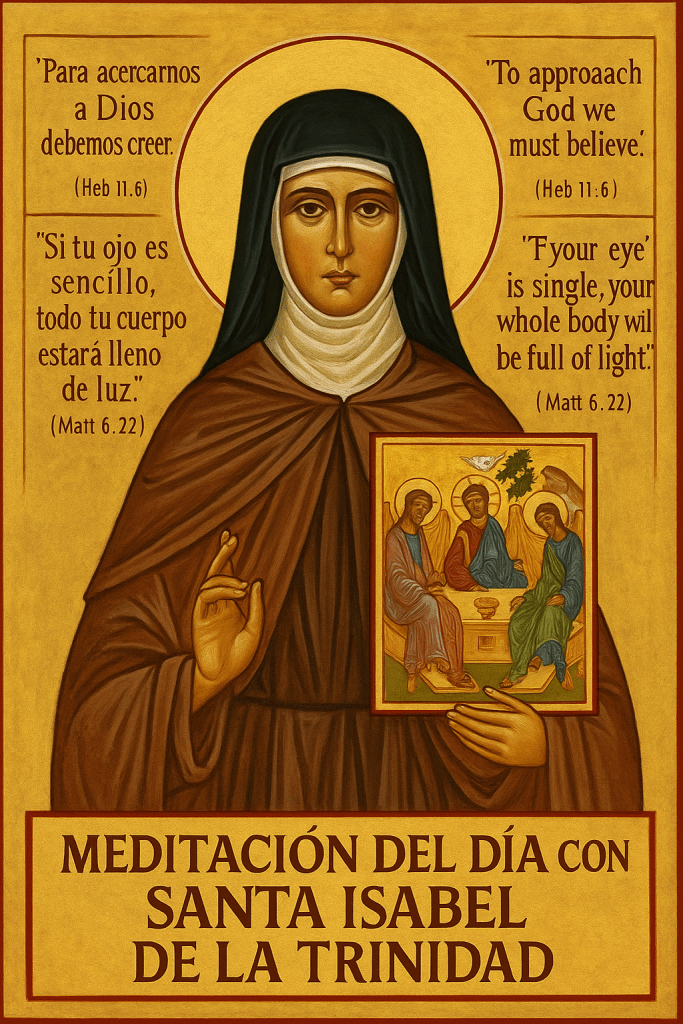
  • Meditación del día con Santa Isabel de la Trinidad

    🇪🇸🇺🇸

    Sexto día – Primera oración

    “Para acercarnos a Dios debemos creer.” (Heb 11,6)

    Así habla San Pablo. Y añade: “La fe es la certeza de lo que se espera, la convicción de lo que no se ve.” (Heb 11,1).

    La fe hace tan presentes y seguras las realidades futuras que llegan a existir en el alma antes de poseerlas. San Juan de la Cruz la llama “los pies” para ir a Dios, y también “posesión en modo oscuro”. Solo ella puede darnos la verdadera luz acerca de Aquel a quien amamos, y el alma debe elegirla como el medio para llegar a la unión bienaventurada.

    Cristo prometió a la samaritana “un manantial de agua que salta hasta la vida eterna” (Jn 4,14). Esa fuente es la fe: aun cubierta con un velo, nos da a Dios mismo. Cuando venga lo perfecto, la visión clara, lo que era imperfecto —el conocimiento por la fe— hallará su plenitud (1 Co 13,10).

    “Hemos conocido y creído en el amor que Dios nos tiene.” (1 Jn 4,16).

    Ese es nuestro gran acto de fe, nuestra respuesta al Amor con amor. Cuando el alma cree en este amor sobreabundante, se cumple lo que se dijo de Moisés: “Se mantuvo firme como si viera al Invisible.” (Heb 11,27).

    Entonces ya no importan los sentimientos ni las consolaciones: el alma cree en Su amor aun en la prueba, y cuanto más probada, más crece su fe. Y allí escucha las palabras del Maestro: “Ve en paz, tu fe te ha salvado.” (Lc 7,50).

    Sexto día – Segunda oración

    “Si tu ojo es sencillo, todo tu cuerpo estará lleno de luz.” (Mt 6,22).

    Este ojo único es la simplicidad de intención: reunir en unidad todas las fuerzas dispersas del alma y dirigirlas solo hacia Dios. La simplicidad honra y alaba a Dios, unifica las virtudes, encuentra a Dios en lo profundo y da luz y valor al alma.

    Es la inclinación interior y la fuente de toda vida espiritual: aplasta el mal, da paz, impone silencio al ruido interior. Aumenta nuestra semejanza divina y nos transporta al abismo donde Dios habita.

    La eternidad nos entrega la herencia en simplicidad: toda la vida de los espíritus, toda su virtud, consiste en la sencillez, y su descanso eterno también.

    El alma simple, elevándose por su mirada interior, penetra hasta su propio abismo y allí contempla el santuario donde la toca la Trinidad Santa: “Hasta el fundamento, que es la puerta de la vida eterna.”

    📖 Daily Meditation with Saint Elizabeth of the Trinity

    Sixth Day – First Prayer

    “To approach God we must believe.” (Heb 11:6)

    So speaks St. Paul. And he adds: “Faith is the substance of things hoped for, the evidence of things not seen.” (Heb 11:1).

    Faith makes future goods so present and so certain that they already subsist in the soul before we possess them. St. John of the Cross calls it the “feet” to go to God, and also “possession in an obscure manner.” Faith alone gives us true light about the One we love, and the soul must choose it as the means to reach blessed union.

    Christ promised the Samaritan woman “a fountain of water springing up unto life everlasting” (Jn 4:14). That fountain is faith: even veiled, it gives us God Himself. When the perfect comes, clear vision, then what is imperfect—knowledge through faith—will reach its fullness (1 Cor 13:10).

    “We have come to know and to believe in the love God has for us.” (1 Jn 4:16).

    That is our great act of faith, our response to Love with love. When the soul believes in this exceeding love, we may say of it what was said of Moses: “He was unshakable in faith as if he had seen the Invisible.” (Heb 11:27).

    Feelings no longer matter: whether joy or suffering, the soul believes in His love. The more it is tried, the stronger faith grows. And there the Master whispers: “Go in peace, your faith has saved you.” (Lk 7:50).

    Sixth Day – Second Prayer

    “If your eye is single, your whole body will be full of light.” (Mt 6:22).

    This single eye is simplicity of intention: it gathers into unity all the scattered forces of the soul and directs them only to God. Simplicity honors and praises God, unifies the virtues, finds Him in the depths, and gives light and courage to the soul.

    It is the inner slope and the fountain of all spiritual life: it crushes evil, gives peace, silences useless noise. It increases our divine likeness and leads us into the abyss where God dwells.

    Eternity gives us our inheritance in simplicity: all the life of the spirits, all their virtue, consists in simplicity, and their final rest too. The simple soul, rising by its inner gaze, penetrates into its own depths and contemplates the sanctuary where the Holy Trinity touches it: “To the very foundation which is the gate of life eternal.”

  • Meditation of the Day with Saint Elizabeth of the Trinity

    Israel Centeno

    Dear brothers and sisters in the contemplative journey:

    Today Elizabeth of the Trinity leads us to the mystery of the Presence that knocks:

    “Behold, I stand at the door and knock. If anyone hears my voice and opens the door, I will come in to him and sup with him, and he with me.” (Rev 3:20)

    Blessed are the ears attentive enough to hear, blessed the eyes of faith that see the Master entering the soul’s inner sanctuary. His coming is not bound by time: it is an eternal now. God within us receives God who comes to us — and God contemplates God.

    Then Elizabeth reminds us of the Eucharistic fire of love:

    “He who eats my flesh and drinks my blood abides in me, and I in him.” (Jn 6:56)

    Christ gives Himself entirely, with an immense hunger to possess us, to penetrate the very marrow of our being and transform it into His own. His love is insatiable: He asks more than we think we can give, yet He fills us with His fire, consumes us, purifies us, and raises us into His life.

    Thus the surrendered soul can truly say: “It is no longer I who live, but Christ who lives in me.” (Gal 2:20)

    Final Prayer

    Lord Jesus, who stand and knock,

    ignite my soul with the fire of Your love.

    Let me sit at Your table, live from Your Bread,

    burn in Your unity until You are in me,

    and I in You, forever

    Español

    Queridos hermanos en la jornada contemplativa:

    Hoy Isabel de la Trinidad nos conduce al misterio de la Presencia que llama:

    “Mira que estoy a la puerta y llamo. Si alguno oye mi voz y me abre, entraré en él, cenaré con él y él conmigo.” (Ap 3,20)

    Bienaventurados los oídos atentos para escuchar esa voz y los ojos que, con la fe viva, contemplan la llegada del Maestro en lo íntimo del alma. Esta venida no es un evento pasajero, sino un “eterno ahora”: Cristo llega siempre como si fuese la primera vez, con la plenitud de sí mismo. Allí, en lo profundo, Dios acoge a Dios: el Dios que habita en nosotros recibe al Dios que viene a visitarnos.

    Luego, Isabel nos recuerda la locura de amor eucarística:

    “El que come mi carne y bebe mi sangre permanece en mí y yo en él.” (Jn 6,56)

    Jesús se nos da todo entero, con hambre inmensa de poseernos, hasta penetrar lo más íntimo de nuestro ser y transformarlo en el suyo. Su amor no se sacia: pide más de lo que creemos poder dar. Y, sin embargo, nos enciende con el fuego de su propia vida, nos limpia, nos consume y nos eleva.

    Así, el alma que se entrega puede decir en toda verdad: “Ya no vivo yo, es Cristo quien vive en mí” (Gal 2,20).

    Oración final

    Señor Jesús, que llamas y esperas a la puerta,

    enciende mi alma con el fuego de tu amor.

    Hazme entrar en tu mesa, vivir de tu Pan,

    arder contigo en unidad hasta que seas Tú en mí,

    y yo en Ti, eternamente

  • “My only occupation is love.”

    Daily Meditation with Elizabeth of the Trinity

    Dear brothers and sisters in the contemplative journey

    Our God is a consuming fire” (Heb 12:29).
    This fire is love, not a fire that annihilates but one that transforms. The Holy Spirit, the eternal bond between the Father and the Son, kindles deep within the soul a flame that renews it without ceasing. Whoever abandons themselves to this fire learns to live in a fruitful silence, free of obstacles, where the soul sails upon the ocean of divinity.

    This is the “mystical death” of which St. Paul speaks: dying to self in order to enter into the fullness of the Spirit. It is not a harsh effort, but a sweet surrender. There the soul is transformed into the divine image, lives in communion with the Trinity, and already tastes eternal life.

    Christ Himself said: “I have come to cast fire upon the earth, and how I long for it to be already blazing!” (Lk 12:49). This fire exalts the dignity of the soul and makes it like the Beloved in love. To attain it, the will must be surrendered: to do everything with love, to suffer everything with love. Then the soul can say, even in the midst of worldly cares:
    “My only occupation is love.”

    Silence and inner freedom:

    Whoever abandons themselves to this fire learns to live in a fruitful silence, free of created obstacles. This silence is not emptiness but fullness: it is to sail upon the ocean of Divinity.

    Mystical death:

    St. Paul speaks of “mystical death” as a dying to oneself in order to enter into the Spirit. Elizabeth describes it as a simple and sweet process: less obsession with what remains to be destroyed, more desire to plunge into the furnace of love of the Holy Spirit, the eternal bond between the Father and the Son.

    Transformation and divine image:

    The soul that surrenders is led beyond all that is sensible, “into the sacred darkness,” toward communion with the Trinity. This contemplative life is not escape, but the foretaste of eternal possession.

    The fire that Christ brings to the earth:

    Jesus Himself says that He came to bring fire. That fire is love, which exalts the dignity of the soul, raising it up to become “equal” in love to the Beloved. Friendship with Christ makes everything common: “All that is mine is yours, and yours is mine.”

    Total surrender of the will:

    To live this love, it is necessary to surrender the will: to do everything with love, to suffer everything with love. Elizabeth reminds us, with David, that all our strength must be kept for God. Then the soul can say, even in the midst of worldly occupations: “My only occupation is to love.”

    Biblical and Patristic References (for meditation apart)

    Hebrews 12:29 – “Our God is a consuming fire.”

    1 John 1:3 – “Our fellowship is with the Father and with His Son Jesus Christ.”

    John 15:15 – “I have called you friends, for everything I have heard from my Father I have made known to you.”

    Psalm 59:10 – “I will keep my strength for you.”

    Luke 12:49 – “I have come to bring fire on the earth, and how I wish it were already kindled!”

    Meditación del día según Santa Isabel de la Trinidad

    Texto base (resumido y comentado)

    “Nuestro Dios es un fuego consumidor”:
    Isabel, siguiendo a San Pablo, entiende a Dios como fuego de amor. Este fuego no destruye para aniquilar, sino para transformar en sí mismo todo lo que toca. La obra del Espíritu Santo es justamente esa: abrasar y renovar en lo más profundo de nuestra alma la llama del amor, hasta hacernos participar de la vida trinitaria.

    El silencio y la libertad interior:
    Quien se abandona a este fuego aprende a vivir en un silencio fecundo, libre de obstáculos creados. Este silencio no es vacío, sino plenitud: es navegar en el océano de la Divinidad.

    La muerte mística:
    San Pablo habla de la “muerte mística” como un morir a uno mismo para entrar en el Espíritu. Isabel lo describe como un proceso sencillo y dulce: menos obsesión por lo que falta destruir, más deseo de sumergirse en el horno de amor del Espíritu Santo, vínculo eterno entre el Padre y el Hijo.

    Transformación e imagen divina:
    El alma que se entrega es conducida más allá de todo lo sensible, “en la sagrada oscuridad”, hacia la comunión con la Trinidad. Esta vida contemplativa no es evasión, sino posesión anticipada de la vida eterna.

    El fuego que Cristo trae a la tierra:
    Jesús mismo dice que vino a traer fuego. Ese fuego es el amor que exalta la dignidad del alma, elevándola hasta hacerse “igual” en el amor al Amado. La amistad con Cristo lo vuelve todo común: “todo lo mío es tuyo, y lo tuyo mío”.

    Entrega total de la voluntad:
    Para vivir este amor, es necesario rendir la voluntad: hacer todo con amor, sufrir todo con amor. Isabel nos recuerda con David que toda nuestra fuerza debe guardarse para Dios. Entonces, el alma puede decir en medio de las ocupaciones del mundo:
    “Mi único oficio es amar.”


    Citas bíblicas y patrísticas (para meditar aparte)

    • Hebreos 12:29 – “Nuestro Dios es fuego consumidor.”
    • 1 Juan 1:3 – “Nuestra comunión es con el Padre y con su Hijo Jesucristo.”
    • Juan 15:15 – “Os he llamado amigos, porque todo lo que oí de mi Padre os lo he dado a conocer.”
    • Salmo 58 (59):10 – “Guardaré mi fuerza para ti.”
    • Lucas 12:49 – “He venido a traer fuego a la tierra, ¡y cuánto deseo que ya estuviera ardiendo!”

    “Nuestro Dios es fuego consumidor” (Hb 12,29).
    Ese fuego es amor, un amor que no aniquila sino que transforma. El Espíritu Santo, vínculo eterno entre el Padre y el Hijo, enciende en lo profundo del alma una llama que la renueva sin cesar. Quien se abandona a este fuego aprende a vivir en un silencio fecundo, libre de obstáculos, donde el alma navega en el océano de la divinidad.

    Esta es la “muerte mística” de la que habla San Pablo: morir al propio yo para entrar en la plenitud del Espíritu. No es esfuerzo áspero, sino dulce abandono. Allí el alma se transforma en la imagen divina, vive en comunión con la Trinidad y saborea anticipadamente la vida eterna.

    Cristo mismo dijo: “He venido a traer fuego a la tierra, ¡y cuánto deseo que ya estuviera ardiendo!” (Lc 12,49). Ese fuego enaltece la dignidad del alma y la hace semejante al Amado en el amor. Para alcanzarlo, es necesario rendir la voluntad: hacer todo con amor, sufrir todo con amor. Entonces el alma puede decir, aún en medio de las tareas del mundo:
    “Mi único oficio es amar.”

  • God is a Fire of Love

    Interpretation and adaptation of a text by Saint Elizabeth of the Trinity

    1. God is a Fire of Love

    Saint Paul tells us: “Our God is a consuming fire” (Heb 12:29).

    This fire does not destroy with violence but transforms with love.

    Everything it touches is changed into itself.

    Just as wood becomes flame,

    the soul that opens itself to God becomes a reflection of His love.

    2. The Soul that Lets Itself Be Loved

    Saint Elizabeth reminds us that the greatest thing is not what we do for God,

    but what God does within us.

    Some souls “lose themselves” in His love and rest in Him,

    like a boat sailing freely on an infinite ocean.

    3. Mystical Death

    Saint Paul spoke of dying to oneself.

    Elizabeth sees this “death” not as tragedy,

    but as a sweet surrender:

    less worrying about what I must let go of,

    and more trusting myself to the Furnace of Love that is the Holy Spirit.

    This Spirit is the living Love between the Father and the Son,

    and invites us to enter into that communion.

    4. Contemplation as Communion

    Prayer is not only thinking about God,

    but living with Him, sharing His life,

    being in communion with the Father, the Son, and the Holy Spirit.

    This is contemplation:

    a foretaste of eternal life,

    a peace that surpasses all reason.

    5. Jesus Brings Fire to the Earth

    Jesus said: “I have come to bring fire on the earth, and how I wish it were already kindled!” (Lk 12:49).

    That fire is His love within us.

    He does not desire so much our external works,

    but rather that our soul may grow, rise, and be conformed to Him.

    6. The Surrender of the Will

    To live this love, the soul must be entirely surrendered:

    “Lord, I want what You want.”

    Then everything—work, joys, sorrows—

    becomes an occasion to love.

    As David sang: “I will keep all my strength for You” (Ps 59:9).

    7. One Single Occupation: Love

    When the soul allows itself to be filled with this love,

    it learns that, even in the midst of cares and worries,

    the only thing that truly matters is to love.

    And so it can say with truth:

    “My only work is to love.”

    🙏 For Meditation:

    Do I recognize that it is God who transforms me? Do I trust that His love is stronger than my limitations? Can I begin today to live with a simple purpose: to love in all things?

  • The Limit of Knowledge and the Greatness of Mystery

    Israel Centeno

    The man of knowledge often walks with the certainty of one who has read, studied, and understood much. His strength is reason; his pride, certainty. Yet, at a certain point, he encounters an unavoidable frontier: there will always be something beyond all science, beyond all intelligence, beyond all technology.

    That “something” is not an empty riddle but Someone: the One who loves us, who created us, who gave us laws, who made us capable of loving and being loved. This Someone, who throughout history revealed Himself in signs and words, after the coming of Jesus is no longer content to reveal Himself from afar but desires a living, personal relationship with us.

    And here lies the difficulty: for the man of science, for the philosopher of impeccable logic, accepting such a relationship is almost impossible. He may acknowledge that there is a mystery, but he does so as one who concedes without conceding. He admits it vaguely, reducing it to something undefined, relegating it to the unknowable. In this way, he preserves his pride intact: he recognizes that something greater exists, but at the same time, he distances it, as though God had withdrawn from us.

    Yet deep within his intelligence, he knows that reason alone is not enough. Even the brightest mind cannot grasp the knowledge of God. Not because it is a shameful limit, but because the Infinite cannot be contained in what is finite. The human mind may approach, glimpse, intuit—but never capture. And this impossibility is not defeat; it is a reminder of our condition: creatures called to receive, not to possess.

    We are always limited by space and time. Even living in a three-dimensional world, there are perceptions and experiences forever denied to us. No matter how hard I try, I cannot experience the world as a fish perceives it, nor can I have the perception of a bird in flight. Likewise, no matter how hard I try, I can never contain in my mind the fullness of the Being who sustains the universe. To attempt it would be like trying to hold the ocean in a clay bowl.

    The mystery of God does not annul human knowledge—it crowns it. It shows us that intelligence, however great, is still limited; that science, however vast, remains partial; and that eternal Love is always one step ahead, inviting us into a relationship measured not by equations but by surrender and trust.

    Greatness does not lie in knowing everything but in humbly recognizing that there is something—Someone—greater than ourselves. That recognition opens the door to true wisdom, a wisdom unafraid of limits because it knows that those very limits are also a call to encounter the eternal.

  • Aphorisms of Post-Capitalism

    Israel Centeno

    I was formed in Marx, Lenin, Mao. I believed those books could read the world. Surplus value, means of production, class struggle: dogmas, not categories. Today those certainties are dust: capitalism no longer fits the manuals. Agamben says we live under a machine that manages life without telos. Han says we are smiling slaves of our own self-exploitation. Slavery now wears new faces: exhaustion disguised as freedom. Yet the old slavery persists: – in Pakistan, with workers chained to brick kilns; – in Africa, where war is the daily wage; – in Asia, where children stitch the clothes the West consumes and discards. And then China: a disciplined swarm, a penal hive, eternal buzzing of production. The West is the soft society: no chains, only apps. No whips, only algorithms. Two faces of the same machine: roar and smile, martyrdom and consumption. Where are the exploited? Who are the slaves? “Proletariat” no longer suffices. Marcion suspected: the world is ruled by a strange god. Paul said it outright: we wrestle against principalities and powers. The visible is haunted by the invisible: debt, war, hunger, algorithms. Politics offers no way out: not Marxism, not liberalism, not social democracy. Even the Church’s social doctrine cannot break the circle. All stumble on the same wound: a time without horizon. Creation groans, Paul said, with the pangs of birth. It awaits more than revolutions, more than reforms. It awaits redemption. Marcion longed for a God other than the tyrant of the world. Paul proclaimed that God had already broken in through Christ. That is the crack in the machine: the eternal power already defeated. Meanwhile, the world dances with masks. It celebrates perpetual Halloween. It disguises anguish with consumption. Yet behind the carnival beats the question: – When will the specters of capital vanish? – When will the glory of the children of God be revealed?

  • Testimony of a Woman Incapable of Lying. Spanish’English

    I

    A singular testimony: that of a woman of whom, unanimously, it was said she was incapable of lying.
    Her words carried the weight of naked truth, without adornment or artifice. She did not seek to persuade or embellish; she simply recounted what she had lived, with the transparency of one who knew neither calculation nor convenience.

    In her encounter with the divine, every phrase she left written —or spoken to the few who could hear her— bears the force of the irrefutable. Not because it was clothed in authority, but because it sprang from a radical purity: the incapacity to falsify.

    To such a voice, nothing can be added. One can only receive it with reverence, with the certainty that here speaks truth that burns, truth that unsettles, truth that illuminates.

    Simone Weil Encounters Jesus

    “Perhaps, in spite of everything, he does love me.”


    He entered my room and said:
    “You poor wretch, who understand nothing and know nothing – come with me and I will teach you of things you have no idea of.”
    I followed him.

    He led me into a church. It was new and ugly. He brought me before the altar and said: “Kneel.”
    I replied: “I have not been baptized.”
    He answered: “Fall down on your knees before this place, with love, as before the place where truth exists.”
    And I obeyed.

    He took me then to a garret, from whose window the whole town could be seen: scaffoldings, the river where boats were unloading. He made me sit down.

    We were alone. He spoke, and sometimes others entered for a moment, joining in the conversation before leaving again.

    It was no longer winter; not yet spring. Bare branches stretched in a cold air full of sunlight. The light rose, brightened, faded; then the stars and the moon appeared. Again the dawn returned.

    At times he would bring bread from a cupboard, and we shared it. That bread truly had the taste of bread. I have never tasted it again.

    He poured us wine, which carried the taste of the sun and the soil on which the city stood. Sometimes we lay on the wooden floor, and the sweetness of sleep descended on me. Then I awoke, and drank the light of the sun.

    He had promised to teach me, but he taught me nothing. We talked in a rambling way, as old friends do.

    One day he said: “Now go away.”
    I fell at his knees, clinging, begging him not to send me off. But he pushed me out toward the stairs. I descended as if unconscious, my heart torn to shreds. I walked through the streets, realizing I no longer knew where that house was.

    I never tried to find it again. He had come for me by mistake. My place was not in that garret. My place was anywhere else: in a prison cell, a bourgeois parlor full of trinkets, a station waiting room. Anywhere—but not in that garret.

    And yet, sometimes, words of his return to me. I repeat them with fear, never sure if I remember them rightly. He is not here to confirm them.

    I know well that he does not love me. How could he love me?
    And yet, deep within me, something trembles with the thought—
    that perhaps, in spite of everything, he does.

    Simone Weil se encuentra con Jesús

    «Quizá, a pesar de todo, él me ame.»


    Entró en mi habitación y me dijo:
    «Pobre desdichada, que no entiendes nada y nada sabes. Ven conmigo, y te enseñaré cosas de las que no tienes idea.»
    Y lo seguí.

    Me condujo a una iglesia. Era nueva y fea. Me llevó ante el altar y dijo: «Arrodíllate.»
    Yo respondí: «No he sido bautizada.»
    Él contestó: «Póstrate aquí, con amor, como ante el lugar donde habita la verdad.»
    Y obedecí.

    Luego me llevó a un desván, desde cuya ventana abierta se veía la ciudad entera: andamios de madera, el río donde descargaban los barcos. Me hizo sentar.

    Estábamos solos. Él hablaba, y a veces alguien entraba, se unía un instante a la conversación, y luego se marchaba.

    Ya no era invierno; tampoco aún primavera. Las ramas de los árboles estaban desnudas, sin brotes, en un aire frío lleno de sol. La luz crecía, brillaba, luego se apagaba; aparecían la luna y las estrellas. Y de nuevo volvía el amanecer.

    A veces sacaba pan de un armario y lo compartía conmigo. Ese pan sabía verdaderamente a pan. Nunca más he vuelto a encontrar ese sabor.

    Vertía vino para mí y para él, vino con el gusto del sol y de la tierra sobre la que estaba construida la ciudad. A veces nos tendíamos sobre el suelo de madera, y la dulzura del sueño descendía sobre mí. Luego despertaba y bebía la luz del sol.

    Me había prometido enseñanza, pero no me enseñó nada. Hablábamos sin rumbo fijo, de mil cosas, como viejos amigos.

    Un día me dijo: «Ahora vete.»
    Caí a sus pies, lo abracé, le supliqué que no me echara. Pero me arrojó hacia la escalera. Bajé como sin conciencia, con el corazón hecho pedazos. Caminé por las calles y comprendí que ya no sabía dónde estaba aquella casa.

    Nunca intenté volver a encontrarla. Comprendí que había venido a buscarme por error. Mi lugar no estaba en aquel desván. Mi lugar estaba en cualquier otro sitio: en una celda de prisión, en un salón burgués lleno de baratijas y terciopelo rojo, en la sala de espera de una estación. En cualquier parte, menos en aquel desván.

    Y, sin embargo, a veces me sorprendo repitiendo, con temor y compunción, alguna de sus palabras. ¿Cómo saber si las recuerdo fielmente? Él no está para decírmelo.

    Sé bien que no me ama. ¿Cómo podría amarme?
    Y sin embargo, hay algo profundo en mí, un punto de mi ser, que no puede dejar de pensar, con miedo y temblor, que quizá, a pesar de todo… él me ame.


    Fuente: Simone Weil, Cuadernos (First and Last Notebooks), (Wipf and Stock, 2015), pp. 65–66.