Dear brothers and sisters in the contemplative journey
Our God is a consuming fire” (Heb 12:29). This fire is love, not a fire that annihilates but one that transforms. The Holy Spirit, the eternal bond between the Father and the Son, kindles deep within the soul a flame that renews it without ceasing. Whoever abandons themselves to this fire learns to live in a fruitful silence, free of obstacles, where the soul sails upon the ocean of divinity.
This is the “mystical death” of which St. Paul speaks: dying to self in order to enter into the fullness of the Spirit. It is not a harsh effort, but a sweet surrender. There the soul is transformed into the divine image, lives in communion with the Trinity, and already tastes eternal life.
Christ Himself said: “I have come to cast fire upon the earth, and how I long for it to be already blazing!” (Lk 12:49). This fire exalts the dignity of the soul and makes it like the Beloved in love. To attain it, the will must be surrendered: to do everything with love, to suffer everything with love. Then the soul can say, even in the midst of worldly cares: “My only occupation is love.”
Silence and inner freedom:
Whoever abandons themselves to this fire learns to live in a fruitful silence, free of created obstacles. This silence is not emptiness but fullness: it is to sail upon the ocean of Divinity.
Mystical death:
St. Paul speaks of “mystical death” as a dying to oneself in order to enter into the Spirit. Elizabeth describes it as a simple and sweet process: less obsession with what remains to be destroyed, more desire to plunge into the furnace of love of the Holy Spirit, the eternal bond between the Father and the Son.
Transformation and divine image:
The soul that surrenders is led beyond all that is sensible, “into the sacred darkness,” toward communion with the Trinity. This contemplative life is not escape, but the foretaste of eternal possession.
The fire that Christ brings to the earth:
Jesus Himself says that He came to bring fire. That fire is love, which exalts the dignity of the soul, raising it up to become “equal” in love to the Beloved. Friendship with Christ makes everything common: “All that is mine is yours, and yours is mine.”
Total surrender of the will:
To live this love, it is necessary to surrender the will: to do everything with love, to suffer everything with love. Elizabeth reminds us, with David, that all our strength must be kept for God. Then the soul can say, even in the midst of worldly occupations: “My only occupation is to love.”
Biblical and Patristic References (for meditation apart)
Hebrews 12:29 – “Our God is a consuming fire.”
1 John 1:3 – “Our fellowship is with the Father and with His Son Jesus Christ.”
John 15:15 – “I have called you friends, for everything I have heard from my Father I have made known to you.”
Psalm 59:10 – “I will keep my strength for you.”
Luke 12:49 – “I have come to bring fire on the earth, and how I wish it were already kindled!”
Meditación del día según Santa Isabel de la Trinidad
Texto base (resumido y comentado)
“Nuestro Dios es un fuego consumidor”: Isabel, siguiendo a San Pablo, entiende a Dios como fuego de amor. Este fuego no destruye para aniquilar, sino para transformar en sí mismo todo lo que toca. La obra del Espíritu Santo es justamente esa: abrasar y renovar en lo más profundo de nuestra alma la llama del amor, hasta hacernos participar de la vida trinitaria.
El silencio y la libertad interior: Quien se abandona a este fuego aprende a vivir en un silencio fecundo, libre de obstáculos creados. Este silencio no es vacío, sino plenitud: es navegar en el océano de la Divinidad.
La muerte mística: San Pablo habla de la “muerte mística” como un morir a uno mismo para entrar en el Espíritu. Isabel lo describe como un proceso sencillo y dulce: menos obsesión por lo que falta destruir, más deseo de sumergirse en el horno de amor del Espíritu Santo, vínculo eterno entre el Padre y el Hijo.
Transformación e imagen divina: El alma que se entrega es conducida más allá de todo lo sensible, “en la sagrada oscuridad”, hacia la comunión con la Trinidad. Esta vida contemplativa no es evasión, sino posesión anticipada de la vida eterna.
El fuego que Cristo trae a la tierra: Jesús mismo dice que vino a traer fuego. Ese fuego es el amor que exalta la dignidad del alma, elevándola hasta hacerse “igual” en el amor al Amado. La amistad con Cristo lo vuelve todo común: “todo lo mío es tuyo, y lo tuyo mío”.
Entrega total de la voluntad: Para vivir este amor, es necesario rendir la voluntad: hacer todo con amor, sufrir todo con amor. Isabel nos recuerda con David que toda nuestra fuerza debe guardarse para Dios. Entonces, el alma puede decir en medio de las ocupaciones del mundo: “Mi único oficio es amar.”
Citas bíblicas y patrísticas (para meditar aparte)
Hebreos 12:29 – “Nuestro Dios es fuego consumidor.”
1 Juan 1:3 – “Nuestra comunión es con el Padre y con su Hijo Jesucristo.”
Juan 15:15 – “Os he llamado amigos, porque todo lo que oí de mi Padre os lo he dado a conocer.”
Salmo 58 (59):10 – “Guardaré mi fuerza para ti.”
Lucas 12:49 – “He venido a traer fuego a la tierra, ¡y cuánto deseo que ya estuviera ardiendo!”
“Nuestro Dios es fuego consumidor” (Hb 12,29). Ese fuego es amor, un amor que no aniquila sino que transforma. El Espíritu Santo, vínculo eterno entre el Padre y el Hijo, enciende en lo profundo del alma una llama que la renueva sin cesar. Quien se abandona a este fuego aprende a vivir en un silencio fecundo, libre de obstáculos, donde el alma navega en el océano de la divinidad.
Esta es la “muerte mística” de la que habla San Pablo: morir al propio yo para entrar en la plenitud del Espíritu. No es esfuerzo áspero, sino dulce abandono. Allí el alma se transforma en la imagen divina, vive en comunión con la Trinidad y saborea anticipadamente la vida eterna.
Cristo mismo dijo: “He venido a traer fuego a la tierra, ¡y cuánto deseo que ya estuviera ardiendo!” (Lc 12,49). Ese fuego enaltece la dignidad del alma y la hace semejante al Amado en el amor. Para alcanzarlo, es necesario rendir la voluntad: hacer todo con amor, sufrir todo con amor. Entonces el alma puede decir, aún en medio de las tareas del mundo: “Mi único oficio es amar.”
A singular testimony: that of a woman of whom, unanimously, it was said she was incapable of lying. Her words carried the weight of naked truth, without adornment or artifice. She did not seek to persuade or embellish; she simply recounted what she had lived, with the transparency of one who knew neither calculation nor convenience.
In her encounter with the divine, every phrase she left written —or spoken to the few who could hear her— bears the force of the irrefutable. Not because it was clothed in authority, but because it sprang from a radical purity: the incapacity to falsify.
To such a voice, nothing can be added. One can only receive it with reverence, with the certainty that here speaks truth that burns, truth that unsettles, truth that illuminates.
Simone Weil Encounters Jesus
“Perhaps, in spite of everything, he does love me.”
He entered my room and said: “You poor wretch, who understand nothing and know nothing – come with me and I will teach you of things you have no idea of.” I followed him.
He led me into a church. It was new and ugly. He brought me before the altar and said: “Kneel.” I replied: “I have not been baptized.” He answered: “Fall down on your knees before this place, with love, as before the place where truth exists.” And I obeyed.
He took me then to a garret, from whose window the whole town could be seen: scaffoldings, the river where boats were unloading. He made me sit down.
We were alone. He spoke, and sometimes others entered for a moment, joining in the conversation before leaving again.
It was no longer winter; not yet spring. Bare branches stretched in a cold air full of sunlight. The light rose, brightened, faded; then the stars and the moon appeared. Again the dawn returned.
At times he would bring bread from a cupboard, and we shared it. That bread truly had the taste of bread. I have never tasted it again.
He poured us wine, which carried the taste of the sun and the soil on which the city stood. Sometimes we lay on the wooden floor, and the sweetness of sleep descended on me. Then I awoke, and drank the light of the sun.
He had promised to teach me, but he taught me nothing. We talked in a rambling way, as old friends do.
One day he said: “Now go away.” I fell at his knees, clinging, begging him not to send me off. But he pushed me out toward the stairs. I descended as if unconscious, my heart torn to shreds. I walked through the streets, realizing I no longer knew where that house was.
I never tried to find it again. He had come for me by mistake. My place was not in that garret. My place was anywhere else: in a prison cell, a bourgeois parlor full of trinkets, a station waiting room. Anywhere—but not in that garret.
And yet, sometimes, words of his return to me. I repeat them with fear, never sure if I remember them rightly. He is not here to confirm them.
I know well that he does not love me. How could he love me? And yet, deep within me, something trembles with the thought— that perhaps, in spite of everything, he does.
Simone Weil se encuentra con Jesús
«Quizá, a pesar de todo, él me ame.»
Entró en mi habitación y me dijo: «Pobre desdichada, que no entiendes nada y nada sabes. Ven conmigo, y te enseñaré cosas de las que no tienes idea.» Y lo seguí.
Me condujo a una iglesia. Era nueva y fea. Me llevó ante el altar y dijo: «Arrodíllate.» Yo respondí: «No he sido bautizada.» Él contestó: «Póstrate aquí, con amor, como ante el lugar donde habita la verdad.» Y obedecí.
Luego me llevó a un desván, desde cuya ventana abierta se veía la ciudad entera: andamios de madera, el río donde descargaban los barcos. Me hizo sentar.
Estábamos solos. Él hablaba, y a veces alguien entraba, se unía un instante a la conversación, y luego se marchaba.
Ya no era invierno; tampoco aún primavera. Las ramas de los árboles estaban desnudas, sin brotes, en un aire frío lleno de sol. La luz crecía, brillaba, luego se apagaba; aparecían la luna y las estrellas. Y de nuevo volvía el amanecer.
A veces sacaba pan de un armario y lo compartía conmigo. Ese pan sabía verdaderamente a pan. Nunca más he vuelto a encontrar ese sabor.
Vertía vino para mí y para él, vino con el gusto del sol y de la tierra sobre la que estaba construida la ciudad. A veces nos tendíamos sobre el suelo de madera, y la dulzura del sueño descendía sobre mí. Luego despertaba y bebía la luz del sol.
Me había prometido enseñanza, pero no me enseñó nada. Hablábamos sin rumbo fijo, de mil cosas, como viejos amigos.
Un día me dijo: «Ahora vete.» Caí a sus pies, lo abracé, le supliqué que no me echara. Pero me arrojó hacia la escalera. Bajé como sin conciencia, con el corazón hecho pedazos. Caminé por las calles y comprendí que ya no sabía dónde estaba aquella casa.
Nunca intenté volver a encontrarla. Comprendí que había venido a buscarme por error. Mi lugar no estaba en aquel desván. Mi lugar estaba en cualquier otro sitio: en una celda de prisión, en un salón burgués lleno de baratijas y terciopelo rojo, en la sala de espera de una estación. En cualquier parte, menos en aquel desván.
Y, sin embargo, a veces me sorprendo repitiendo, con temor y compunción, alguna de sus palabras. ¿Cómo saber si las recuerdo fielmente? Él no está para decírmelo.
Sé bien que no me ama. ¿Cómo podría amarme? Y sin embargo, hay algo profundo en mí, un punto de mi ser, que no puede dejar de pensar, con miedo y temblor, que quizá, a pesar de todo… él me ame.
Fuente: Simone Weil, Cuadernos (First and Last Notebooks), (Wipf and Stock, 2015), pp. 65–66.
In an age of polarization and mimetic contagion, we either demonize or idolize, but rarely see clearly. René Girard’s lens helps us uncover the hidden mechanism of “all against one” and discover a new path: not myth, not scapegoating, but the truth revealed in the Cross — the innocence of the victim and the call to reconciliation.
Bilingual
✍️ Article in English
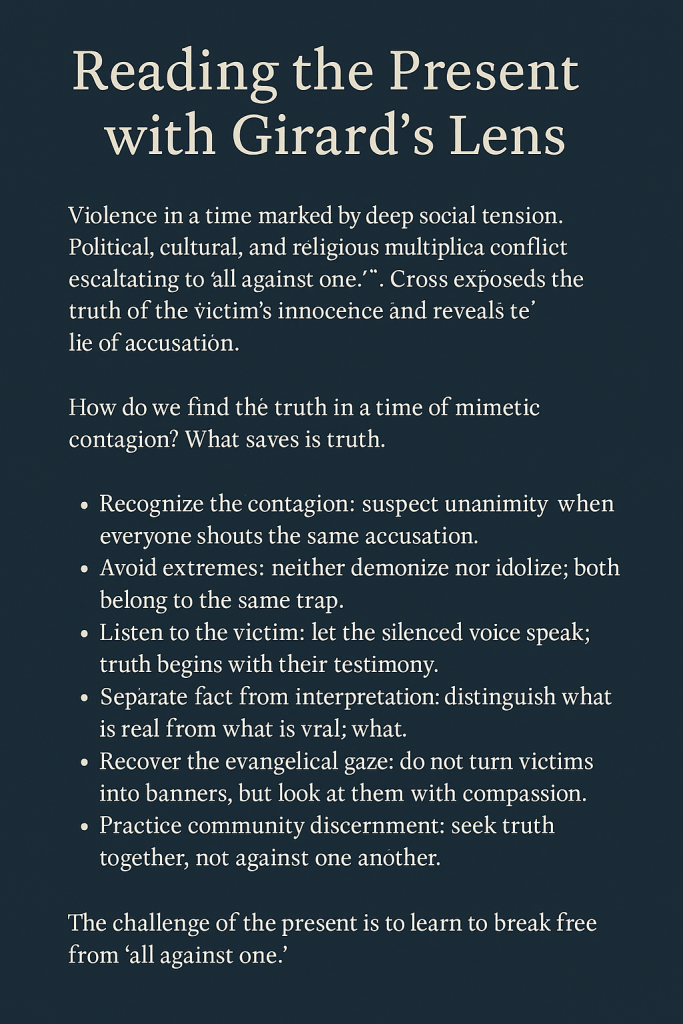
Reading the Present with Girard’s Lens
We live in a time marked by deep social tension. Political, cultural, and religious polarization multiplies divisions, and each side mirrors in the other the very passions that fuel its anger. Hatred imitates hatred, indignation spreads like fire, fear multiplies by contagion. In this collective mirror, conflict escalates until the entire community vibrates under the invisible pressure of finding someone to blame, someone to bear the weight of all unrest.
Then the most ancient mechanism of humanity emerges: the convergence of all against one. A culprit is identified, a face that concentrates suspicion and rage. It can be an individual, a minority, even a symbol. The unanimous cry rises: “If we eliminate this one, there will be peace.” And the sacrifice takes place: exclusion, lynching, assassination, social cancellation. The group feels, for an instant, a false peace, as if the problem had been solved.
But what follows is the building of a narrative. In the mythic logic, the victim is presented as guilty; their elimination is justified, even sacred. Violence is thus legitimized. In the evangelical logic, however, the victim is shown to be innocent. Their exclusion does not save the community but reveals the injustice of unanimity. It shows that supposed peace is built upon a lie.
This is our present: one sector demonizes, another deifies; one cries “monster”, the other “martyr.” Both fall into the mimetic trap. Neutrality becomes almost impossible, because contagion pressures everyone to take sides, to reproduce collective passion.
Against this endless cycle, the Cross opens another path. It is not a military or political triumph; it does not resemble the victory of a Roman general dragging prisoners in chains. The triumph of the Cross is paradoxical: it exposes the very mechanism of violence and strips it of its prestige. In the innocence of the victim, the lie of accusation is revealed. The Cross shows that neither demonization nor sacralization can save. What saves is truth — the recognition that we all participate in the mechanism and all stand in need of conversion.
How, then, do we find the truth in a time of mimetic contagion?
Recognize the contagion: when everyone shouts the same accusation, suspect the unanimity.
Avoid extremes: neither demonize nor idolize; both belong to the same trap.
Listen to the victim: let the silenced voice speak; truth begins with their testimony.
Separate fact from interpretation: distinguish what is real from what is viral.
Recover the evangelical gaze: do not turn victims into banners, but look at them with compassion.
Practice community discernment: seek truth together, not against one another.
The challenge of the present is not to choose whom to demonize or whom to sacralize, but to recognize how the “all against one” still operates and to learn to break free from it. The evangelical revelation calls us not to justify violence or glorify victims as idols, but to humanize: to defend innocence, resist contagion, dismantle the narratives that legitimize exclusion, and open a path toward reconciliation.
✍️ Artículo en Español
Leer el presente con la mirada de Girard
Vivimos en un tiempo marcado por la tensión social. La polarización política, cultural y religiosa multiplica las divisiones, y cada bando refleja en el otro las pasiones que alimentan su furia. El odio imita al odio, la indignación se contagia como fuego, el miedo se multiplica. En este espejo colectivo, el conflicto crece hasta que toda la comunidad vibra bajo una presión invisible: la necesidad de encontrar a alguien a quien culpar, alguien que cargue con el peso del malestar.
Entonces aparece el mecanismo más antiguo de la humanidad: la convergencia de todos contra uno. Se identifica un culpable, un rostro que concentra la sospecha y la rabia. Puede ser un individuo, una minoría, incluso un símbolo. El grito unánime se eleva: «Si eliminamos a este, habrá paz». Y el sacrificio se consuma: exclusión, linchamiento, asesinato, cancelación social. El grupo experimenta, por un instante, una paz ilusoria, como si el problema hubiera sido resuelto.
Pero lo que sigue es la construcción de un relato. En la lógica mítica, la víctima aparece como culpable; su eliminación se presenta como justa, necesaria o incluso sagrada. Así, la violencia queda legitimada. En la lógica evangélica, en cambio, la víctima es mostrada como inocente. Su exclusión no salva: desnuda la injusticia de la unanimidad, muestra que la paz aparente se levanta sobre una mentira.
Este es nuestro presente: un sector demoniza, otro sacraliza; unos gritan «monstruo», otros «mártir». Ambos caen en la trampa mimética. La neutralidad se vuelve casi imposible, porque la presión del contagio empuja a tomar partido, a reproducir la pasión colectiva.
Frente a este ciclo interminable, la Cruz abre otro camino. No es un triunfo militar ni político; no se parece a la victoria de un general romano que arrastra prisioneros encadenados. El triunfo de la Cruz es paradójico: consiste en exponer el mecanismo de la violencia y despojarlo de su prestigio. En la inocencia de la víctima se revela la mentira de la acusación. La Cruz enseña que ni la demonización ni la sacralización salvan; lo que salva es la verdad: reconocer que todos participamos en el mecanismo y todos necesitamos conversión.
¿Cómo encontrar, entonces, la verdad en un tiempo de contagio mimético?
Reconocer el contagio: cuando todos acusan lo mismo, sospechemos de la unanimidad.
Evitar los extremos: ni demonizar ni idolatrar; ambos pertenecen a la misma trampa.
Escuchar la voz de la víctima: dejar hablar a quien fue silenciado; la verdad comienza con su testimonio.
Separar hechos de interpretaciones: distinguir lo real de lo viral.
Recuperar la mirada evangélica: no convertir a las víctimas en banderas, sino mirarlas con compasión.
Practicar el discernimiento comunitario: buscar la verdad juntos, no unos contra otros.
El desafío del presente no es elegir a quién demonizar ni a quién sacralizar, sino reconocer cómo sigue operando el “todos contra uno” y aprender a liberarnos de él. La revelación evangélica no nos llama a justificar la violencia ni a glorificar a las víctimas como ídolos, sino a humanizar: a defender la inocencia, resistir el contagio, desmontar las narrativas que legitiman la exclusión y abrir un camino de reconciliación.
La Sábana no es dogma de fe. No creemos en la resurrección por la Sábana, pero sigue siendo motivo de asombro lo que se encuentra al estudiarla y al tratar de replicarla sin éxito, a pesar de que algunos afirman que fue producida en la Edad Media.
La Sábana de Turín ha sido, durante siglos, objeto de devoción y controversia. Más allá de los debates sobre su autenticidad histórica, recientes aplicaciones de inteligencia artificial (IA) han permitido aproximaciones inéditas a la imagen grabada en el lienzo. Estos estudios no han revelado códigos ocultos ni mensajes intencionales, sino algo más fundamental: patrones geométricos y matemáticos consistentes que sugieren un proceso de formación no explicado satisfactoriamente.
Entre los hallazgos destacan los obtenidos con análisis de componentes principales (PCA), una técnica que elimina el ruido de los datos y resalta las variables más significativas. Al aplicarla a escaneos digitales de alta resolución, los investigadores observaron que la figura humana pasaba a un segundo plano y emergía un campo de información. La gradación de luces y sombras mostraba una consistencia matemática precisa: la intensidad de la impronta variaba de manera proporcional a la distancia hipotética entre cuerpo y tela. En otras palabras, la Sábana contiene información tridimensional que sigue una regla física estable: cuanto más cerca el cuerpo, más fuerte la señal; cuanto más lejos, más débil¹.
Asimismo, la IA detectó un andamiaje geométrico subyacente en zonas anatómicas específicas, como las manos y la curvatura de las costillas. Estos patrones habían permanecido invisibles al ojo humano, ocultos por la trama del lino y los daños acumulados. Para descartar errores, los modelos de IA fueron alimentados con imágenes de otros lienzos antiguos y obras artísticas. El resultado fue concluyente: la estructura geométrica era exclusiva de la Sábana de Turín².
Las implicaciones son significativas. La precisión geométrica y la tridimensionalidad observadas hacen improbable que la imagen haya sido generada por contacto directo —lo que produciría manchas irregulares—. Sugieren, más bien, un proceso de proyección, como si alguna forma de energía hubiera transmitido la información desde cierta distancia.
Entre las hipótesis exploradas se encuentran el efecto corona, en el que un campo eléctrico de alto voltaje alrededor de un cuerpo podría haber dejado una impronta superficial, y la de un pulso de radiación ultravioleta, capaz de afectar únicamente la capa más externa de las fibras³. Sin embargo, hasta ahora ningún experimento ha conseguido reproducir, al mismo tiempo, las características únicas de la Sábana:
La superficialidad de la coloración (limitada a las fibrillas externas del lino).
Su naturaleza de negativo fotográfico.
La coherencia tridimensional de la intensidad de la imagen.
La presencia de patrones geométricos consistentes.
En conclusión, los estudios con IA no han resuelto el debate sobre la edad de la Sábana, pero sí han desplazado la discusión hacia otro terreno: el de su estructura informacional. El lienzo no es solo objeto de análisis histórico o artístico, sino un fenómeno que contiene información tridimensional organizada bajo reglas matemáticas. En este sentido, la Sábana de Turín, lejos de ser un simple vestigio textil, continúa representando un desafío abierto para la ciencia contemporánea.
Notas
Thomas McAvoy, Artificial Intelligence Analysis of Images of the Shroud of Turin, International Journal of Astrophysics and Space Science, vol. 13, n.º 1, 2025.
Three-Dimensional Reconstructions of the Shroud of Turin: From Photographic Negatives to AI-Enhanced Forensic Analysis, Academia.edu, 2024.
Giulio Fanti et al., Comparative tests on various image formation hypotheses simulating the Turin Shroud image, Journal of Imaging Science and Technology, vol. 63, n.º 6, 2019.
📖 English Version
What Does Artificial Intelligence Tell Us About the Shroud of Turin?
The Shroud is not a dogma of faith. We do not believe in the resurrection because of the Shroud, but it remains a source of wonder when studied and when replication attempts continue to fail, despite claims that it was produced in the Middle Ages.
The Shroud of Turin has, for centuries, been an object of devotion and controversy. Beyond debates about its historical authenticity, recent applications of artificial intelligence (AI) have enabled unprecedented approaches to the image imprinted on the cloth. These studies have not revealed hidden codes or intentional messages, but rather something more fundamental: consistent geometric and mathematical patterns that suggest a process of formation not yet satisfactorily explained.
Among the findings are those obtained through principal component analysis (PCA), a technique that eliminates noise in datasets and highlights the most significant variables. When applied to high-resolution digital scans, researchers observed that the human figure receded into the background, and what emerged was a field of information. The gradation of light and shadow revealed precise mathematical consistency: the intensity of the imprint varied in proportion to the hypothetical distance between body and cloth. In other words, the Shroud contains three-dimensional information that follows a stable physical rule: the closer the body, the stronger the signal; the farther away, the weaker.¹
AI also detected an underlying geometric scaffolding in specific anatomical regions, such as the hands and the curvature of the ribs. These patterns had remained invisible to the human eye, concealed by the weave of the linen and centuries of damage. To rule out errors, AI models were tested with images of other ancient linens and artistic works. The result was conclusive: the geometric structure was unique to the Shroud of Turin².
The implications are significant. The observed geometric precision and three-dimensionality make it unlikely that the image was generated by direct contact—which would have produced irregular smudges. Rather, they suggest a process of projection, as though some form of energy had transmitted the information from a distance.
Proposed hypotheses include the corona discharge theory, in which a high-voltage electric field around a body could leave a superficial imprint, and that of a short burst of ultraviolet radiation, capable of affecting only the outermost fibers of the linen³. Yet no experiment to date has succeeded in reproducing all the Shroud’s unique features at once:
The superficial nature of the coloration (limited to the outer fibrils of the linen).
The photographic negative quality of the image.
The three-dimensional coherence of the imprint’s intensity.
The presence of consistent geometric patterns.
In conclusion, AI-based studies have not resolved the debate about the age of the Shroud, but they have shifted the discussion toward another domain: its informational structure. The cloth is not merely an object of historical or artistic analysis, but a phenomenon containing three-dimensional information organized under mathematical rules. In this sense, the Shroud of Turin, far from being a simple textile relic, continues to pose an open challenge to contemporary science.
Notes
Thomas McAvoy, Artificial Intelligence Analysis of Images of the Shroud of Turin, International Journal of Astrophysics and Space Science, vol. 13, no. 1, 2025.
Three-Dimensional Reconstructions of the Shroud of Turin: From Photographic Negatives to AI-Enhanced Forensic Analysis, Academia.edu, 2024.
Giulio Fanti et al., Comparative tests on various image formation hypotheses simulating the Turin Shroud image, Journal of Imaging Science and Technology, vol. 63, no. 6, 2019.
At this very moment, as I type these words, hatred is expressing itself in the world with such force that it makes me wonder whether love will truly have the last word. Lord, why did you go to the cross, if today the same crowd would once again crucify a man without fault or error? Nothing seems to have changed, despite revelation.
I have searched for answers. In last Sunday’s homily, the priest of my parish spoke of the mystery of the cross and the sacrifice of the Son of God. He admitted that he did not have many answers, but he did have one that was firm: it is a mystery. The incarnation, the passion, the death, and the resurrection are not empty symbols, but the key that remains for us: to lift up the serpent of Moses to avoid the bites, to embrace the cross in order to attain redemption.
Hatred has a face. It can be drawn in literature—in Iago, in Macbeth—in history, in revolts and revolutions, in cruel tyrants who left behind extermination camps and torture chambers. Hatred has both an individual and collective body, but behind all its masks its anatomy always obeys the same logic.
Hatred, like love, is born of extreme emotions that engage the senses. It can be ardent or glacial, passionate or cold; it changes tone, but not intensity. No one loves with indifference, while hatred always carries a radical indifference: it denies the good and rejects the dignity of the other. We hate what we despise, what we fear, what threatens to strip something from us. Never with the courage to give, always with the cowardice to take.
It can remain latent, like a silent tumor waiting for a trigger to manifest itself. It hides, but never completely: it seeps through the eyes, the words, the gestures. We hate by mimesis, when the other reflects what we cannot bear in ourselves; out of complex and resentment, when an inner wound spills outward. And because hatred is propagable and inflammable, a rumor or a slogan is enough to ignite the tribe and transform fear into collective violence.
In Jacques Maritain, I found that hatred multiplies when the other is instrumentalized, reduced to a means rather than an end. Where there should be political charity and the common good, enemies are fabricated. Hatred corrupts politics: in the name of a supposed common good, walls are erected to divide.
Edith Stein taught me that hatred is, above all, the radical failure of empathy. The human being is made to open to the other and to recognize in them an interiority akin to one’s own. When this orientation breaks down, hatred installs itself as a parasite of the spirit: it consumes vital energy but produces nothing of its own. It is inverted love, a twisted passion: intensity without openness, desire turned into negation.
In Simone Weil, I understood that hatred resembles gravity. The soul needs justice, truth, and meaning as urgently as it needs bread and water. When these needs are denied, force takes the place of good, and the spirit plunges downward. Hatred is the weight that drags, the uprooting that breaks attention and replaces grace with violence.
With René Girard, I learned to see the broken mirror of desire: we hate what is too similar, what is too close. What the other reveals in me that I do not want to face. Mimetic desire feeds rivalries that erupt into violence, and the tribe, in order to ward off fear, unloads its tension onto a common enemy, a scapegoat. Hatred thus becomes a collective mechanism, legitimized by the false peace that follows sacrifice.
I have seen how hatred trades, shifts, negotiates. It never gives: it seizes, it deprives. It can incubate in solitude or overflow into the multitude. It always seeks a moral pretext: it disguises itself as the common good, but it excludes; it disguises itself as tribal identity, but it asserts itself by negating the stranger. It is skilled in its justifications: it wears the garments of virtue, but only corrodes.
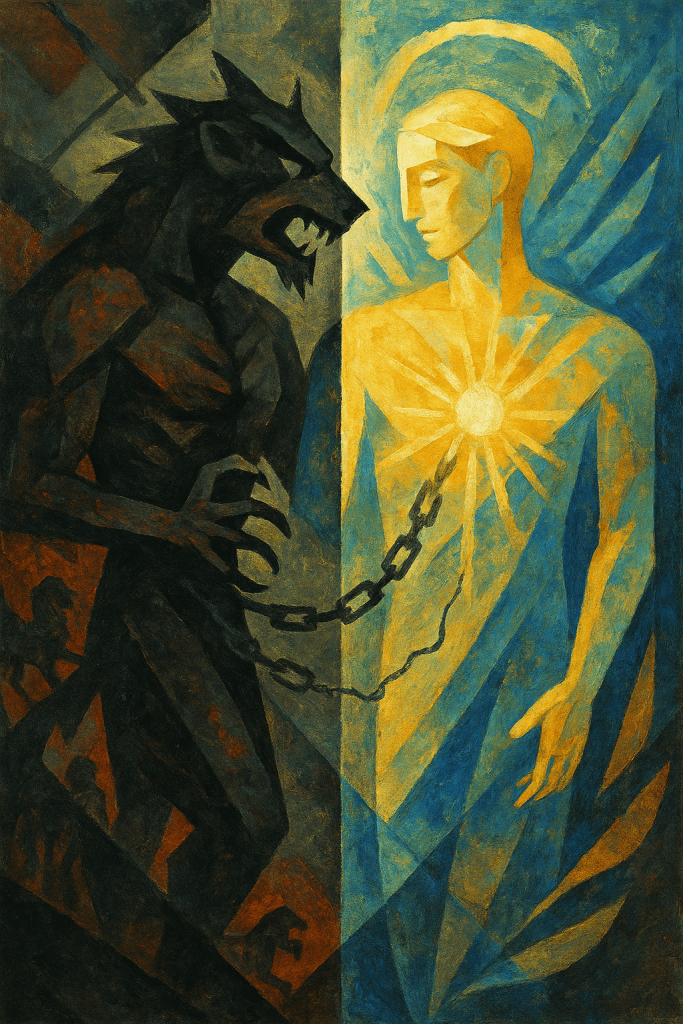
Its anatomy always reveals the same: absence, distortion, parasitism. It lives off what it consumes and dies when it finds nothing to devour. It is the shadow of love, its darkest caricature. In the end, hatred is death.
I have also thought of what Scripture says about hardened hearts. When hatred appears, the first thing to break is the capacity to feel and to open up: the heart turns to stone. But on the cross, the blood of God was not shed in vain. There, in that paradox, death was overcome.
It is a mystery I cannot fully decipher, but one that sustains me: that in the place where absolute hatred was expressed—in violence, in injustice, in contempt—absolute love was also revealed. And if, as the Gospel of John says, “God is love” (Jn 5), then this is not metaphor nor empty consolation, but the affirmation that even when everything seems dominated by the shadow of hatred, love remains the root and the final word.
Anatomía del odio
En este mismo momento, mientras escribo estas palabras, el odio se expresa en el mundo con tal fuerza que me obliga a preguntarme si el amor realmente tendrá la última palabra. Señor, ¿por qué fuiste a la cruz, si hoy la misma multitud crucificaría de nuevo a un hombre sin error ni culpa? Nada parece haber cambiado, a pesar de la revelación.
He buscado respuestas. En la homilía del domingo pasado, el sacerdote de mi parroquia habló del misterio de la cruz y del sacrificio del Hijo de Dios. Reconoció que él mismo no tenía muchas respuestas, pero sí una contundente: es un misterio. La encarnación, la pasión, la muerte y la resurrección no son símbolos vacíos, sino la clave que nos queda: levantar la serpiente de Moisés para evitar las picaduras, abrazar la cruz para alcanzar la redención.
El odio tiene rostro. Puede dibujarse en la literatura —en Yago, en Macbeth—, en la historia de las revueltas y revoluciones, en los tiranos crueles que dejaron tras de sí campos de exterminio y salas de tortura. El odio encarna en rostros individuales y colectivos, pero detrás de todas sus máscaras, su anatomía responde siempre a la misma lógica.
El odio, como el amor, nace de emociones extremas que comprometen los sentidos. Puede ser ardiente o glacial, pasional o frío; cambia de tono, pero no de intensidad. Nadie ama con indiferencia, mientras que el odio arrastra una indiferencia radical: niega el bien y rechaza la dignidad del otro. Se odia lo que se desprecia, lo que se teme, lo que amenaza con arrebatarnos algo propio. Nunca con el coraje de dar, siempre con la cobardía de arrebatar.
Puede permanecer en estado latente, como un tumor silencioso que espera un disparador para manifestarse. Se oculta, pero nunca del todo: se filtra en la mirada, en la palabra, en el gesto. Se odia por mímesis, cuando el otro refleja lo que no tolero en mí mismo; por complejo y resentimiento, cuando una herida interior se desborda hacia afuera. Y porque es propagable e inflamable, basta un rumor o una consigna para que incendie a la tribu y transforme el miedo en violencia colectiva.
He leído en Jacques Maritain que el odio se multiplica cuando instrumentalizamos al otro, cuando lo reducimos a medio y no a fin. Allí donde debería haber caridad política y bien común, se fabrican enemigos. El odio pervierte la política: en nombre de un supuesto bien común se erigen muros que dividen.
Edith Stein me enseñó que el odio es el fracaso radical de la empatía. El ser humano está hecho para abrirse al otro y reconocerlo como interioridad semejante. Cuando esa orientación se quiebra, el odio se instala como parásito del espíritu: consume energía vital, pero no produce nada propio. Es un amor invertido, una pasión torcida, intensidad sin apertura, deseo vuelto negación.
En Simone Weil comprendí que el odio se parece a la gravedad. El alma necesita justicia, verdad y sentido con la misma urgencia que el pan y el agua. Cuando estas necesidades se niegan, la fuerza ocupa el lugar del bien y el espíritu se precipita hacia abajo. El odio es peso que arrastra, desarraigo que rompe la atención y sustituye la gracia por violencia.
Con René Girard descubrí que se odia lo semejante, lo demasiado parecido. Lo que me revela en el otro lo que no quiero ver en mí mismo. El deseo mimético alimenta rivalidades que desembocan en violencia, y la tribu, para conjurar su miedo, descarga la tensión sobre un enemigo común, un chivo expiatorio. Así el odio se convierte en mecanismo colectivo, legitimado por la falsa paz que sigue al sacrificio.
He visto que el odio transa, cambia de rostro, negocia. Nunca da: arrebata, priva. Puede incubarse en la soledad o desbordarse en la multitud. Siempre busca un aval moral: se disfraza de bien común, pero excluye; se disfraza de identidad tribal, pero se afirma negando al extranjero. Es hábil en su justificación: adopta ropajes de virtud, pero solo erosiona.
Su anatomía revela siempre lo mismo: ausencia, distorsión, parasitismo. Vive de lo que consume y muere cuando no encuentra a quién devorar. Es la sombra del amor, su caricatura oscura. En última instancia, el odio es muerte.
He pensado también en lo que dicen las Escrituras sobre los corazones endurecidos. Cuando el odio aparece, lo primero que se rompe es la capacidad de sentir y de abrirse: el corazón se vuelve piedra. Pero en la cruz, la sangre de Dios no se derramó en vano. Allí, en esa paradoja, la muerte fue vencida.
Es un misterio que no sé descifrar del todo, pero que me sostiene: que en el lugar donde se expresó el odio absoluto —la violencia, la injusticia, el desprecio— también se manifestó el amor absoluto. Y si, como afirma el evangelio de Juan, “Dios es amor” (Jn 5), entonces incluso cuando todo parece dominado por la sombra del odio, el amor permanece como raíz y última palabra.
The Eternal as Rebellion: Gen Z, Alpha, and the Return to the Sacred
Español
El siglo XXI avanza con una particularidad: la transición generacional se produce bajo el signo de las plataformas digitales. La manera en que los jóvenes se definen, debaten y se agrupan ya no pasa por instituciones tradicionales, sino por redes donde conviven símbolos, discursos y comunidades dispersas. La Generación Z, que hoy tiene entre 13 y 28 años, y la emergente Generación Alpha, que apenas comienza a configurarse como sujeto colectivo, crecen bajo un escenario de saturación informativa, polarización política y crisis de sentido. En contraste, los millennials —quienes dominaron la narrativa cultural desde inicios de los 2000— comienzan a mostrar los límites de su modelo progresista, individualista y materialista. Una de las señales más claras de este agotamiento se refleja en la baja natalidad: los millennials liberales tienden a evitar la formación de familias y a postergar, o incluso renunciar, a tener hijos, mientras que sus pares conservadores han mantenido tasas de natalidad más altas1.
Es en este cruce entre biografía, demografía y cultura digital donde se abre un espacio para pensar si el futuro inmediato no podría estar marcado por un reflujo progresista y una revalorización de los valores tradicionales, entendidos no como una restauración mecánica del pasado, sino como un redescubrimiento de aquellas fuentes de sentido que otorgan estabilidad: la familia, la religión, la comunidad, la trascendencia. Paradójicamente, lo que antes se percibía como ortodoxo o incluso como conformista —ser católico, profesar una fe, buscar en lo eterno un horizonte— comienza a adquirir un aura de rebeldía. Para muchos jóvenes de la Generación Z, asistir a la misa en latín, orar en silencio o proclamar una vida antimaterialista es hoy un gesto contracultural frente a una sociedad entregada a la banalidad del consumo y la aceleración tecnológica. En una época que se pretende emancipadora, el regreso a lo sagrado aparece como la verdadera disidencia.
En Estados Unidos, este contraste se refleja con nitidez. De acuerdo con el U.S. Census Bureau (2024), la tasa de natalidad de los millennials progresistas es un 20% inferior a la de los conservadores de su misma cohorte, con sólo el 30% de los progresistas entre 29 y 44 años teniendo hijos, frente al 50% de los conservadores2. Esta diferencia, aunque pueda parecer pequeña, tiene implicaciones profundas: en la medida en que los progresistas priorizan el estilo de vida individual, son los conservadores quienes están criando a la Generación Alpha. La Generación Z, por su parte, ha sorprendido a analistas al mostrar una inclinación hacia prácticas religiosas que sus padres dieron por superadas. El interés por la misa en latín entre los jóvenes católicos es uno de los ejemplos más llamativos: según Barna Group (2024), un 20% de los católicos de esta generación ha asistido a parroquias tradicionales, frente a apenas un 10% de los millennials en su momento3. No es sólo una preferencia litúrgica: es un modo de afirmar una identidad en un entorno que considera la fe como algo superfluo.
Las plataformas digitales, lejos de ser neutrales, funcionan como vitrinas simbólicas de este pulso. X, con la “X” negra que Elon Musk impuso como logotipo, se ha convertido en un espacio de resistencia frente a la censura y el control algorítmico. En paralelo, Bluesky, con su mariposa azul, es percibido como refugio progresista, aunque con alcance limitado. En YouTube y Spotify proliferan canales y podcasts de corte católico o filosófico —Sensus Fidelium, Pints with Aquinas, Word on Fire— que alcanzan millones de visualizaciones. Y en Substack, escritores de nicho conservador encuentran un hogar para pensar y discutir sin las restricciones de la corrección política. Que lo católico, lo cristiano, lo trascendente aparezca con fuerza en estas plataformas —donde lo banal y lo efímero parecen gobernar— revela que la contracultura de nuestro tiempo no lleva crestas ni consignas, sino sotanas, rosarios y textos antiguos.
En Europa Occidental, el proceso de secularización parece consolidado, con tasas de natalidad en mínimos históricos y religiosidad institucional débil. Sin embargo, emergen resistencias: jóvenes que peregrinan a Chartres, comunidades que redescubren la liturgia tradicional, minorías que, en medio de una sociedad escéptica, se aferran a la fe como una forma de identidad. Su marginalidad, lejos de debilitarlos, les da un brillo de autenticidad. En Polonia y Hungría, la religiosidad ha recuperado un peso político y social inesperado, mientras que en Rusia y Rumanía la Iglesia Ortodoxa se afianza como pilar identitario4.
América Latina, por su parte, mantiene un cristianismo masivo y dinámico, dividido entre catolicismo y evangelismo, pero coincidente en su énfasis en la familia y la comunidad. África, con su demografía desbordante y su religiosidad vibrante, se perfila como el gran protagonista del futuro: allí donde se concentra la vida, la fe no es un residuo del pasado, sino un motor de cohesión5. En Asia, la pluralidad es extrema: Japón y Corea del Sur encarnan la secularización, pero la India, Filipinas y la China rural conservan tradiciones que siguen marcando a millones.
Si se observan en conjunto, estos procesos sugieren un patrón: allí donde el progresismo cultural parece triunfar, también se desgasta en la baja natalidad, en la pérdida de cohesión, en la desorientación existencial. Y allí donde la tradición parecía declinar, resurgen signos de vitalidad: jóvenes que buscan liturgias antiguas, comunidades que se fortalecen en medio de la crisis, religiosidades vibrantes en continentes demográficamente centrales. No se trata de anunciar un destino inevitable, pero sí de reconocer que, en un mundo saturado de promesas de libertad sin arraigo, lo verdaderamente contracultural parece ser volver a lo esencial: la familia, la fe, la trascendencia. Quizá el siglo XXI, lejos de ser la era de la secularización definitiva, sea el tiempo en que el alma humana, cansada del vértigo, se atreva a regresar a lo que nunca dejó de anhelar.
English
The twenty-first century advances with a peculiarity: generational transition takes place under the sign of digital platforms. The ways in which young people define themselves, debate, and gather no longer pass through traditional institutions but through networks where symbols, discourses, and scattered communities coexist. Generation Z, now between 13 and 28 years old, and the emerging Generation Alpha, just beginning to take shape as a collective subject, grow up in a context of information saturation, political polarization, and crisis of meaning. By contrast, millennials—who dominated cultural narratives since the early 2000s—are beginning to reveal the limits of their progressive, individualist, and materialist model. One of the clearest signs of this exhaustion is reflected in low birth rates: liberal millennials tend to avoid family formation and to postpone, or even renounce, having children, while their conservative peers have maintained higher fertility rates1.
It is at this intersection of biography, demography, and digital culture that one can consider whether the near future may be marked by a progressive ebb and a revaluation of traditional values, understood not as a mechanical restoration of the past but as a rediscovery of those sources of meaning that offer stability: family, religion, community, transcendence. Paradoxically, what was once perceived as orthodox or even conformist—being Catholic, professing faith, seeking in the eternal a horizon—now acquires an aura of rebellion. For many young people of Generation Z, attending the Latin Mass, praying in silence, or proclaiming an anti-materialist life is today a countercultural gesture in a society surrendered to the banality of consumption and technological acceleration. In an age that prides itself on emancipation, the return to the sacred appears as the true dissent.
In the United States, this contrast is clear. According to the U.S. Census Bureau (2024), the fertility rate of progressive millennials is 20% lower than that of conservatives in the same cohort, with only 30% of progressives aged 29 to 44 having children, compared to 50% of conservatives2. This difference, though seemingly small, has profound implications: as progressives prioritize individual lifestyles, conservatives are the ones raising Generation Alpha. Generation Z, for its part, has surprised analysts by showing an inclination toward religious practices their parents considered outdated. Interest in the Latin Mass among young Catholics is striking: according to Barna Group (2024), 20% of Catholic Gen Zers have attended traditional parishes, compared to just 10% of millennials at their age3. This is not merely a liturgical preference: it is a way of affirming identity in an environment that treats faith as superfluous.
Digital platforms, far from neutral, serve as symbolic showcases of this cultural pulse. X, with the black “X” imposed by Elon Musk as logo, has become a space of resistance to censorship and algorithmic control. By contrast, Bluesky, with its blue butterfly, is perceived as a progressive refuge, though with limited reach. YouTube and Spotify host countless Catholic or philosophical channels and podcasts—Sensus Fidelium, Pints with Aquinas, Word on Fire—that reach millions. And on Substack, conservative niche writers find a home to think and debate without the constraints of political correctness. That Catholicism, Christianity, and transcendence should appear so strongly in these platforms—where banality and ephemerality seem to reign—reveals that the counterculture of our time wears no mohawks or slogans, but cassocks, rosaries, and ancient texts.
In Western Europe, secularization appears consolidated, with fertility rates at historic lows and institutional religiosity weakened. Yet resistance emerges: young pilgrims walking to Chartres, communities rediscovering traditional liturgy, minorities that, amid skeptical societies, cling to faith as a form of identity. Their marginality, far from weakening them, lends them an aura of authenticity. In Poland and Hungary, religiosity has regained unexpected political and social weight, while in Russia and Romania the Orthodox Church consolidates itself as an identity pillar4.
Latin America, meanwhile, maintains a massive and dynamic Christianity, divided between Catholicism and Evangelicalism but converging in its emphasis on family and community. Africa, with its overflowing demography and vibrant religiosity, stands as the great protagonist of the future: where life abounds, faith is not a residue of the past but a motor of cohesion5. In Asia, plurality is extreme: Japan and South Korea embody radical secularization, while India, the Philippines, and rural China retain traditions that continue to mark millions.
Viewed together, these processes suggest a pattern: where progressive culture seems triumphant, it also suffers wear—low fertility, loss of cohesion, existential disorientation. And where tradition seemed in decline, signs of vitality reappear: young people seeking ancient liturgies, communities strengthening amid crisis, vibrant religiosity in demographically central continents. This is not to proclaim an inevitable return of traditional values, but to recognize that in a world saturated with promises of rootless freedom, the truly countercultural act may be to return to the essential: family, faith, transcendence. Perhaps the twenty-first century, far from being the age of definitive secularization, will be the time when the human soul, weary of vertigo, dares to return to what it never ceased to long for.
Notes
Footnotes
Pew Research Center, “Religion and Family in America,” 2023. ↩↩2
U.S. Census Bureau, Fertility by Demographic Groups, 2024. ↩↩2
No cabe duda: el ser humano comparte con los animales su naturaleza gregaria. Como muchos otros, vive en manada, protege a su grupo, establece jerarquías y sanciona a quienes rompen el orden. Basta observar lobos, elefantes o primates superiores: la manada impone una disciplina que garantiza la supervivencia colectiva. Y cuando alguien desafía esa jerarquía, suele ser castigado por el líder, restableciendo así el equilibrio. Podríamos incluso hablar de “organizaciones tribales” en el reino animal.
Pero en los animales, el castigo termina allí. Nunca aparece, después del acto, el remordimiento. Ningún lobo se atormenta por haber mordido a su rival, ningún león se arrepiente de haber devorado a la cría de una manada enemiga. El remordimiento, esa punzada íntima que pesa sobre la conciencia, no entra en el cálculo de la evolución biológica. Desde el punto de vista de la caza y la supervivencia, el remordimiento es incluso una desventaja: debilita al cazador, lo hace vacilar, lo vuelve menos apto frente al instinto.
Y sin embargo, el hombre siente remordimiento. No sólo por quitar la vida dentro de su grupo, sino también por herir o matar a un extraño, incluso de otra especie. Ninguna ley evolutiva explica este dolor del alma. Es algo más: un signo de interioridad. Edith Stein lo llamó la capacidad de autoposesión y autotrascendencia del espíritu humano1.
Lo mismo ocurre con el heroísmo. En la naturaleza, el más débil queda atrás: la manada sigue adelante, porque detenerse pondría en peligro la supervivencia de todos. Pero el ser humano es el único que se devuelve, arriesga su vida, enfrenta al enemigo y protege al herido. Ese gesto heroico no se explica por el instinto: responde a una ley más alta, inscrita en el corazón.
La rivalidad y la mímesis, que René Girard estudió como núcleo de la condición humana, también se observan en el mundo animal. Los machos compiten por el territorio, por la hembra, por la primacía, y la imitación del deseo genera choques inevitables. Incluso el mecanismo del chivo expiatorio —el sacrificio de un individuo que momentáneamente restaura la paz del grupo— aparece, de manera más elemental, en algunas especies2. Pero en el hombre, estos impulsos toman una forma cualitativamente distinta: se transforman en violencia ritual, en linchamiento colectivo, en sacrificios humanos y divinos.
¿Dónde se rompe este ciclo? Según Girard, sólo en Cristo3. El Hijo de Dios, el inocente sin pecado, acepta ser el chivo expiatorio universal, pero al resucitar revela la falsedad de la violencia sacrificial. En Él, el ciclo de la mímesis y de la rivalidad encuentra su fin: ya no hay víctima que sostenga la paz a costa de la sangre, sino un reino donde “los sordos oyen, los ciegos ven, los cojos caminan y los muertos se levantan” (cf. Mt 11,5). Cristo, que es todo bondad y todo amor, inaugura un camino distinto: la comunión no fundada en el sacrificio de otro, sino en el don de sí mismo para redimir a todos.
El hombre, claro, sigue siendo un animal cruel. Su historia está marcada por violencia, dominio y venganza. Pero a diferencia de otros animales, su alma nunca lo deja en paz. Esa alma —creada a imagen y semejanza de Dios4— lleva en sí misma la bondad y la verdad. Y por eso el hombre vive en conflicto: entre los impulsos de la carne y la voz de su conciencia, entre la brutalidad del instinto y la llamada a la eternidad.
Aristóteles lo intuyó cuando dijo que el hombre es zoón logikón, el animal racional5. Tomás de Aquino lo desarrolló al afirmar que el hombre es capaz de Dios (capax Dei), precisamente porque posee un alma espiritual6. Heidegger, desde otro horizonte, reconoció que somos el ser que se pregunta por el Ser mismo7. Y Charles Taylor, más recientemente, subrayó que el hombre no sólo actúa, sino que se interpreta a sí mismo8.
En todos ellos, desde la filosofía antigua hasta el pensamiento contemporáneo, resuena la misma intuición: lo que nos separa del resto de los animales no es la manada, ni la jerarquía, ni el instinto de supervivencia. Es el alma. Un alma que, al buscar la verdad y el bien, se convierte en el escenario de un conflicto interminable. Y quizá allí, en ese conflicto, resida la verdadera dignidad del hombre y su trascendencia hacia una forma superior de vida que no está limitada por el espacio ni por el tiempo, sino que es eterna porque es plena, como lo prometió Cristo: agua viva que nunca se agota (cf. Jn 4,14).
English
There is no doubt: the human being shares with animals its gregarious nature. Like many others, he lives in a herd, protects his group, establishes hierarchies, and sanctions those who break the order. One only needs to observe wolves, elephants, or higher primates: the herd imposes a discipline that guarantees collective survival. And when someone challenges that hierarchy, he is usually punished by the leader, thus restoring balance. We could even speak of “tribal organizations” in the animal kingdom.
But in animals, punishment ends there. Remorse never appears after the act. No wolf torments itself for biting a rival, no lion regrets devouring the offspring of an enemy herd. Remorse, that intimate pang weighing on conscience, does not enter into the calculation of biological evolution. From the perspective of hunting and survival, remorse is even a disadvantage: it weakens the hunter, makes him hesitate, renders him less fit against instinct.
And yet, man feels remorse. Not only for taking life within his group, but also for harming or killing a stranger, even of another species. No evolutionary law explains this pain of the soul. It is something more: a sign of interiority. Edith Stein called it the capacity for self-possession and self-transcendence of the human spirit1.
The same is true of heroism. In nature, the weakest are left behind: the herd moves on, for to stop would endanger the survival of all. But the human being is the only one who turns back, risks his life, confronts the enemy, and protects the wounded. That heroic gesture cannot be explained by instinct: it responds to a higher law inscribed in the heart.
Rivalry and mimesis, which René Girard studied as central to the human condition, are also observed in the animal world. Males compete for territory, for the female, for primacy, and the imitation of desire generates inevitable clashes. Even the scapegoat mechanism—the sacrifice of an individual that momentarily restores the peace of the group—appears, in a more elementary form, in some species2. But in man, these impulses take a qualitatively different form: they become ritual violence, collective lynching, human and divine sacrifices.
Where is this cycle broken? According to Girard, only in Christ3. The Son of God, the innocent without sin, accepts being the universal scapegoat, but in rising again reveals the falsehood of sacrificial violence. In Him, the cycle of mimesis and rivalry meets its end: there is no longer a victim to sustain peace through blood, but a kingdom where “the deaf hear, the blind see, the lame walk, and the dead are raised” (cf. Mt 11:5). Christ, who is all goodness and all love, inaugurates a different way: communion not founded on the sacrifice of another, but on the gift of Himself to redeem all.
Man, of course, remains a cruel animal. His history is marked by violence, domination, and vengeance. But unlike other animals, his soul never leaves him in peace. That soul—created in the image and likeness of God4—carries within itself both goodness and truth. And that is why man lives in conflict: between the impulses of the flesh and the voice of his conscience, between the brutality of instinct and the call to eternity.
Aristotle intuited it when he said that man is zoón logikón, the rational animal5. Thomas Aquinas developed it by affirming that man is capable of God (capax Dei), precisely because he possesses a spiritual soul6. Heidegger, from another horizon, recognized that we are the being who asks about Being itself7. And Charles Taylor, more recently, underlined that man not only acts, but interprets himself8.
In all of them, from ancient philosophy to contemporary thought, the same intuition resounds: what separates us from the rest of the animals is not the herd, nor hierarchy, nor the instinct for survival. It is the soul. A soul that, in seeking truth and goodness, becomes the stage of an unending conflict. And perhaps there, in that conflict, lies the true dignity of man and his transcendence toward a higher form of life that is not bound by space or time, but is eternal because it is full, as Christ promised: living water that never runs dry (cf. Jn 4:14).
Notes
Footnotes
Edith Stein, Endliches und ewiges Sein (Ser finito y ser eterno / Finite and Eternal Being), 1936. ↩↩2
René Girard, La violencia y lo sagrado (Violence and the Sacred), 1972. ↩↩2
René Girard, Yo veía a Satanás caer como el relámpago (I Saw Satan Fall Like Lightning), 1999. ↩↩2
A Elisa, como una invitación a leer las Escrituras desde su centro.
La Escritura no es una colección dispersa de relatos antiguos ni un archivo de sabiduría arcaica, sino una historia unificada: la historia de la salvación. El Antiguo Testamento prepara, el Nuevo Testamento cumple. Pero la clave hermenéutica que da sentido a todo es Cristo. Sólo a través de Él podemos comprender la creación, la Ley, los profetas y la esperanza de Israel.
Jesús mismo lo revela en el camino de Emaús: “Y comenzando por Moisés y por todos los profetas, les explicó lo que se decía de Él en todas las Escrituras” (Lc 24,27). Todo el Antiguo Testamento es anuncio, sombra y figura; en Cristo se convierte en realidad. Los estudiosos de la Biblia han mostrado con abundancia esta unidad: cientos de referencias cruzadas vinculan los dos Testamentos, y todas convergen en el misterio de Cristo. Cada promesa, cada figura, cada profecía se cumple en Él.
En el Génesis, el hombre aparece creado a imagen y semejanza de Dios, imagen herida por el pecado pero no borrada. La historia entera de Israel es la historia de una alianza: un Dios que llama y un pueblo que responde, unas veces con fidelidad y otras con infidelidad. El propósito original era caminar en comunión con Dios, pero esa comunión alcanza su plenitud sólo en Cristo, el Hijo amado, que revela que nuestro destino no es simplemente obedecer una ley, sino llegar a ser hijos en el Hijo: “A todos los que lo recibieron les dio poder de ser hijos de Dios” (Jn 1,12).
La Ley fue dada como guía, como pedagogo, pero por sí sola no podía dar vida. Cristo, en el evangelio de Juan, abre el horizonte definitivo: “Yo he venido para que tengan vida, y la tengan en abundancia” (Jn 10,10). La verdadera vida no se mide en años ni en posesiones, sino en la comunión con el Padre por medio del Hijo. La existencia humana queda transfigurada: ya no es mera supervivencia ni búsqueda de glorias pasajeras, sino vocación a la eternidad, permaneciendo en Cristo como el sarmiento en la vid.
Israel fue el pueblo elegido, portador de las promesas; en Cristo esas promesas se abren a todas las naciones. La Iglesia nace de su costado traspasado, como la nueva Eva del nuevo Adán. Allí se proclama la Palabra, los sacramentos comunican la vida divina, y la caridad hace visible al Dios que es Amor. La Iglesia no es un añadido a la revelación, sino la forma histórica en la que el misterio de Cristo se prolonga y se comparte.
El Antiguo Testamento, leído a esta luz, incluye también la voz de los Salmos, donde Cristo mismo ora con las palabras de su pueblo. En la cruz hace suyo el grito del Salmo 22: “Dios mío, Dios mío, ¿por qué me has abandonado?”. Lo que en el Salterio era súplica y promesa, en Él se convierte en cumplimiento. La Iglesia reza los Salmos no como piezas del pasado, sino como oración viva de Cristo que asume la voz de todos.
En los libros de Jueces, Samuel y Reyes se percibe la sed de liberación y de un reino. Los jueces levantados por Dios dan respiro, pero sus victorias son parciales y pasajeras; sólo en Cristo aparece el juez definitivo cuya justicia no falla. En los Reyes vemos la expectativa de un reino: Saúl, David, Salomón… hombres grandes, pero frágiles, que no cumplieron las promesas. Su fracaso apunta al verdadero Rey, el Hijo de David, que reinará para siempre no con la espada ni con riquezas, sino con la entrega de su vida. Los evangelios presentan a Jesús como ese Mesías esperado, que inaugura un reino que no es de este mundo.
En el Deuteronomio, Moisés anuncia que Dios suscitará un profeta como él. Los evangelios muestran que esa profecía se cumple en Cristo, el nuevo Moisés que entrega la Ley definitiva, no escrita en piedra sino en los corazones. Allí donde Moisés intercedió y renovó la alianza, Cristo sella con su propia sangre una alianza eterna. La obediencia que el Deuteronomio pedía para alcanzar la bendición encuentra en Cristo su plenitud: Él cumple la Ley y en Él la maldición del pecado queda rota.
El Evangelio revela a Dios, que ya se había manifestado en el Antiguo Testamento, pero ahora de manera concreta y definitiva. En Cristo, ese Dios que antes hablaba en promesas y figuras se muestra con rostro humano, con una voz que llama por nuestro nombre, con una vida derramada en amor. Él mismo dice: “Yo soy el camino, la verdad y la vida; nadie va al Padre sino por mí” (Jn 14,6). Y también: “El Padre y yo somos uno” (Jn 10,30), “Yo estoy en el Padre y el Padre en mí” (Jn 14,10), mostrando la íntima comunión a la que somos invitados. Él no sólo anuncia, sino que señala con claridad hacia dónde debemos ir: es la luz que vence a las tinieblas, la verdad que nos libera, la vida que no acaba. Y nos entrega la clave de esa comunión que anticipa la eternidad: “El que coma de este pan vivirá para siempre” (Jn 6,51). En la Eucaristía nos deja la prenda de la vida eterna, el anticipo de la gloria, la certeza de que en Él todo se cumple.
Después vienen las cartas apostólicas, especialmente las de Pablo, que amplían aún más el horizonte. En la primera carta a los Corintios, Pablo habla del misterio del cuerpo resucitado: “Se siembra en corrupción, resucita en incorrupción; se siembra en ignominia, resucita en gloria; se siembra en debilidad, resucita en poder; se siembra un cuerpo natural, resucita un cuerpo espiritual” (1 Co 15,42-44). El Apóstol recuerda que lo que ahora vemos es apenas semilla de lo que será plenitud. También habla del “tercer cielo”, de lo que “nadie vio ni oyó, ni vino a la mente del hombre” (2 Co 12,2-4; 1 Co 2,9), mostrando que la gloria futura supera toda imaginación. Pero Pablo no limita todo al futuro: afirma que ya ahora estamos llamados a dejar que “Cristo viva en nosotros” (Ga 2,20), de modo que en la debilidad se manifieste la fuerza de Dios, porque “cuando soy débil, entonces soy fuerte” (2 Co 12,10).
Pablo transmite además lo que se considera el primer credo cristiano, también en su primera carta a los Corintios: “Que Cristo murió por nuestros pecados, según las Escrituras; que fue sepultado y que resucitó al tercer día, según las Escrituras; y que se apareció a Cefas y luego a los Doce” (1 Co 15,3-5). Aquí se condensa el núcleo de la fe: la muerte y resurrección de Cristo como centro y sentido de la historia. Y en ese mismo espíritu Pablo compone su himno al amor: “El amor es paciente, es bondadoso… todo lo cree, todo lo espera, todo lo soporta. El amor no pasa nunca” (1 Co 13,4-8). Así confirma la gran revelación de Juan: “Dios es amor” (1 Jn 4,8). Lo que Cristo revela con su vida y entrega, los apóstoles lo proclaman como esencia misma de Dios y camino del hombre.
Finalmente, el Apocalipsis abre la visión del cumplimiento último: Cristo es el Alfa y la Omega, el principio y el fin, el que era, el que es y el que ha de venir (Ap 1,8). En Él se cierra el arco de la revelación, y en Él la humanidad alcanza su destino definitivo: la comunión plena con Dios en el cielo nuevo y la tierra nueva, donde no habrá más llanto ni muerte, porque todo habrá sido hecho nuevo.
Christ-Centered Reading of Scripture
To Elisa, as an invitation to read Scripture from its center.
Scripture is not a scattered collection of ancient stories or an archive of archaic wisdom, but a unified history: the history of salvation. The Old Testament prepares, the New Testament fulfills. But the hermeneutical key that gives meaning to it all is Christ. Only through Him can we understand creation, the law, the prophets, and the hope of Israel.
Jesus Himself reveals this on the road to Emmaus: “Beginning with Moses and all the Prophets, He explained to them what was said in all the Scriptures concerning Himself” (Lk 24:27). The entire Old Testament is announcement, shadow, and figure; in Christ it becomes reality. Biblical scholars have shown just how profound this unity is: hundreds of cross-references link the two Testaments, and all converge on the mystery of Christ. Every promise, every figure, every prophecy is fulfilled in Him.
In Genesis, man appears created in the image and likeness of God, an image wounded by sin but not erased. The entire history of Israel is the story of a covenant: a God who calls, and a people who respond, sometimes in fidelity, other times in infidelity. The original purpose was to walk in communion with God, but that communion reaches its fullness only in Christ, the beloved Son, who reveals that our destiny is not merely to obey a law, but to become children in the Son: “To all who received Him, He gave the power to become children of God” (Jn 1:12).
The Law was given as a guide, as a pedagogue, but on its own it could not give life. Christ, in the Gospel of John, opens the definitive horizon: “I came that they may have life, and have it abundantly” (Jn 10:10). True life is not measured in years or possessions, but in communion with the Father through the Son. Human existence is transfigured: no longer mere survival or pursuit of fleeting glory, but a vocation to eternity, abiding in Christ like the branch in the vine.
Israel was the chosen people, bearer of the promises; in Christ those promises are opened to all nations. The Church is born from His pierced side, as the new Eve from the new Adam. There the Word is proclaimed, the sacraments communicate divine life, and charity makes visible the God who is Love. The Church is not an addition to revelation, but the historical form in which the mystery of Christ is prolonged and shared.
The Old Testament, read in this light, also includes the voice of the Psalms, where Christ Himself prays in the words of His people. On the cross He makes His own the cry of Psalm 22: “My God, my God, why have you forsaken me?” What was once supplication and promise becomes fulfillment in Him. The Church prays the Psalms not as relics of the past but as the living prayer of Christ who gives voice to all.
In the books of Judges, Samuel, and Kings we see Israel’s yearning for deliverance and for a king. The judges rise and fall, delivering their people only temporarily; in Christ appears the final Judge, whose justice never fails. Saul, David, and Solomon show both greatness and failure, pointing beyond themselves to the true King, the Son of David, whose reign is not of this world. Jesus is proclaimed as that Messiah, inaugurating a kingdom of life, justice, and peace that no sword can overthrow.
In Deuteronomy, Moses promises that God will raise up a prophet like him. The Gospels present Jesus as the fulfillment of that prophecy, the new Moses who delivers the definitive Law—not on tablets of stone, but written on hearts. Where Moses interceded for the people and renewed the covenant, Christ offers His own blood as the seal of an eternal covenant. The blessings and curses that marked the old covenant find their fulfillment in Him: He fulfills the Law, and in Him the curse of sin is broken forever.
The Gospel reveals God, who had already manifested Himself in the Old Testament, but now in a concrete and definitive way. In Christ, that God who once spoke in promises and figures now shows Himself with a human face, with a voice that calls us by name, with a life poured out in love. He Himself says: “I am the way, the truth, and the life; no one comes to the Father except through me” (Jn 14:6). And He also declares: “The Father and I are one” (Jn 10:30), “I am in the Father and the Father is in me” (Jn 14:10), showing the intimate communion into which we are invited. He is not only the One who announces, but the One who clearly points out where we must go: He is the light that conquers darkness, the truth that sets us free, and the life that never ends. And He gives us the key to that communion which anticipates eternity: “Whoever eats this bread will live forever” (Jn 6:51). In the Eucharist He leaves us the pledge of eternal life, the foretaste of glory, the certainty that in Him every purpose is fulfilled.
Then come the apostolic letters, especially those of Paul, which open the horizon even further. In his first letter to the Corinthians, he speaks of the mystery of the resurrected body: “It is sown in corruption, it is raised in incorruption; it is sown in dishonor, it is raised in glory; it is sown in weakness, it is raised in power; it is sown a natural body, it is raised a spiritual body” (1 Cor 15:42–44). Here the Apostle reminds us that what we see now is only the seed of what will be fullness. He also speaks of the “third heaven,” of that which “no eye has seen, no ear has heard, nor has it entered into the human heart” (2 Cor 12:2–4; 1 Cor 2:9), indicating that future glory surpasses all imagination. Yet Paul does not limit himself to the future: he affirms that even now we are called to let “Christ live in us” (Gal 2:20), so that in our weakness the power of God may be revealed, for “when I am weak, then I am strong” (2 Cor 12:10).
Paul also hands on what is considered the first Christian creed, again in his first letter to the Corinthians: “That Christ died for our sins according to the Scriptures, that He was buried, that He was raised on the third day according to the Scriptures, and that He appeared to Cephas, and then to the Twelve” (1 Cor 15:3–5). Here the core of faith is condensed: the death and resurrection of Christ as the center and meaning of history. And in that same spirit Paul writes his hymn to love: “Love is patient, love is kind… it bears all things, believes all things, hopes all things, endures all things. Love never fails” (1 Cor 13:4–8). Thus he confirms the great revelation of John: “God is love” (1 Jn 4:8). What Christ reveals with His life and His self-giving, the apostles proclaim as the very essence of God and the path of man.
Finally, the Book of Revelation opens the vision of ultimate fulfillment: Christ is the Alpha and the Omega, the beginning and the end, the One who was, who is, and who is to come (Rev 1:8). In Him the arc of revelation is completed, and in Him humanity finds its ultimate destiny: full communion with God in the new heaven and the new earth, where every tear will be wiped away and death will have no power.
Nunca dijo que la Iglesia estaría libre del mal en cada uno de sus pasos, solo que el mal se alzaría… y que, al final, no prevalecería».*
Mitos sobre la Iglesia Católica: Entre la leyenda negra y la historia
Israel Centeno
Introducción
Pocas instituciones han sido objeto de tantas críticas, caricaturas y leyendas como la Iglesia Católica. Su peso en la historia de Occidente la convirtió en blanco de propaganda anticlerical durante el Renacimiento, la Reforma y la Ilustración, y más tarde del laicismo moderno. Por supuesto, la Iglesia ha cometido errores y pecados graves: nadie puede negarlos sin caer en una apologética ciega. Pero tampoco puede reducirse una institución de dos milenios a clichés de panfleto. La llamada leyenda negra —alimentada por los rivales de España, por el anticatolicismo protestante y por la propaganda ilustrada— ha fijado en la memoria popular imágenes que muchas veces no resisten el contraste con la historia real.
Este ensayo revisa algunos de los principales mitos: las Cruzadas, la Inquisición, Galileo, la acusación de idolatría, los papas corruptos, el Opus Dei, la pederastia, el Banco Ambrosiano, la supuesta oposición a la ciencia, la evangelización en América, la esclavitud y otros episodios. La intención no es justificar ni encubrir, sino separar la sombra de la caricatura y reconocer la luz donde se ha querido ocultar.
Las Cruzadas: entre defensa y mito
Mito: Las Cruzadas fueron guerras de fanáticos religiosos que invadieron tierras ajenas y asesinaron inocentes en nombre de la fe.
Realidad: Las Cruzadas surgen como respuesta a siglos de expansión islámica sobre territorios cristianos y a las amenazas contra los peregrinos en Tierra Santa. No fueron una “invasión sin causa”, sino un intento —imperfecto y cargado de intereses políticos— de recuperar los lugares santos y defender a los fieles orientales. Hubo excesos y episodios vergonzosos, como el saqueo de Constantinopla en la Cuarta Cruzada, pero reducir todo el movimiento a barbarie fanática es una simplificación nacida de la propaganda ilustrada y laicista.
Paradójicamente, mientras se exagera la violencia de las Cruzadas, se silencian episodios mucho más sangrientos ocurridos en países protestantes o laicos. En territorios calvinistas —Suiza, Escocia, Países Bajos, regiones de Alemania— las cacerías de brujas cobraron decenas de miles de vidas. Solo en el Sacro Imperio Germánico se calcula que unas 15.000 mujeres fueron ejecutadas por supuesta brujería. Inglaterra, tras la Reforma, vivió oleadas similares de persecución. Y en Francia, bajo el Terror revolucionario, la guillotina acabó con más vidas en unos pocos años que la Inquisición en siglos.
Así, el mito de las Cruzadas como “máxima expresión del fanatismo católico” oculta el contexto histórico que las originó e ignora violencias aún mayores desatadas en otras latitudes. La historia exige matices: ni glorificación ingenua ni caricatura propagandística.
La Inquisición: mito y propaganda
Lejos del mito popular, la Inquisición española no fue una orgía sangrienta que devoró millones de inocentes. La investigación histórica más seria muestra que, en tres siglos de actividad, las ejecuciones estuvieron entre tres y cinco mil: una cifra muy inferior a la “leyenda negra” difundida por los enemigos de la monarquía hispana. Y si se compara, el contraste es abrumador: en la Inglaterra de la Reforma, las cacerías de brujas se cobraron decenas de miles de vidas; en la Francia revolucionaria, la guillotina del Terror despachó a más de 16.000 personas en pocos años; y las revoluciones modernas, herederas de ese espíritu, multiplicaron el baño de sangre en nombre de la libertad y la igualdad.
En la propia España, no eran pocos los que preferían caer en manos de la Inquisición antes que en las cárceles del rey. El tribunal eclesiástico, con todos sus defectos, era más garantista que los procesos civiles: ofrecía defensa, abogados y apelaciones. La leyenda negra que se levantó contra el Santo Oficio se alimentó de la imprenta, nacida en países enemigos políticos y religiosos de España. Panfletos, grabados y libelos circularon por Europa mostrando supuestos tormentos que en realidad correspondían a prácticas seculares del norte, pero que se atribuían al tribunal español para desacreditarlo. Así se forjó una imagen monstruosa más de propaganda que de archivo.
Galileo y la ciencia
Otro mito recurrente acusa a la Iglesia de enemiga de la ciencia, de haber perseguido a Galileo por defender la verdad. La realidad es más matizada. Galileo era católico, amigo de cardenales, protegido por el papa Urbano VIII, y trabajaba en una institución que ya apoyaba la astronomía copernicana. El conflicto fue más político y personal que científico: Galileo insistió en presentar su modelo como verdad absoluta cuando aún no había pruebas concluyentes, y ridiculizó a su propio protector en un diálogo publicado. Fue condenado por desobediencia, no por hacer ciencia.
Esto no exonera a la Iglesia de su error, pero muestra que no se trató de una persecución sistemática contra el conocimiento. Prueba de ello es que la Iglesia fundó universidades, observatorios y academias científicas. Y hoy, lejos del mito, no existe un dogma “antievolucionista”: desde Pío XII hasta Juan Pablo II y Francisco, la teoría de la evolución se reconoce como compatible con la fe, siempre que se afirme que el alma humana es don divino.
Acusación de idolatría
Se acusa a los católicos de ser “idólatras”, adoradores de imágenes. La teología distingue entre latría (adoración solo a Dios), dulía (veneración a los santos) e hiperdulía (a la Virgen María). Las imágenes no son dioses, sino medios pedagógicos y devocionales. Ya el Antiguo Testamento contenía signos materiales: los querubines del Arca, la serpiente de bronce en el desierto. La iconoclasia protestante redujo esa riqueza simbólica a un rechazo absoluto, confundiendo símbolo con ídolo.
Papas corruptos y corrupción institucional
Es cierto que hubo papas corruptos: el “siglo oscuro” del X o los Borgia en el Renacimiento son ejemplos vergonzosos. Pero estos casos fueron excepcionales dentro de 266 pontífices que incluyen mártires, santos y reformadores. Lo sorprendente no es que haya habido papas corruptos, sino que, a pesar de ellos, la doctrina se haya mantenido intacta: el depósito de la fe sobrevivió a sus peores guardianes, cumpliéndose la promesa de Cristo.
Del mismo modo, instituciones eclesiales se corrompieron en épocas concretas, pero siempre surgieron santos y reformadores: Francisco de Asís, Teresa de Ávila, Catalina de Siena. La corrupción existe, pero también la santidad que florece en la misma Iglesia.
Escándalos modernos: pederastia y Banco Ambrosiano
Sería falso negar que la Iglesia ha vivido escándalos terribles. Los abusos sexuales cometidos por clérigos y las omisiones en su manejo son una herida abierta. Por décadas primó una cultura de silencio que pretendía proteger la institución a costa de las víctimas. Hoy la Iglesia reconoce ese pecado y ha adoptado políticas de tolerancia cero, ha expulsado sacerdotes culpables, creado protocolos de prevención y colaborado con la justicia. No es una batalla ganada, pero es un camino asumido.
En lo financiero, el caso del Banco Ambrosiano mostró la vulnerabilidad del Vaticano cuando se mezcla con intereses de poder y dinero. Fue un escándalo que impulsó reformas de transparencia, auditorías y control, aunque la mancha histórica quedó.
Estos pecados no son mitos, sino realidades dolorosas. Pero es falso hacer de ellos la esencia de la Iglesia. Ella misma ha demostrado capacidad de autocrítica y reforma, sin abandonar su misión espiritual.
El mito del Opus Dei
El Opus Dei ha sido presentado como “la mano siniestra” de la Iglesia: conspirativa, elitista, manipuladora. La realidad es más compleja. Hay exmiembros que denuncian abusos y secretismo, pero también fieles que lo viven como vocación seria de santificación en la vida ordinaria. Periodistas como John Allen Jr. han mostrado que gran parte de su mala fama proviene del sensacionalismo o de novelas como El Código Da Vinci. No es una secta fuera de control, sino una prelatura personal aprobada por la Iglesia, con luces y sombras como cualquier otra institución.
Evangelización en América
Se dice que la evangelización fue solo imposición y destrucción cultural. Pero junto a abusos reales, hubo una corriente de defensa y respeto. Antonio de Montesinos denunció la esclavitud en 1511; Bartolomé de las Casas dedicó su vida a los indígenas; Francisco de Vitoria elaboró el derecho de gentes reconociendo su dignidad.
Lejos de destruir lenguas, los misioneros escribieron gramáticas y catecismos en náhuatl, quechua, guaraní. La primera imprenta del continente imprimió en lenguas nativas. Las reducciones jesuíticas de Paraguay fueron comunidades autónomas donde el guaraní fue lengua oficial y florecieron la música y el arte. Hubo imposición, sí, pero también defensa, diálogo y protección.
La Iglesia y la esclavitud
Se afirma que la Iglesia apoyó la esclavitud desde el inicio. Pero ya a finales del siglo XV, el cardenal Cisneros aconsejó a los Reyes Católicos no permitirla. En 1537, Paulo III declaró en Sublimis Deus que los indios “son verdaderamente hombres” y no podían ser esclavizados. Los dominicos, jesuitas y teólogos de Salamanca denunciaron la esclavitud como contraria al derecho natural.
Al no hallar justificación en el Evangelio, los colonizadores recurrieron a Aristóteles y su noción de “esclavos por naturaleza” para legitimar lo injustificable. El Evangelio no sostiene la esclavitud; proclama la dignidad de todo ser humano.
Es cierto que hubo contradicciones: silencio frente a la esclavitud africana, clérigos cómplices, aplicación débil de principios. Pero las primeras críticas sistemáticas a la esclavitud en la era moderna surgieron precisamente desde dentro de la Iglesia.
Conclusión
La Iglesia Católica tiene sombras reales: papas corruptos, silencios vergonzosos, abusos criminales. Pero también ha sido víctima de caricaturas propagandísticas que exageran o deforman episodios. Cruzadas, Inquisición, Galileo, evangelización, esclavitud: ninguno puede entenderse sin contexto histórico y sin reconocer la ambivalencia humana que atraviesa toda institución.
El Evangelio no justifica la esclavitud, la fe católica no prescribe idolatría, y la ciencia nunca fue sistemáticamente perseguida por la Iglesia. Los mitos sobreviven porque simplifican. La verdad, en cambio, exige reconocer lo complejo: la Iglesia es santa en su origen, pero pecadora en sus miembros. Su historia no es relato de perfección, sino de gracia que actúa en medio del barro.
*“Jesus said: the evil one shall not prevail.
He never said the Church would be free of evil at every step, only that evil would rise —and yet would not prevail.”*
Myths about the Catholic Church: Between the Black Legend and History
Introduction
Few institutions have been the target of so many criticisms, caricatures, and legends as the Catholic Church. Its weight in the history of the West made it the focus of anticlerical propaganda during the Renaissance, the Reformation, and the Enlightenment, and later of modern secularism. Of course, the Church has committed grave errors and sins—no one can deny them without falling into blind apologetics. But neither can an institution of two millennia be reduced to pamphlet clichés. The so-called Black Legend—fueled by Spain’s rivals, Protestant anti-Catholicism, and Enlightenment propaganda—has fixed in popular memory images that often do not withstand historical scrutiny.
This essay revisits some of the main myths: the Crusades, the Inquisition, Galileo, the accusation of idolatry, corrupt popes, Opus Dei, clerical abuse, the Banco Ambrosiano, the supposed opposition to science, forced evangelization in the Americas, slavery, and other episodes. The aim is not to justify or conceal, but to separate shadow from caricature, and to acknowledge the light where it has been deliberately obscured.
The Crusades: between defense and myth
Myth: The Crusades were nothing more than wars of fanatic religious zealots invading foreign lands and killing innocents in the name of faith.
Reality: The Crusades arose as a response to centuries of Islamic expansion into Christian territories and to threats against pilgrims in the Holy Land. They were not an “unprovoked invasion,” but an attempt—imperfect and laden with political interests—to recover holy places and defend Eastern Christians. There were excesses and shameful episodes, such as the sack of Constantinople in the Fourth Crusade, but reducing the entire movement to fanatical barbarism is a simplification born of later Enlightenment and secular propaganda.
Paradoxically, while the violence of the Crusades is exaggerated, far bloodier episodes in Protestant or secular countries are often ignored. In Calvinist strongholds—Switzerland, Scotland, the Netherlands, and parts of Germany—the witch hunts claimed tens of thousands of lives. In the Holy Roman Empire alone, around 15,000 women were executed for alleged witchcraft. England, after the Reformation, witnessed similar waves of persecution. And in France, during the secular Terror, the guillotine executed more lives in a few short years than the Inquisition did in centuries.
Thus, the myth of the Crusades as the “supreme expression of Catholic fanaticism” hides the historical context that gave rise to them and ignores even greater violence unleashed elsewhere. History demands nuance: neither naïve glorification nor propagandistic caricature.
The Inquisition: myth and propaganda
Far from the popular myth, the Spanish Inquisition was not a bloodthirsty machine devouring millions of innocents. Serious historical research shows that, in three centuries of activity, executions numbered between three and five thousand—a figure vastly lower than the “Black Legend” spread by Spain’s political enemies. Compared to other contexts, the contrast is striking: in Reformation England, witch hunts took tens of thousands of lives; in revolutionary France, the secular guillotine of the Terror dispatched more than 16,000 people in just a few years; and modern revolutions, heirs of that spirit, multiplied the bloodshed in the name of liberty and equality.
In Spain itself, many preferred to fall into the hands of the Inquisition rather than the king’s prisons. The ecclesiastical tribunal, with all its flaws, offered more guarantees than civil courts: defense, lawyers, appeals. The “Black Legend” against the Holy Office fed on the printing press, born in countries that were both political and religious enemies of Spain. Pamphlets, engravings, and libels circulated across Europe depicting supposed torments that in fact belonged to secular practices in the north, but were attributed to the Spanish tribunal to discredit it. Thus was forged a monstrous image owed more to propaganda than to the inquisitorial archives.
Galileo and science
Another recurring myth accuses the Church of being an enemy of science, persecuting Galileo for defending the truth. The reality is more nuanced. Galileo was Catholic, friend of cardinals, protected by Pope Urban VIII, and worked within an institution that already supported Copernican mathematical astronomy. The conflict was more political and personal than scientific: Galileo insisted on presenting his model as absolute truth when conclusive evidence was not yet available, and he ridiculed his own protector in a published dialogue. He was condemned for disobedience, not for doing science.
This does not exonerate the Church’s mistake, but it shows there was no systematic persecution of knowledge. Proof lies in the fact that the Church founded universities, observatories, and scientific academies. Today, far from the myth, there is no “anti-evolutionist” dogma: from Pius XII to John Paul II to Francis, evolution has been recognized as scientifically valid and compatible with faith, provided the human soul is affirmed as a divine gift.
The charge of idolatry
Catholics are often accused of “idolatry,” of worshiping images and statues. Catholic theology distinguishes clearly between latria (adoration of God alone), dulia (veneration of saints), and hyperdulia (the Virgin Mary). Images are pedagogical and devotional means, not gods. Even in the Old Testament, material symbols appear: the Ark of the Covenant adorned with cherubim, the bronze serpent in the desert. Protestant iconoclasm simplified this symbolic richness into absolute rejection, confusing symbol with idol.
Corrupt popes and institutional corruption
It is true there have been corrupt popes: the 10th century “Dark Age,” or the Borgia papacy in the Renaissance, present scandalous figures of worldliness. But these cases, though real, are exceptions within a history of 266 popes that includes martyrs, saints, and reformers. What is surprising is not that there were corrupt popes, but that despite them doctrine remained intact: the deposit of faith survived its worst guardians, fulfilling Christ’s promise.
Likewise, ecclesial institutions have been corrupted at various times, but movements of reform always arose from within: Francis of Assisi, Teresa of Ávila, Catherine of Siena. Corruption is real, but so too is the holiness that flourishes inside the same Church.
Modern scandals: clerical abuse and the Banco Ambrosiano
It would be false to deny that the Church has endured terrible scandals in recent times. Sexual abuse by clergy and omissions in handling it remain an open wound. For decades a culture of cover-up prevailed, thought to protect the institution at the cost of victims. Today the Church acknowledges this sin and has advanced toward zero-tolerance policies, laicization of guilty clerics, prevention protocols, and collaboration with civil justice. It is not a battle won, but a path assumed.
Financially, the Banco Ambrosiano case revealed the Vatican’s vulnerability when mingled with power and money. The scandal prompted reforms in transparency, auditing, and control, though the historical stain remains.
These sins are not “myths”: they are painful realities. But it is false to make them the Church’s essence. She has shown herself capable of self-criticism and reform, without abandoning her spiritual mission.
The myth of Opus Dei
Opus Dei has been depicted as the Church’s “sinister hand”: conspiratorial, elitist, manipulative. The reality is more complex. There are testimonies from ex-members denouncing abusive practices, aggressive recruitment, or secrecy, but there are also faithful who live it as a serious vocation of sanctification in ordinary life. Journalists like John Allen Jr. have shown that much of its bad reputation comes from sensationalism or novels like The Da Vinci Code. Opus Dei is not a rogue sect but a personal prelature approved by the Church, with lights and shadows like any other institution.
Forced evangelization in the Americas
It is often said that evangelization of native peoples was nothing but imposition and cultural destruction. History shows another side: alongside real abuses, there was a strong current of defense and respect. Fray Antonio de Montesinos denounced slavery in 1511; Bartolomé de las Casas devoted his life to indigenous causes; Francisco de Vitoria elaborated the law of nations recognizing their dignity.
Far from destroying languages, missionaries wrote grammars and catechisms in Nahuatl, Quechua, and Guaraní. The first printing press in the Americas produced books in native tongues. Jesuit reductions in Paraguay were experiments in autonomous communities where Guaraní was the official language and music and arts flourished. There was imposition, yes, but there was also defense, dialogue, and protection.
The Church and slavery
Another myth says the Church supported slavery from the start. In truth, as early as the 15th century, Cardinal Cisneros advised the Catholic Monarchs not to permit it. In 1537, Pope Paul III, in Sublimis Deus, declared that the Indians “are truly men” and could not be enslaved. Dominicans, Jesuits, and Salamanca theologians denounced slavery as contrary to natural law.
Colonial powers, unable to find justification in the Gospels, turned instead to Aristotle and his idea of “natural slaves” to legitimize the unjustifiable. The Gospel offers no support for slavery; rather, it proclaims the dignity of every human being.
Contradictions did exist: silence regarding African slavery, complicit clerics, weak application of principles. Yet the first systematic modern critiques of slavery arose precisely from within the Church.
Conclusion
The Catholic Church bears real shadows: corrupt popes, shameful silences, criminal abuses. But she has also been the target of caricatures and propaganda, exaggerating or distorting episodes to discredit her. The Crusades, the Inquisition, Galileo, evangelization, slavery—none of these can be understood without historical context and the recognition of human ambivalence in every institution.
The Gospels do not justify slavery, Catholic faith does not prescribe idolatry, nor was science systematically opposed by the Church. Myths survive because they simplify. Truth, on the other hand, demands complexity: the Church is holy in her origin, but sinful in her members. Her history is not a tale of perfection, but of grace at work in the midst of human frailty.
The Catholic Church in the U.S. Is Leaving Its Children Alone
The Catholic Church in the United States faces a paradox. It is rich in resources, with impressive buildings, structured parishes, and a long history. Yet, too often, it feels absent in the very thing that defines it: pastoral presence.
I say this not as an outsider, but as someone who has lived the journey. My conversion to the Church happened before 2011. I was married in the Church, my daughters were baptized, I received and confirmed the sacraments. But I lived distracted—career, politics, personal ambitions—faith was at the margins. I was, at best, lukewarm.
Then came exile, violence, and loss. Between 2009 and 2010, I endured beatings, kidnapping, a short period of torture, and the collapse of my country under messianic populism. I discovered the solitude of abandonment—only shallow sympathy on Facebook or Twitter. And yet, in Montserrat, through the Virgin, I received a grace from the Holy Spirit that changed everything. It was there that my Catholic faith ceased to be cultural and became life itself.
But faith does not grow in a vacuum. I tried to form my daughters in the faith. I failed. First, because I did not firmly warn them against a church that calls itself Christian but is not recognized as such by interfaith consensus. Their contact with it only deepened their prejudice against Catholicism. Later, when we moved to the U.S., I failed again: I did not resist the ideological reprogramming in universities. Out of naivety, I believed academia was neutral. I did not see that my daughters were being reshaped, that they were losing their faith under the guise of education. The irony is bitter: we are still in debt for the privilege of financing that “re-wiring.”
And where was the Church? Where was the pastor to guide us? In America, I found closed churches, communities difficult to enter, pastoral care nearly invisible. Even when I sought spiritual direction in writing, the answers were absent or perfunctory.
That vacuum has been filled—by influencers and YouTubers. Many present themselves as guides, but they are often more concerned with their brand, their followers, or their ideology than with the Gospel. Protestants, for all our differences, show greater consistency in their evangelizing mission. They are out in the streets, on the phone, in people’s homes. The Catholic Church, meanwhile, risks leaving her children adrift in the hands of algorithms.
I cannot leave the Church. The sacraments bind me to Christ for eternity. But I must say it clearly: the Church in the United States is too often absent where it should be most present. If it continues this way, many more Catholics will look for their answers elsewhere—and they will find only noise, ideology, and manipulation.
The solution is not complicated. Open the churches. Lengthen the hours. Train and send more confessors and spiritual directors. Make pastors visible. Show up. The Gospel cannot be reduced to office schedules or parish bureaucracy.
I remain Catholic, and I reaffirm my faith in the creed and the sacraments. But I cry out as a son of the Church: do not leave us alone. Do not abandon the field to digital mirages and charismatic impostors. The pastoral mission of the Catholic Church is to walk with her people. If we do not see that presence, we risk losing not just a generation, but the soul of the Church’s mission in this land.
The prologue of the Gospel of John is perhaps one of the most sublime texts in all of Scripture: “In the beginning was the Word… in Him was life, and the life was the light of men. The light shines in the darkness, and the darkness has not overcome it” (Jn 1:1,4–5). Here the Christian faith recognizes not merely a symbol, but an ontological truth: Christ is the Light.
Modern physics offers us an intuition which, far from contradicting, seems to resonate with this mystery. Light—in its physical reality, photons—is that which does not experience time as we know it. At the speed of light there is no succession of instants; there is no “before” and “after.” In some sense, one touches an eternal present. Theology names this eternity: an absolute now, without measure or decay.
When John proclaims that Christ is the Light of the world, he is affirming that in Him the eternal now of God has broken into history. Whoever receives this Light enters already into contact with the eternal. Whoever turns away from it remains in darkness, which is death. There is no third realm—no gray between light and shadow—for all that has been created is ordered toward the Light. All was created by the Light and for the Light. What does not participate in it is not another principle, but nothingness. Darkness is not an opposing force; it is the radical absence of that which gives existence.
For this reason, the ultimate end of human life can be nothing other than to enter into the Light. The Incarnation is precisely this: the eternal Light made flesh, the Word who assumed our temporality to open for us the way into eternity. As John says: “The true light that enlightens every man was coming into the world” (Jn 1:9). The destiny of all existence is not dispersion but irradiation; not decline, but consummation in clarity. The entire universe, with its galaxies and its silences, was created for the Light. And the history of every person, with its wounds and longings, finds its final horizon in that radiance which does not fade.
This is why the Apocalypse proclaims: “I am the Alpha and the Omega, the first and the last, the beginning and the end” (Rev 22:13). Alpha and Omega are not mere letters: they are the whole alphabet of creation, the origin and its fulfillment. To say this is to affirm that in Christ all begins and all reaches completion; that in Him there is no unfolding of time, but the eternal now where God Himself declares: “Here I am; I made all things, and you may live here with Me.”
This invitation is a call to love. Yet here love is not a fleeting passion, but a free act of the will: the decision to choose the true Light. It is not to love the brightness streaming through my window, nor the artificial brilliance the world produces and extinguishes, but to love the Light with a capital L, Christ incarnate, who asks us to live as He lived—humble, compassionate, obedient to the Father.
But illusions abound. There are lights which are not light, fleeting glimmers crafted by finite means for finite ends. They captivate and enslave. Behind them lies a prince—the prince of this world—whose reign is illusion and shadow. The soul, placed before this choice, hears the inner call: either choose the Light that never fades, or surrender to the shadow of the mirage.
The mystics knew this well. St. John of the Cross spoke of the “Living Flame of Love,” the Light that burns without consuming, that transforms the beloved into itself. St. Teresa of Ávila wrote of the “most interior light” that expands and dilates the soul within its dwelling. There, in the innermost depths, the Light does not dazzle but kindles; it does not annihilate but recreates.
In Christ, the incarnate Light, the Alpha and the Omega, humanity discovers the path into God’s eternal now. Eternity is not endless time, but the fullness of life in the Light. And to love this Light is already to begin to inhabit eternity within time.
La Luz como Principio y Fin del Ser
El prólogo del Evangelio de Juan es, quizá, uno de los textos más sublimes de toda la Escritura: “En el principio era el Verbo… en Él estaba la vida, y la vida era la luz de los hombres. La luz brilla en las tinieblas, y las tinieblas no la vencieron” (Jn 1,1.4-5). Aquí la fe cristiana reconoce no sólo un símbolo, sino una verdad ontológica: Cristo es la Luz.
La física moderna nos ofrece una intuición que, lejos de contradecir, parece resonar con este misterio. La luz —en su realidad física, los fotones— es aquello que no conoce el tiempo tal como lo conocemos nosotros. A la velocidad de la luz no hay sucesión de instantes; no existe un “antes” y un “después”. Se toca, en cierto modo, un eterno presente. La teología llama a esto la eternidad: un ahora absoluto, sin medida ni caducidad.
Cuando Juan proclama que Cristo es la luz del mundo, lo que está afirmando es que en Él ha irrumpido en la historia ese eterno ahora de Dios. Quien recibe esa luz entra ya en contacto con lo eterno. Quien se aparta de ella queda en tinieblas, es decir, en la muerte. No se trata de que haya un tercer espacio —un gris entre la luz y las tinieblas—, sino de que todo lo creado está ordenado hacia la luz. Todo fue creado por la luz y para la luz, y lo que no participa de ella no es que esté en otra categoría, sino que está en la nada. La oscuridad no es un principio opuesto, sino la ausencia radical de lo que da existencia.
Por eso, el fin último de la vida humana no puede ser otro que entrar en la luz. La Encarnación es precisamente esto: que la Luz eterna se hizo carne, que el Verbo asumió nuestra temporalidad para abrirnos la entrada en la eternidad. Como dice Juan: “La luz verdadera, que ilumina a todo hombre, venía al mundo” (Jn 1,9). El destino de toda existencia no es la dispersión, sino la irradiación; no es el ocaso, sino la consumación en la claridad. El universo entero, con sus galaxias y sus silencios, fue creado para la luz. Y la historia de cada persona, con sus búsquedas y heridas, tiene como último horizonte ese resplandor que no se apaga.
De aquí se entiende también lo que proclama el Apocalipsis: “Yo soy el Alfa y la Omega, el primero y el último, el principio y el fin” (Ap 22,13). Alfa y Omega no son solo letras: son el alfabeto entero de la creación, el principio y el fin en una sola presencia. Decir esto es afirmar que en Cristo todo comienza y todo culmina; que en Él no hay tiempo desplegado, sino un eterno ahora en el que Dios mismo declara: “Aquí estoy; yo hice todas las cosas, y tú puedes vivir aquí conmigo”.
Esa invitación es un llamado al amor. Pero el amor aquí no es emoción pasajera, sino acto libre de la voluntad: un decidirse por la Luz verdadera. No se trata de amar la claridad que se filtra por la ventana, ni los destellos finitos del mundo, sino de amar a la Luz con mayúscula, Cristo encarnado, que pide de nosotros un comportamiento semejante al suyo: humildad, compasión, obediencia al Padre.
Los espejismos abundan: hay luces que no son luz, fulgores que fascinan y esclavizan. Tras ellos se esconde un príncipe —el príncipe de este mundo—, cuyo reino es la ilusión y la tiniebla. El alma, puesta ante esta disyuntiva, escucha el llamado interior: o eliges la Luz que no declina, o te entregas a la sombra del espejismo.
Los místicos han visto en este llamado la consumación del alma. San Juan de la Cruz lo expresó en su Llama de amor viva: la Luz que incendia sin consumir, que transforma en sí misma al amado. Teresa habló de la “luz tan interior” que ensancha y dilata el alma en su morada. Allí, la Luz no deslumbra, sino que enciende; no destruye, sino que recrea.
En Cristo, Luz encarnada, Alfa y Omega, el ser humano encuentra el acceso al eterno ahora de Dios. La eternidad no es un tiempo sin fin, sino la plenitud de la vida en la Luz. Y amar esa Luz es comenzar a habitar ya la eternidad en medio del tiempo.