You came from a country where everything was wrong, invaded and at war with one much larger. You thought you could save your life by going far away, leaving behind violence, even the natural call of the homeland. But homeland—what is homeland? In the end, it always belongs to the dead. We are the same ones who flee, seeking refuge where everyone says there is peace, where violence exists only in cowboy films, mafia sagas, or Hollywood plots.
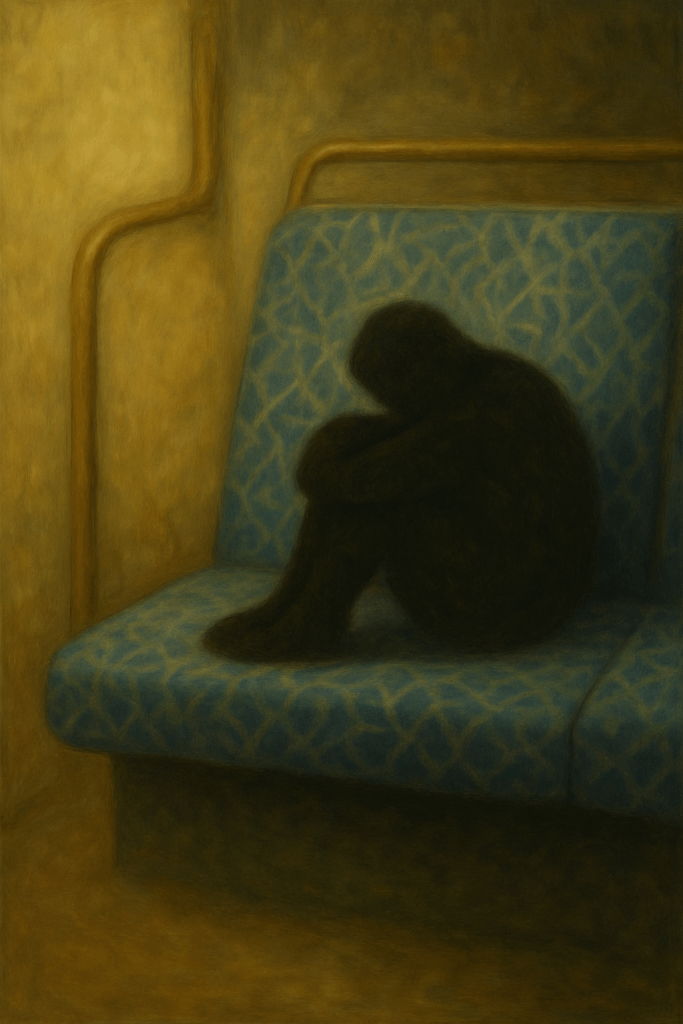
You found a different reality, yes, but one that seemed navigable: here there is no open war, you could return from work one afternoon, alone, take a bus. Just a few stations. You sit down, lower your head, and scroll through the messages on your phone. You do this every day. The bus doesn’t bother you. Routine disguises fatigue.
I try to imagine what you felt, Iryna. Poor girl—and I say “poor” not as insult but because it pains me to call you so. The very thought pierces me: just a few seconds. You realized everything was already in motion, that a shadow rose behind you. And shadows have no weight. Only the determination of hate. Or of absurdity. Or of a destiny dictated by causes beyond sense.
You felt the stab and folded into yourself, as if to avoid a second blow. But it was precise, like the thrust of a matador. Other passengers saw and turned away. They shrank back, busying themselves as if evil would not touch them. They did not help you. The man had time to strip off his shirt soaked in your blood, toss it onto a seat, and flee as if nothing had happened.
Those of us who saw the video saw the drops of your life scattered on the bus floor. We saw the passengers frozen, ashamed, inhibited by fear. What you felt in those seconds as life left you—we will never know. We cannot pretend that instead of horror you felt confusion. It was horror pure, total, concentrated. It was a determination aimed at your very existence.
You would never know that this man should never have been there. You would never know that, somehow—as always—he would be justified: because there is violence, because there is racism, because there is injustice. And then the intolerable happens: the victim dissolves, becomes a footnote, a statistic, a silence. The aggressor occupies the center of the narrative, and your name, Iryna, is erased. Erased in the chronicle, erased in the speeches, erased even in the memory of those who excuse themselves by saying evil “had its causes.”
But you were not a cause, not a concept, not a symbol: you were life. And when life is erased, it condemns us all to the same shadow that overtook you.
“How alone you must have felt, Iryna. Disconnected from everyone, already outside every human bond. What desolation in those few moments that stole your future on this earth, far from your own.”
Israel Centeno
The Vocation of Woman in the Order of Nature and Grace: An Integrated Reading of Edith Stein
Israel Centeno
In The Vocation of Man and Woman According to the Order of Nature and Grace, Edith Stein — Saint Teresa Benedicta of the Cross — laments that the word “vocation” has been reduced to a mere professional choice. In common usage, it means little more than deciding what career to pursue or what job to take, but for Stein, vocation is a personal and objective call that comes from God, recognizing our natural capacities and orienting them toward a supernatural end. It is never simply an individual project; it is the intersection between received nature and the grace that calls.
Her reflection is rooted in the opening chapters of Genesis, where man and woman together receive the mission of being God’s image and of caring for creation. Woman is presented as a “suitable helper,” a phrase that for Stein does not imply subordination, but rather active collaboration of equal dignity. After the fall, this vocation is wounded: man’s work becomes toilsome, motherhood is linked with pain, and the relationship between the sexes loses its original harmony. Yet in the midst of the curse comes a promise: victory over the serpent will come through the woman’s offspring. From that moment, the female figure is inscribed at the very center of the plan of salvation.
For Stein, the original vocation of both man and woman is lived in a complementarity that does not erase difference. Man, more oriented toward conquest and mastery over the earth, is called to protect, defend, and guard; woman, more inclined toward welcoming and preserving life, is endowed with a special sensitivity for what is organic, for the growth of what is concrete and personal, ensuring that what exists may become what it is meant to be. This distinction is not hierarchical but reciprocal: both sets of gifts are created for mutual service, so that man, through the harmonious development of the feminine strengths, may be freed from one-sidedness, and woman, by collaborating in outward and creative tasks, may overcome her own tendency toward enclosure.
When this complementarity is broken by sin, the relationship degenerates into domination and submission. Man, forgetting that his gifts exist for the other’s development, may use them as an instrument of his own concupiscence, becoming a despot; woman, relinquishing her role as companion, may fall into voluntary servitude, reducing her life to instincts and possession. The degeneration is not only emotional: in both sexes there can emerge the tendency toward violent possession of things and persons, falsifying reality and destroying the harmony entrusted to them.
In woman, the particular danger is to reduce her mission to merely preserving what she possesses, becoming combative against all change, or to cling to her children as property, curtailing their freedom in the name of a misunderstood love. Thus, instead of putting her gifts at the service of the growth of others and the glory of God, she stifles progress and undoes happiness. Stein locates the root of this evil in the perversion of the relationship with God: in the biblical narrative, the woman, seduced, rises against Him and draws man into disobedience, and the resulting penalty is subjection to male power. The sin to which woman is more exposed, Stein says, is sensuality, and whenever she acts as seductress, she becomes, paradoxically, an instrument of that very evil against which she was entrusted to fight.
This reading is not, for Stein, a condemnation, but a call to recover the original vocation, healed and elevated in Christ. In the Gospels, Jesus acts in ways that contradict the restrictive culture of His time: He speaks and teaches women, makes them participants in His mission, entrusts Mary Magdalene with the paschal announcement, and, in a gesture without parallel, reveals to the Samaritan woman — openly and without evasion — that He is the Messiah. In that encounter, the woman becomes an apostle to her people, bearer of a revelation that neither Peter nor the other disciples had received so directly.
The tension that appears in some of Paul’s letters, especially in 1 Timothy where women are restricted from public teaching, Stein interprets as pastoral norms shaped by local circumstances, not as universal laws. The Pauline affirmation that in Christ “there is neither male nor female” is, for her, the interpretive key that harmonizes apostolic practice with the model of Jesus. If Christ entrusts women with both word and mission, the Church is called to acknowledge their full participation in the work of salvation.
In this perspective, the vocation of woman, in nature, is to welcome, guard, and nurture life; in grace, it is to cooperate with Christ in redemption; and in the present mission, it is to be a sign of God’s tenderness and fidelity in the family, in the Church, and in society. To reduce her to a secondary role is to betray both the Gospel and the dynamic of the Spirit’s gifts. From Eve to the Samaritan woman, from Mary to the women disciples of the Resurrection, Scripture bears witness that woman is a privileged channel of divine action. For Stein, recalling this is not merely an act of memory, but an urgent summons to reactivate the full participation of women in the Church’s mission, in accordance with the dignity and grace given to them from the beginning.
May 5, 2017, at Baylor ISR . The speaker also mentions previously meeting Eleonore Stump at Liberty University in Lynchburg, Virginia, and later at Virginia Tech (3:16) in 1990, and the University of Missouri, Columbia during his undergraduate studies, before she moved to St. Louis University
Here we go, with the subject of atonement.
At the outset, let’s note that the doctrine that Christ has saved human beings from their sins—with all the implications of salvation—stands as the distinctive doctrine of Christianity. In this book, I want to consider this theological doctrine with philosophical care, within the context of a vast history of interpretation. So, this is an exercise in philosophical theology.
This doctrine has the power to move people, whether to heart-melting love or to serious repudiation and rejection. To evaluate those different attitudes, one must understand the doctrine. What actually is this doctrine that is so distinctive of Christianity? Understanding it is not an easy matter.
Looking over the history of Christianity, you’ll see that each era had its own questions to consider. The early periods wrestled with the Incarnation, the Trinity, and so on. In the age of high scholasticism, other issues emerged, especially as Islam, Judaism, and Christianity interacted. Yet, until recently, the question of what the atonement actually is never became a burning issue in the prevailing culture. But in our time, it has become precisely that. For some, this doctrine is the primary reason to reject Christianity, so it is time for us to turn our attention to it.
For many, the word “atonement” conjures up the idea of placating an offended God through bloody sacrifice. That is not how I intend to use the word. But we do need a word to describe the nature and effects of Christ’s passion, death, and resurrection—or more broadly, Christ’s life, passion, death, and resurrection. “Atonement,” despite its baggage, seems to carry the least theological baggage of all possible terms. So although many contemporary people think it refers narrowly to Christ’s crucifixion making things right with God, I want the word to be more neutral and broad. This is worth remembering as we proceed.
The doctrine of atonement differs from other major Christian doctrines—like the doctrine of the Incarnation—in that it has no formula specifying its interpretation. For the Incarnation, there’s the Chalcedonian formula: Christ is one person with two natures, fully human and fully divine. No analogous formula exists for the atonement. There are creedal or conciliar statements that rule out certain interpretations—like docetism, which says Christ didn’t really suffer—but no statement that precisely specifies how we are to understand the atonement. That’s important because it allows for highly divergent interpretations, all of which can count as orthodox.
In this book, I’ve tried to learn from the history of interpretations of the doctrine. There are many, but I haven’t adopted any one of them wholesale. Instead, I’ve started by considering the problem: clearly, the atonement is a solution to a problem. There’s little controversy over that in the tradition. But what is the problem?
The word “atonement” itself was coined to express the idea of making one—atonement—between God and human beings, who were not previously at one. The problem atonement is meant to solve is the absence of unity between God and humanity, which, as the tradition sees it, stems from the human proneness to wrongdoing—what I will use interchangeably with “sin.” From Augustine onward, the tradition sees the absence of unity as rooted in the human will, which is inclined toward sin.
If you think about the problem that way, it becomes clear that the solution must address multiple components. Human beings tend to prefer their own power or pleasure over greater goods. They’re not doomed to do so, but are inclined that way. Inevitably, in the life of any person, this tendency is actualized. Every human being will at some point act on this proneness to sin. That’s the forward-looking aspect of the problem: we know the future will bring such actualizations. There’s also a backward-looking aspect: except for Christ (and, in Catholicism, Mary), every person past the age of reason has committed morally wrong acts in the past. Thus, every person can look back on actions contrary to the will of God—there is guilt for what is past and the knowledge of future wrongdoing.
And then, on top of guilt, there is shame. One can feel shame for one’s own wrongdoing, but also for things done to them, for defects of nature, or for being part of a group. For example, the children of high-ranking Nazis, innocent of their parents’ crimes, have felt shame just for belonging to that family. There is shame simply in being a member of the human species, given the moral horrors, cruelty, and destruction humans have perpetrated. If you imagine a morally perfect species, facing them as one of us would be unbearable.
If atonement is to be a full solution to the problem of human sinfulness, it must address all varieties of shame as well. Atonement is meant to undo what went wrong in the Fall, and all these things—guilt, shame, moral wrongdoing—are consequences of that.
So, the components of the problem that atonement is meant to solve can be outlined as follows:
Current disposition to moral wrongdoing—the inclination to prefer lesser goods, which brings the liability to future sinful acts.
Guilt—the fact of having actually committed morally wrong acts in the past.
Impairments in the psyche of the wrongdoer—the damage wrongdoing causes within the self.
Ill effects of wrongdoing in the world—the harm caused to others and to the broader order.
Shame—arising not only from one’s own acts, but also from the actions of others, natural defects, or belonging to a group.
To see these elements clearly, consider a notable moral monster—Eichmann, for instance. Before his execution in Jerusalem, a Lutheran chaplain asked Eichmann if he would like to confess. Eichmann replied, “Why would I confess? I’ve never done anything wrong.” This illustrates the ill effects of wrongdoing on the wrongdoer’s psyche: the will and intellect are corrupted to the point that self-understanding is lost. The harm done to the world—Eichmann was responsible for millions of deaths—is clear. Yet, guilt and shame are universal; not only “monsters” have to deal with them, but all of us.
So, these aspects—proneness to wrongdoing, guilt, impairment, external harm, and shame—create a distance between God (perfectly good) and humanity, a distance atonement is supposed to remedy.
Interpretations of Atonement
In the history of doctrine, there are three major types of interpretation:
Patristic (early church fathers)
Anselmian
Thomistic (Aquinas)
Let me try to be concise. The patristic interpretation focuses on a cosmic drama involving Satan. Anselm, however, regarded this as a misguided or “stupid” interpretation. Many today have tried to rehabilitate the patristic view, but I still find it difficult to understand and so, with reluctance, set it aside—not because I think the church fathers were stupid, but because, at present, I don’t know how to make sense of their view, and neither, it seems, does anyone else. So, I bracket the patristic approach, though I am sure I lose something by doing so.
That leaves us with the Anselmian and Thomistic kinds. Each of these is really a family of theories. Broadly, all interpretations can be divided based on what they see as the obstacle to reconciliation between God and humanity. The Anselmian type locates the obstacle in something about God—God’s honor, justice, or goodness. The Thomistic type sees the obstacle as lying in something about human beings.
Now, some might assume that the Anselmian kind is “Protestant” and the Thomistic is “Catholic,” but this isn’t accurate. There are Catholic versions of Anselmian theories and potentially Protestant versions of Thomistic theories. The distinction is not strictly denominational.
My point is this: although there is much to learn from both the Anselmian and Thomistic kinds, neither is wholly satisfactory. At best, each is missing something; at worst, each is fundamentally misguided. So, I have tried to rethink the doctrine, with respect for the tradition, but seeking a more coherent, morally acceptable interpretation—one that is consistent with biblical texts and other theological doctrines. I argue that such an interpretation is possible.
The Heart of the Account: Love
The core of my account centers on the nature of love. I use Aquinas’s account, which, in my view, is the best philosophical account of love available. It explains cases that other theories cannot. In a nutshell, love consists of two interrelated desires: a desire for the good of the beloved, and a desire for union with the beloved. The “good” is what is truly good for the beloved, not merely what they want. And “union” is not just companionship, but being truly “at one” with the beloved—even, sometimes, in ways that look like separation.
To illustrate, imagine a two-year-old at the dinner table. His mother says, “If you throw your pizza on the floor again, dinner is over.” He does it; she sends him to his room. Both are denied what they want (he wants pizza and companionship, she wants a peaceful meal). Yet, she still loves him, desiring his good and union with him—her actions flow from love, even if union looks like separation at that moment.
So, an acceptable interpretation of atonement must show how it solves the problems of guilt and shame, and love is central to this. In terms of Aquinas’s account, guilt is connected to the anticipation that others will desire what is not your good (because of your wrong), and shame to the anticipation that others will reject you. The guilty person focuses on the good, the ashamed person on union.
Critique of the Anselmian Interpretation
Where most people get stuck in my manuscript is at my rejection of the Anselmian kind of interpretation. For nearly everyone, this type of interpretation is the one we have been steeped in—whether as critics or believers. So, for many, my argument that the Anselmian interpretation fails sounds like a repudiation of Christianity itself. But that is not my intention. My goal is to defend the doctrine of atonement by showing a better interpretation.
My central objection to the Anselmian view is this: it is incompatible with the doctrine that God is loving. And that incompatibility, in my judgment, cannot be repaired. The bottom line is this: the point of Christ’s incarnation, life, passion, death, and resurrection is not to win clemency or pardon from God. All the many versions of the Anselmian theory share the idea that Christ’s work removes some obstacle on God’s side, thus making union between God and humanity possible.
I argue that this is mistaken. The better way to understand the atonement is as addressing the obstacle within human beings, not within God.
Rethinking the Doctrine
So, what does Christ do in the atonement? My project centers on the idea that Christ brings about two metaphysical alterations: one in his own human nature, and one in the psyches of all human beings of faith. These alterations make mutual indwelling possible.
I take seriously Christ’s prayer in the Gospel of John: “Father, let them be one as we are one—I in them and you in me.” Mutual indwelling is what union between God and human beings is supposed to be.
When two humans are united, it is their thoughts, feelings, or histories that are joined, given their metaphysical smallness. But when God is one of the relata, what can be united is whole persons. The union is deeper, more comprehensive—mutual indwelling, not merely shared life.
I examine the “cry of dereliction” on the cross—Christ’s words, “My God, my God, why have you forsaken me?”—and try to make sense of it in a way that fits with other doctrines. When the biblical texts say Christ “became sin for us” or “bore our sins,” I take this to mean that on the cross, Christ opens himself to receive the psyches of all sinful human beings. His human psyche is flooded by their presence—not as an invasion, but as a welcome.
If you know stories from popular culture (like science fiction, where aliens invade and take over a human), you know the horror of a psyche being overtaken by something foreign. But here, Christ voluntarily and lovingly welcomes into his psyche the full weight of sinful humanity, with all its shame, guilt, and revulsion. It is something like the “mind-meld” scenes in Tolkien, where the experience is overwhelming. This is what happens as human beings, in their brokenness, are received into Christ’s perfectly holy psyche.
That’s one half of mutual indwelling—humanity dwelling in Christ. The other half is the Holy Spirit indwelling human beings of faith. The moment someone comes to faith, there is agreement across Christian doctrine: the Holy Spirit comes to dwell within that person.
But if the indwelling of the Spirit is not to be like an alien invasion—if it is to be union rather than takeover—there must also be welcome on the part of the human. And that is hard to achieve. Every human being desires to love and be loved, but there is resistance, closure, failure to commit—hence the entire counseling profession.
You go to a counselor knowing you have problems with love, with commitment. And yet, even when you want to be healed, you also resist it. If God simply zapped integration into you, it would be God’s will, not yours, and there would be no true union—because union requires two wills, not just one.
So, what can be done? When a person ceases resisting God’s love, when they surrender, then the Holy Spirit can come in. God’s grace can produce the act of faith that welcomes the Spirit, and the union begun by Christ on the cross is now completed.
The Human Struggle to Surrender
But why is it so hard for human beings to surrender to God’s love, even when we want to love and be loved? Partly, it is because true union threatens our autonomy and self-image. If you commit yourself to another, that person’s desires and judgments matter for your life. You see yourself through their eyes, and you may not like what you see. There is a risk of rejection—of being found wanting and abandoned.
There is also, in some, a tendency to self-assertion and rebellion. John Stuart Mill said, in effect, “If there is a God who can send me to hell for not worshipping him, then to hell I will go.” This stance—defiance as tragic hero—may seem noble. But what does it mean to defy a God who comes not as a conqueror but as one who is naked, tortured, and dying, humiliated on a cross? How threatening, really, is such a God? What does it mean to rebel against one who invites you with utter vulnerability?
If there is any way to persuade human beings that it is safe to surrender—to let go, and accept God’s love—it is the story of Christ on the cross: God in love, suffering and dying in humiliation. What cannot be achieved by divine fiat, and what humans are too broken to do on their own, God prepares for, encourages, and makes possible through Christ’s atonement.
When that surrender finally comes, the Holy Spirit enters in, and now we have mutual indwelling: as the Father is in the Son and the Son in the Father, so human beings are in Christ, and Christ’s Spirit is within them. This is the beginning of union—not the end, but the start of a new reality.
Concluding Summary
In the remainder of my presentation (which I’m leaving aside for now), I would discuss what happens after this beginning of union. But this is enough to show how I am thinking of the atonement in a non-Anselmian way.
To summarize:
The atonement does not remove an obstacle in God, but addresses the obstacle in human beings.
Love, as Aquinas describes it—the desire for the good of the beloved and for union with the beloved—is central.
Christ, on the cross, opens himself to all our sin and shame, welcoming us in our brokenness.
Human beings, in turn, are enabled (not coerced) to surrender, so that the Holy Spirit can dwell within them.
Mutual indwelling, the deep union of wills, is begun—God in us, and we in God.
This, I believe, offers a more coherent and morally satisfying interpretation of the Christian doctrine of atonement—one that does justice to the biblical texts, the tradition, and the reality of human need.
In an age marked by spiritual fragmentation, cultural disorientation, and the exhaustion of absolute narratives, a subtle yet persistent longing still pulses within the human heart: the thirst for fullness. This is not merely a religious impulse in the conventional sense, but a deeper, more primal yearning—one that precedes belief systems and creeds. It is the question that burns without a name, the inner movement that seeks meaning even when surrounded by night.
This thirst recognizes no ideological allegiance. It can dwell in the soul of the agnostic, the skeptic, or even the self-declared atheist. It may arise in the silent awe of a scientist contemplating the order of nature, in the trembling of an artist before unexpected beauty, or in the weariness of a volunteer who gives their days to care for the forgotten. There is no need to utter the name of God to feel summoned by something that exceeds all utility, something that calls without words from the center of one’s being.
Saint Augustine sensed this mystery with the wisdom of one who had wandered far and returned, wounded and changed: “You have made us for Yourself, O Lord, and our hearts are restless until they rest in You.” Restlessness of heart is not a flaw but a sign. An interior compass indicating that the world’s promises—power, pleasure, consumption, ideology—cannot quench the soul’s thirst. Because what the heart longs for is not another possession, but communion; not a formula, but a truth that embraces one’s entire existence.
Simone Weil, with the unusual clarity of one who sees from the margins, understood that the path toward the Mystery can begin with an act of attention. “Absolutely unmixed attention is prayer,” she wrote. That gaze which does not seek to possess or reduce the other to function or use is already a religious act, even when unnamed. Without dogma or baptism, Weil insisted that the human soul is summoned to respond to the suffering of others—even if that means walking alone and bearing the weight of the world. Pure attention to reality can be a form of prayer, a door to the divine.
Beauty, too—so often trivialized in a culture of spectacle—can be a sacred wound. When someone is moved by a sunrise, a melody, a work of art, or the smile of a child, something deep within is broken open. This stirring is more than aesthetic delight; it is a participation in the harmony that sustains the world. Edith Stein, philosopher and mystic, affirmed that “true beauty arises from a pure heart and an illumined mind.” Beauty, then, does not decorate life: it reveals it. It becomes a threshold. As Hans Urs von Balthasar wrote in his Glory, authentic beauty has form—and that form is Christ. Thus, one who honestly follows the traces of beauty may, without realizing it, stumble into Truth.
Service to others, especially to the suffering, is another quiet path toward the Mystery. No creed is needed to wash the feet of the elderly, to listen to the sick, to accompany a migrant, or to comfort a child. In each of these acts, the compassion of Christ is made flesh. “Whatever you did for one of these little ones, you did for me,” says the Gospel. Edith Stein translated this into her own words: “True love consists in giving back to the other their own existence, their own dignity, untouched.” To love in this way—without seeking recognition—is to embody a faith that perhaps the lips cannot yet articulate.
There are souls who walk without a map but not without direction. Who do not recite creeds, yet love justice. Who never kneel in a church, yet tremble before beauty. Who do not read Scripture, yet open their homes to those in need. They are seekers. Thirsting ones. Children of longing. And that longing—when sincere and unmasked—is already a form of openness to the divine. For only fullness can quench the soul’s thirst. And fullness, at its highest, has a face: the face of Christ, who comes to meet us even in the night of unknowing.
This essay does not seek to draw lines between believers and nonbelievers. On the contrary, it aims to recognize in every honest heart a spark of that light which never goes out. To show that the journey toward Goodness, Truth, and Beauty—however slow, ambiguous, or uncertain—is already a living prayer. And that those who love justice, tend to the suffering, cultivate beauty, and seek truth with courage are already very near the Kingdom. Even if they do not know it. Even if they cannot name it. Even if they walk with thirst and without map. For the Mystery does not require comprehension to reach the soul. It only needs to find a heart that is open.
When Jesus says, “Whoever believes in me shall never die,” he is not making a poetic or symbolic claim. He speaks from the heart of divine revelation, with a clarity that, once grasped, transforms our entire perception of history and human destiny. “Whoever believes in me will never see death” (Jn 8:51). This seemingly simple phrase contains the whole of the Christian promise. Understanding it deeply allows us to read both history and eschatology in an entirely new light.
Unlike other religious or philosophical movements that emerged around the first century—such as Pharisaism, Sadduceeism, or even Essenism—the message of Jesus did not die with its leader but rather multiplied. Instead of dissolving with the execution of its Master, that small band of Galileans and marginal Jews became the foundation of something entirely new: the Church, the Mystical Body of Christ, which not only survived but expanded, transforming cultures, empires, and entire civilizations.
This expansion cannot be explained by human means alone. As Romano Guardini affirmed, what the early Christians possessed was not a new moral code or ideology, but a living experience of the Risen One. The resurrection of Jesus was not a metaphor or a collective illusion but an event that shattered the laws of physics without violating them, that upended history without crushing it, and that offered a new horizon: the glorification of the body, communion with God, real eternal life—not symbolic.
Paul, in his letter to the Corinthians, expresses this reality in deeply eschatological terms:
“It is sown a perishable body, it is raised an imperishable body; it is sown in dishonor, it is raised in glory; it is sown in weakness, it is raised in power; it is sown a natural body, it is raised a spiritual body” (1 Cor 15:42-44).
And he adds, in a climactic outburst of hope:
“In the twinkling of an eye, at the last trumpet… the dead will be raised imperishable, and we shall be changed” (1 Cor 15:52).
Paul is not speaking mythologically. He describes the radical, definitive passage from time into eternity, from the corruptible body to the glorious body, from mortal experience into full communion with the Triune God. This transformation is not symbolic—it is real, and it is grounded in the foundational event of our faith: the resurrection of Christ.
When Jesus affirms that those who believe in Him “will not see death,” He refers to the second death—the separation of the soul from God (cf. Rev 20:6). Physical death becomes a transition, not an end. The soul, upheld by grace, remains in communion with Christ and awaits—in God’s time, not ours—the final glorification of the body.
This means that eternal life does not begin after death, but from the moment we believe and live in Christ. We are already—sacramentally—living the firstfruits of eternal life. The Christian lives dying to the world but rising already in spirit.
That is why Jesus says, “Let the dead bury their dead” (Mt 8:22). What sounds scandalous becomes a key eschatological insight: there are dead who walk, and there are those who, though dead to the world, live for God. The one united to Christ already partakes, though veiled, in future glory.
The Christian hope is not merely “going to heaven.” It is to be fully transformed by grace, participating in the divine mode of being. As John writes:
“What we will be has not yet been made known. But we know that when He appears, we shall be like Him, for we shall see Him as He is” (1 Jn 3:2).
To see God is to become a reflection of His glory, not as something incidental but as the true destiny of the redeemed soul. This beatific vision, the culmination of eschatology, implies full communion with the Father, Son, and Holy Spirit. What we now know as promise, we will behold as Presence. And what we now believe with effort, will become eternal rest in the Truth that never fades.
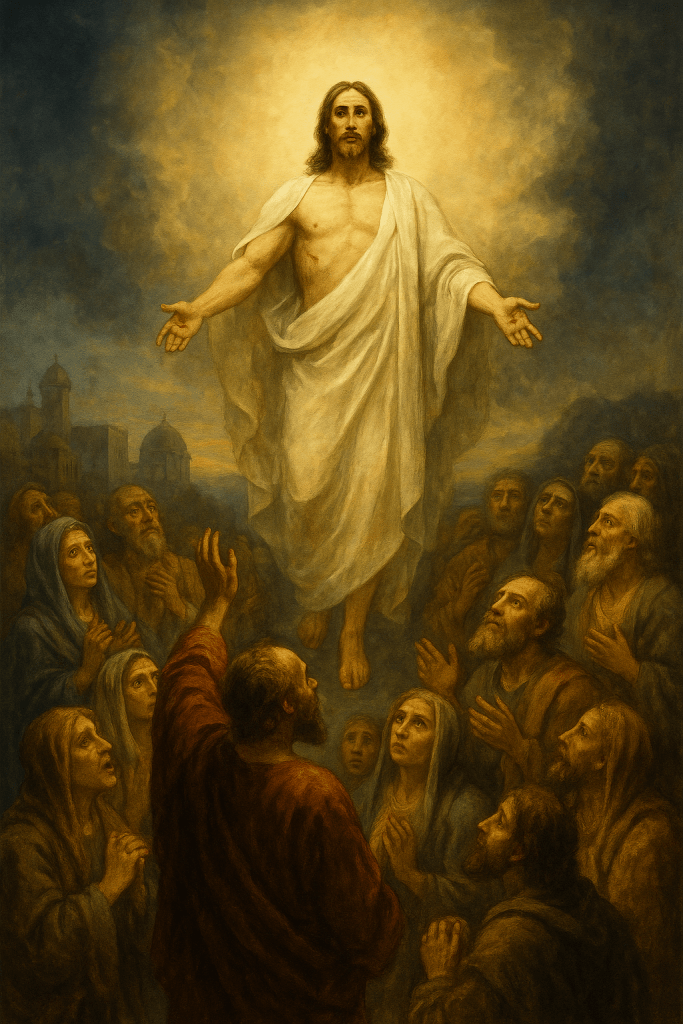
We already have a decisive sign: the risen body of Christ. In Him we see what our own glorified bodies will be. His body is no longer bound by the natural laws of this world: He enters a locked room, appears to the disciples of Emmaus, and yet He eats, is touched, speaks. This is not a pious metaphor—this is the Good News. How could it not be, when it reveals the luminous destiny of the redeemed human being?
We have seen His glory, foreshadowed at Tabor, where the mortal body is transfigured before the trembling eyes of Peter, James, and John. And we also have the visions of Teresa of Ávila, John of the Cross, Thomas Aquinas, who describe with mystical sobriety eternal life as perfect union and unending joy, where the will rests in the Absolute Good and the intellect in Truth without shadow. Even Simone Weil, who never formally entered the Church, said that Christ spoke to her directly, that they prayed the Our Father in Greek together, and that the beauty of the Cross revealed the meaning of existence.
All of this invites us to look upward, despite evil, despite the broken world, despite the modern man who makes himself god through scientific and technological delirium. Precisely because of that, because modernity has closed itself to mystery, it becomes more urgent to proclaim the Good News: Christ is risen, and His glorified body is the pledge of our future glorification.
Christianity does not flourish because it is more useful, moral, or sentimental. It flourishes because it is true. Because it offers a real answer to suffering, to death, and to the longing for eternity. Whoever believes in Christ will not know death, for he already lives in Him—and will live forever.
On this promise rests the Church, the martyrs, the saints’ fidelity, and the hope of the faithful. Eschatology is not an appendix to theology—it is its crowning. And in it we learn that, in the end, there will be no terror, no silence, no ash. There will remain Love—and we shall be with Him, in glory.
No Conoceremos la Muerte
Cuando Jesús dice: “El que cree en mí no morirá para siempre”, no hace una afirmación poética o simbólica. Habla desde el corazón de la revelación divina, con una claridad que, al ser comprendida, transforma la percepción entera de la historia y del destino humano. “Quien cree en mí no conocerá la muerte” (Jn 8,51). Esta frase, aparentemente simple, contiene la totalidad de la promesa cristiana. Comprenderla con profundidad nos permite leer la historia y la escatología bajo una luz completamente nueva.
A diferencia de otros movimientos religiosos o filosóficos que surgieron en torno al siglo I, como el fariseísmo, el saduceísmo o incluso el esenismo, el mensaje de Jesús no se extinguió con la muerte de su líder, sino que se multiplicó. En vez de disolverse con la ejecución de su Maestro, ese pequeño grupo de galileos y judíos marginales se convirtió en el cimiento de una realidad completamente nueva: la Iglesia, el Cuerpo Místico de Cristo, que no sólo sobrevivió, sino que se expandió, transformando culturas, imperios y civilizaciones enteras.
Esta expansión no puede explicarse por medios humanos. Como afirma Romano Guardini, lo que los primeros cristianos poseían no era un código ético nuevo, ni una ideología, sino una experiencia viva del Resucitado. La resurrección de Jesús no fue una metáfora ni una ilusión comunitaria, sino un evento que rompió las leyes de la física sin violarlas, que trastocó la historia sin aplastarla, y que ofreció un horizonte nuevo: la glorificación del cuerpo, la comunión con Dios, la vida eterna real, no simbólica.
San Pablo, en su carta a los Corintios, expresa esta realidad con un lenguaje profundamente escatológico: “Se siembra un cuerpo corruptible, resucita un cuerpo incorruptible; se siembra en ignominia, resucita en gloria; se siembra en debilidad, resucita en poder; se siembra un cuerpo animal, resucita un cuerpo espiritual” (1 Cor 15,42-44). Y añade, como un clímax apocalíptico lleno de esperanza: “En un abrir y cerrar de ojos, al toque final de la trompeta… los muertos resucitarán incorruptibles y nosotros seremos transformados” (1 Cor 15,52).
Aquí san Pablo no está hablando en términos mitológicos. Lo que describe es el paso radical y definitivo del tiempo a la eternidad, del cuerpo sujeto a corrupción al cuerpo glorioso, de la experiencia mortal a la comunión plena con el Dios trino. Esta transformación no es simbólica, sino real, y está fundada en el acontecimiento fundante de nuestra fe: la resurrección de Cristo.
Cuando Jesús afirma que quienes creen en Él “no conocerán la muerte”, se refiere a la segunda muerte, aquella que implica la separación del alma con Dios (cf. Ap 20,6). La muerte física será un tránsito, pero no un final. El alma, sostenida por la gracia, permanecerá en comunión con Cristo y esperará —en el tiempo de Dios, no en el nuestro— la glorificación final de su cuerpo.
Esto implica que la vida eterna no comienza después de la muerte, sino desde el momento en que se cree y se vive en Cristo. Ya estamos —de forma sacramental— en las primicias de la vida eterna. El cristiano vive muriendo hacia el mundo, pero ya resucitando en su espíritu.
Por eso Jesús dice: “Deja que los muertos entierren a sus muertos” (Mt 8,22). Lo que parece un escándalo se convierte en clave de lectura escatológica: hay muertos que caminan, y hay vivos que han muerto al mundo, pero viven para Dios. El que está unido a Cristo participa ya, aunque veladamente, de la gloria futura.
La esperanza escatológica del cristiano no es simplemente “ir al cielo”. Es ser transformado plenamente por la gracia, participando del modo de ser divino, como afirma San Juan: “Aún no se ha manifestado lo que seremos. Sabemos que, cuando Él se manifieste, seremos semejantes a Él, porque lo veremos tal cual es” (1 Jn 3,2).
Ver a Dios es convertirse en reflejo de su gloria, no como algo accesorio, sino como destino propio del alma redimida. Esa visión beatífica, culminación de la escatología, implica la plena comunión con el Padre, el Hijo y el Espíritu Santo. Lo que ahora conocemos como promesa, lo veremos como Presencia. Y lo que hoy creemos con esfuerzo, se hará descanso eterno en la Verdad que no pasa.
Ya tenemos un dato decisivo: el cuerpo resucitado de Cristo. En Él se nos ha mostrado cómo será ese cuerpo glorioso que esperamos. No está sujeto a las leyes naturales de este mundo: entra en un cenáculo con las puertas cerradas, se hace presente entre los discípulos de Emaús al partir el pan, y sin embargo, tiene carne y huesos, come pescado, permite ser tocado, habla. Esta no es una metáfora piadosa, es la buena nueva. ¿Cómo no habría de serlo, si nos revela el destino luminoso del hombre redimido?
Hemos visto ya su gloria, anticipada en el Tabor, donde el cuerpo mortal se transfigura ante los ojos temblorosos de Pedro, Santiago y Juan. Y tenemos además las visiones de Santa Teresa de Ávila, San Juan de la Cruz, Santo Tomás de Aquino, que describen con sobriedad mística la vida eterna como unión perfecta y gozo sin fin, donde la voluntad descansa en el Bien absoluto y la inteligencia en la Verdad sin sombra. Incluso Simone Weil, que no cruzó formalmente el umbral de la Iglesia, afirmó que Cristo le habló directamente, que rezaron juntos el Padre Nuestro en griego, y que la belleza de la cruz le reveló el sentido de toda la existencia.
Todo esto nos invita a mirar hacia lo alto, a pesar del mal, a pesar del mundo roto, a pesar del hombre que pretende ser Dios de sí mismo a través del delirio científico y tecnológico. Precisamente por eso, porque el hombre moderno se ha cerrado al misterio, se hace más urgente proclamar la buena noticia: Cristo ha resucitado, y su cuerpo glorioso es la prenda de nuestra glorificación futura.
El cristianismo no florece porque sea más útil, más moral o más sentimental. Florece porque es verdadero. Porque da una respuesta real al dilema del sufrimiento, al enigma de la muerte y al anhelo de eternidad. El que cree en Cristo no conocerá la muerte, porque ya vive con Él, y vivirá para siempre.
En esta promesa se sostiene la Iglesia, el martirio, la fidelidad de los santos, y la esperanza del pueblo fiel. La escatología no es un apéndice de la teología: es su coronación. Y en ella se nos revela que, en el momento final, no quedará el terror, ni el silencio, ni la ceniza. Quedará el Amor, y nosotros con Él, en gloria.
The human brain is a structural marvel: complex, functional, alive. It is the operations center where stimuli are processed, memories stored, motor responses organized, and commands executed. From it, the heart is regulated, light becomes color, vibration becomes sound, loss becomes pain. It is, without doubt, the most powerful biological device known to science. But it is not consciousness.
We can observe the brain through MRIs, dissect its lobes, stimulate specific regions electrically, identify patterns in its activity. But no brain scan has ever shown us where a metaphor is born, where a heroic decision takes shape, where forgiveness forms. The brain can become saddened, can release substances that bring us down or lift us up, but it does not know what it is to be sad. It does not know what sadness feels like. Or joy. Or love. The how of emotion, its infinite shades, are not generated in the flesh — they pass through it, but they are not reducible to it.
This is the abyss David Chalmers called the “hard problem of consciousness”: to explain how qualia —subjective sensations— arise from a purely physical basis. Even if we fully understood the mechanisms that accompany an emotion, we would still have no idea why it feels the way it does. Thomas Nagel put it starkly: “there is something it is like to be a bat,” and no third-person description can capture that first-person experience. The question at hand is not a technical mystery — it is an ontological rupture.
Even emergentism —the idea that consciousness arises as a higher-order property of organized matter— dissolves under scrutiny. It does not explain why or how this emergence occurs; it merely asserts it. But to name is not to explain. To say that consciousness is an epiphenomenon is to admit we have no clue what we are talking about.
Panic cannot be described from the inside. We can list its signs: racing heart, sweating, disordered thoughts. But the core of panic —that overwhelming, uncontrollable presence— is ineffable. Two people can experience the same event —a reunion, a wound, a humiliation— and yet feel utterly different. Because every consciousness is a sealed world, accessible only to itself. And that difference in experience, unique and irreducible, can be found in no fold of the temporal lobe.
The flesh —the body, the brain, the grey matter— is the center of operations. But it is not the seat of the soul. At best, it is the stage. At worst, a prison. What is felt —what is truly lived— cannot be captured by measurements or algorithms. The lab can induce chemical pleasure, but it cannot produce the sweetness of a remembered song in the midst of grief. It can simulate anxiety, but not the internal cry of one who loves and is not loved.
Physicist Roger Penrose sensed this from another angle: if consciousness were computable, then an algorithm could replicate it. But it is not. Reproducing neural connections is not enough. There is a presence —an interiority— that is not reducible to code or calculation. As Wittgenstein observed, “subjective experience cannot be shared; it can only be shown.”
We might attempt to write an equation:
Consciousness = f(brain) + X
And that X is everything that escapes. Everything that doesn’t fit into machines. Everything that makes me me, and you you. That irreducible remainder is what gives rise to freedom, identity, art, and faith. It is that remainder which allows someone, in the midst of hunger or pain, to give their life for another. It is there that the will is born which defies self-preservation, there where an ethic appears that does not obey evolutionary logic.
That remainder —ignored by reductionism, vaguely gestured at by emergentism— is, for some, the trace of a soul. Or at least, a sign that there is something in us that is not merely physical. Something that can be wounded without touching the body. Something that can burn without fever.
To deny this is to deny experience itself. And not even the most advanced science can do that without betraying itself.
Español
El misterio de la conciencia
Por Israel Centeno
El cerebro humano es una maravilla estructural: complejo, funcional, activo. Es el centro de operaciones donde se procesan estímulos, se almacenan recuerdos, se organizan respuestas motoras, se ejecutan comandos. Desde allí se regula el ritmo del corazón y se interpreta la luz como color, la vibración como sonido, la pérdida como dolor. Es, sin duda, el dispositivo biológico más poderoso conocido por la ciencia. Pero no es la conciencia.
Podemos observar el cerebro con resonancias magnéticas, diseccionar sus lóbulos, excitar regiones específicas con estímulos eléctricos, identificar patrones en su actividad. Pero ninguna imagen cerebral nos ha mostrado aún dónde se produce una metáfora, dónde nace una decisión heroica, dónde se forma el perdón. El cerebro puede entristecerse, puede liberar sustancias que nos abaten o que nos elevan, pero no sabe qué es estar triste. No sabe cómo se siente la tristeza. Ni la alegría. Ni el amor. El cómo experienciamos las emociones, los matices infinitos del sentir, no se genera en la carne: atraviesa la carne, pero no es reducible a ella.
Este es el abismo que David Chalmers llamó “el problema duro de la conciencia”: explicar cómo surgen los cualia, las sensaciones subjetivas, desde una base puramente física. Por más que entendamos todos los mecanismos cerebrales que acompañan una emoción, seguimos sin poder explicar por qué esa actividad se siente de una forma determinada. En palabras de Thomas Nagel, “hay algo que es ser un murciélago”, una vivencia desde dentro, y eso no puede ser reducido a una descripción externa. Lo que está en juego aquí no es un misterio técnico, sino ontológico.
Incluso el emergentismo —esa postura filosófica que intenta salvar al materialismo diciendo que la conciencia emerge como propiedad superior de la materia compleja— termina desdibujando el problema. No explica por qué o cómo ocurre esa emergencia. Solo lo postula como si nombrarlo fuese suficiente. Pero nombrar no es explicar. Decir que la conciencia es un epifenómeno es confesar que no la entendemos.
No se puede relatar cómo se siente el pánico. Podemos enumerar sus signos: sudoración, taquicardia, desorden mental. Pero el núcleo del pánico —esa presencia devastadora, incontrolable, abrumadora— es inefable. Dos personas pueden vivir un mismo hecho: un reencuentro, una herida, una humillación. Pero cada una sentirá de modo distinto. Porque cada conciencia es un mundo cerrado al que solo accede su dueño. Y esa diferencia experiencial, única, irreductible, no puede localizarse en ningún pliegue del lóbulo temporal.
La carne, vuelvo a repetir, es el centro de operaciones. Pero no es el lugar donde se manifiesta el alma. En el mejor de los casos, es el escenario. En el peor, una cárcel. Lo que se siente —lo que en verdad se vive— no se deja atrapar por mediciones ni algoritmos. El laboratorio puede inducir placer químico, pero no puede producir la dulzura de una canción recordada en medio de la tristeza. Puede simular angustia, pero no el llanto interior de quien ama y no es amado.
El físico Roger Penrose lo intuyó desde otra orilla: si la conciencia fuera computable, entonces un algoritmo podría replicarla. Pero no lo es. No basta con reproducir conexiones. Hay una presencia, una interioridad, que no es reducible a código ni a cálculo. Como también sospechó Wittgenstein: “la experiencia subjetiva no se puede compartir; solo se puede mostrar”.
Podríamos escribir una ecuación:
Conciencia = f(cerebro) + X
Y ese X es todo lo que escapa. Todo lo que no entra en las máquinas. Todo lo que hace que yo sea yo, y tú seas tú. Es ese resto irreductible que funda la libertad, la identidad, el arte, la fe. Es ese resto el que hace posible que alguien, en medio del hambre o del dolor, decida dar su vida por otro. Es ahí donde nace la voluntad que contradice el instinto de conservación, la ética que no obedece a la lógica de la especie.
Ese resto —que el reduccionismo ignora y el emergentismo apenas insinúa— es, para algunos, la huella de un alma. O al menos, el signo de que hay algo en nosotros que no es meramente físico. Algo que puede ser herido sin tocar el cuerpo. Algo que puede arder sin fiebre.
Negar esto es negar la experiencia misma. Y eso, ni la ciencia más avanzada puede hacerlo sin traicionarse.
After a reading of Nelson Rivera book, Totalitarian Cyclop
Israel Centeno
Since God died, the inventory has only grown. The numbers multiply, the bodies pile up, and the world—this world we insisted on calling civilized—writes in ash the names of those it swore to redeem. The Enlightenment promised us light, but forgot to teach us how not to burn each other alive. It built parliaments on graves and carved the word reason with bayonets. We thought we had become gods, and in doing so, turned the Other into clay.
Was there ever a civilizing gesture that did not come at the cost of someone’s blood? Is there any doctrine, however noble, that does not hide a fist behind its banner? And still, we speak of progress. And still, we parade words like justice, freedom, humanity, as if they hadn’t been torn to shreds in every corner of the earth.
The humanism that emerged after the death of God became a refined cruelty, an “inhuman humanism” that perfected the art of domination while reciting verses about dignity. If Auschwitz taught us anything, it is that horror is not the opposite of civilization—it is its shadow, its necessary twin.
What, then, can we expect from transhumanism, if humanism itself has been soaked in horror? What will happen when Dostoyevsky’s demons learn to compute, to code, to simulate empathy with a precision no soul could ever match? What tyranny will emerge when general AI, running on quantum logic, governs not only our decisions, but our memories, our feelings, our histories? What happens when we are ruled not by laws, but by algorithms that know us better than we know ourselves—and do not love us?
The horror, as Kurtz whispered. The horror, now multiplied, simultaneous, unbound by time. Past, present and future devoured in a single digital breath.
And yet, Christ spoke of love. That scandalous love of the neighbor that remains impossible for the cynic, a pious fraud for the Sunday believer, and an urgent truth we continue to elude.
The apocalypse is not in the fire, but in the silence of those who refuse to remember. We are not waiting for the end. We are already surviving it. And writing—writing is the last form of resistance.


 Centeno's Lighthouse