The Vocation of Woman in the Order of Nature and Grace: An Integrated Reading of Edith Stein
Israel Centeno
In The Vocation of Man and Woman According to the Order of Nature and Grace, Edith Stein — Saint Teresa Benedicta of the Cross — laments that the word “vocation” has been reduced to a mere professional choice. In common usage, it means little more than deciding what career to pursue or what job to take, but for Stein, vocation is a personal and objective call that comes from God, recognizing our natural capacities and orienting them toward a supernatural end. It is never simply an individual project; it is the intersection between received nature and the grace that calls.
Her reflection is rooted in the opening chapters of Genesis, where man and woman together receive the mission of being God’s image and of caring for creation. Woman is presented as a “suitable helper,” a phrase that for Stein does not imply subordination, but rather active collaboration of equal dignity. After the fall, this vocation is wounded: man’s work becomes toilsome, motherhood is linked with pain, and the relationship between the sexes loses its original harmony. Yet in the midst of the curse comes a promise: victory over the serpent will come through the woman’s offspring. From that moment, the female figure is inscribed at the very center of the plan of salvation.
For Stein, the original vocation of both man and woman is lived in a complementarity that does not erase difference. Man, more oriented toward conquest and mastery over the earth, is called to protect, defend, and guard; woman, more inclined toward welcoming and preserving life, is endowed with a special sensitivity for what is organic, for the growth of what is concrete and personal, ensuring that what exists may become what it is meant to be. This distinction is not hierarchical but reciprocal: both sets of gifts are created for mutual service, so that man, through the harmonious development of the feminine strengths, may be freed from one-sidedness, and woman, by collaborating in outward and creative tasks, may overcome her own tendency toward enclosure.
When this complementarity is broken by sin, the relationship degenerates into domination and submission. Man, forgetting that his gifts exist for the other’s development, may use them as an instrument of his own concupiscence, becoming a despot; woman, relinquishing her role as companion, may fall into voluntary servitude, reducing her life to instincts and possession. The degeneration is not only emotional: in both sexes there can emerge the tendency toward violent possession of things and persons, falsifying reality and destroying the harmony entrusted to them.
In woman, the particular danger is to reduce her mission to merely preserving what she possesses, becoming combative against all change, or to cling to her children as property, curtailing their freedom in the name of a misunderstood love. Thus, instead of putting her gifts at the service of the growth of others and the glory of God, she stifles progress and undoes happiness. Stein locates the root of this evil in the perversion of the relationship with God: in the biblical narrative, the woman, seduced, rises against Him and draws man into disobedience, and the resulting penalty is subjection to male power. The sin to which woman is more exposed, Stein says, is sensuality, and whenever she acts as seductress, she becomes, paradoxically, an instrument of that very evil against which she was entrusted to fight.
This reading is not, for Stein, a condemnation, but a call to recover the original vocation, healed and elevated in Christ. In the Gospels, Jesus acts in ways that contradict the restrictive culture of His time: He speaks and teaches women, makes them participants in His mission, entrusts Mary Magdalene with the paschal announcement, and, in a gesture without parallel, reveals to the Samaritan woman — openly and without evasion — that He is the Messiah. In that encounter, the woman becomes an apostle to her people, bearer of a revelation that neither Peter nor the other disciples had received so directly.
The tension that appears in some of Paul’s letters, especially in 1 Timothy where women are restricted from public teaching, Stein interprets as pastoral norms shaped by local circumstances, not as universal laws. The Pauline affirmation that in Christ “there is neither male nor female” is, for her, the interpretive key that harmonizes apostolic practice with the model of Jesus. If Christ entrusts women with both word and mission, the Church is called to acknowledge their full participation in the work of salvation.
In this perspective, the vocation of woman, in nature, is to welcome, guard, and nurture life; in grace, it is to cooperate with Christ in redemption; and in the present mission, it is to be a sign of God’s tenderness and fidelity in the family, in the Church, and in society. To reduce her to a secondary role is to betray both the Gospel and the dynamic of the Spirit’s gifts. From Eve to the Samaritan woman, from Mary to the women disciples of the Resurrection, Scripture bears witness that woman is a privileged channel of divine action. For Stein, recalling this is not merely an act of memory, but an urgent summons to reactivate the full participation of women in the Church’s mission, in accordance with the dignity and grace given to them from the beginning.
May 5, 2017, at Baylor ISR . The speaker also mentions previously meeting Eleonore Stump at Liberty University in Lynchburg, Virginia, and later at Virginia Tech (3:16) in 1990, and the University of Missouri, Columbia during his undergraduate studies, before she moved to St. Louis University
Here we go, with the subject of atonement.
At the outset, let’s note that the doctrine that Christ has saved human beings from their sins—with all the implications of salvation—stands as the distinctive doctrine of Christianity. In this book, I want to consider this theological doctrine with philosophical care, within the context of a vast history of interpretation. So, this is an exercise in philosophical theology.
This doctrine has the power to move people, whether to heart-melting love or to serious repudiation and rejection. To evaluate those different attitudes, one must understand the doctrine. What actually is this doctrine that is so distinctive of Christianity? Understanding it is not an easy matter.
Looking over the history of Christianity, you’ll see that each era had its own questions to consider. The early periods wrestled with the Incarnation, the Trinity, and so on. In the age of high scholasticism, other issues emerged, especially as Islam, Judaism, and Christianity interacted. Yet, until recently, the question of what the atonement actually is never became a burning issue in the prevailing culture. But in our time, it has become precisely that. For some, this doctrine is the primary reason to reject Christianity, so it is time for us to turn our attention to it.
For many, the word “atonement” conjures up the idea of placating an offended God through bloody sacrifice. That is not how I intend to use the word. But we do need a word to describe the nature and effects of Christ’s passion, death, and resurrection—or more broadly, Christ’s life, passion, death, and resurrection. “Atonement,” despite its baggage, seems to carry the least theological baggage of all possible terms. So although many contemporary people think it refers narrowly to Christ’s crucifixion making things right with God, I want the word to be more neutral and broad. This is worth remembering as we proceed.
The doctrine of atonement differs from other major Christian doctrines—like the doctrine of the Incarnation—in that it has no formula specifying its interpretation. For the Incarnation, there’s the Chalcedonian formula: Christ is one person with two natures, fully human and fully divine. No analogous formula exists for the atonement. There are creedal or conciliar statements that rule out certain interpretations—like docetism, which says Christ didn’t really suffer—but no statement that precisely specifies how we are to understand the atonement. That’s important because it allows for highly divergent interpretations, all of which can count as orthodox.
In this book, I’ve tried to learn from the history of interpretations of the doctrine. There are many, but I haven’t adopted any one of them wholesale. Instead, I’ve started by considering the problem: clearly, the atonement is a solution to a problem. There’s little controversy over that in the tradition. But what is the problem?
The word “atonement” itself was coined to express the idea of making one—atonement—between God and human beings, who were not previously at one. The problem atonement is meant to solve is the absence of unity between God and humanity, which, as the tradition sees it, stems from the human proneness to wrongdoing—what I will use interchangeably with “sin.” From Augustine onward, the tradition sees the absence of unity as rooted in the human will, which is inclined toward sin.
If you think about the problem that way, it becomes clear that the solution must address multiple components. Human beings tend to prefer their own power or pleasure over greater goods. They’re not doomed to do so, but are inclined that way. Inevitably, in the life of any person, this tendency is actualized. Every human being will at some point act on this proneness to sin. That’s the forward-looking aspect of the problem: we know the future will bring such actualizations. There’s also a backward-looking aspect: except for Christ (and, in Catholicism, Mary), every person past the age of reason has committed morally wrong acts in the past. Thus, every person can look back on actions contrary to the will of God—there is guilt for what is past and the knowledge of future wrongdoing.
And then, on top of guilt, there is shame. One can feel shame for one’s own wrongdoing, but also for things done to them, for defects of nature, or for being part of a group. For example, the children of high-ranking Nazis, innocent of their parents’ crimes, have felt shame just for belonging to that family. There is shame simply in being a member of the human species, given the moral horrors, cruelty, and destruction humans have perpetrated. If you imagine a morally perfect species, facing them as one of us would be unbearable.
If atonement is to be a full solution to the problem of human sinfulness, it must address all varieties of shame as well. Atonement is meant to undo what went wrong in the Fall, and all these things—guilt, shame, moral wrongdoing—are consequences of that.
So, the components of the problem that atonement is meant to solve can be outlined as follows:
Current disposition to moral wrongdoing—the inclination to prefer lesser goods, which brings the liability to future sinful acts.
Guilt—the fact of having actually committed morally wrong acts in the past.
Impairments in the psyche of the wrongdoer—the damage wrongdoing causes within the self.
Ill effects of wrongdoing in the world—the harm caused to others and to the broader order.
Shame—arising not only from one’s own acts, but also from the actions of others, natural defects, or belonging to a group.
To see these elements clearly, consider a notable moral monster—Eichmann, for instance. Before his execution in Jerusalem, a Lutheran chaplain asked Eichmann if he would like to confess. Eichmann replied, “Why would I confess? I’ve never done anything wrong.” This illustrates the ill effects of wrongdoing on the wrongdoer’s psyche: the will and intellect are corrupted to the point that self-understanding is lost. The harm done to the world—Eichmann was responsible for millions of deaths—is clear. Yet, guilt and shame are universal; not only “monsters” have to deal with them, but all of us.
So, these aspects—proneness to wrongdoing, guilt, impairment, external harm, and shame—create a distance between God (perfectly good) and humanity, a distance atonement is supposed to remedy.
Interpretations of Atonement
In the history of doctrine, there are three major types of interpretation:
Patristic (early church fathers)
Anselmian
Thomistic (Aquinas)
Let me try to be concise. The patristic interpretation focuses on a cosmic drama involving Satan. Anselm, however, regarded this as a misguided or “stupid” interpretation. Many today have tried to rehabilitate the patristic view, but I still find it difficult to understand and so, with reluctance, set it aside—not because I think the church fathers were stupid, but because, at present, I don’t know how to make sense of their view, and neither, it seems, does anyone else. So, I bracket the patristic approach, though I am sure I lose something by doing so.
That leaves us with the Anselmian and Thomistic kinds. Each of these is really a family of theories. Broadly, all interpretations can be divided based on what they see as the obstacle to reconciliation between God and humanity. The Anselmian type locates the obstacle in something about God—God’s honor, justice, or goodness. The Thomistic type sees the obstacle as lying in something about human beings.
Now, some might assume that the Anselmian kind is “Protestant” and the Thomistic is “Catholic,” but this isn’t accurate. There are Catholic versions of Anselmian theories and potentially Protestant versions of Thomistic theories. The distinction is not strictly denominational.
My point is this: although there is much to learn from both the Anselmian and Thomistic kinds, neither is wholly satisfactory. At best, each is missing something; at worst, each is fundamentally misguided. So, I have tried to rethink the doctrine, with respect for the tradition, but seeking a more coherent, morally acceptable interpretation—one that is consistent with biblical texts and other theological doctrines. I argue that such an interpretation is possible.
The Heart of the Account: Love
The core of my account centers on the nature of love. I use Aquinas’s account, which, in my view, is the best philosophical account of love available. It explains cases that other theories cannot. In a nutshell, love consists of two interrelated desires: a desire for the good of the beloved, and a desire for union with the beloved. The “good” is what is truly good for the beloved, not merely what they want. And “union” is not just companionship, but being truly “at one” with the beloved—even, sometimes, in ways that look like separation.
To illustrate, imagine a two-year-old at the dinner table. His mother says, “If you throw your pizza on the floor again, dinner is over.” He does it; she sends him to his room. Both are denied what they want (he wants pizza and companionship, she wants a peaceful meal). Yet, she still loves him, desiring his good and union with him—her actions flow from love, even if union looks like separation at that moment.
So, an acceptable interpretation of atonement must show how it solves the problems of guilt and shame, and love is central to this. In terms of Aquinas’s account, guilt is connected to the anticipation that others will desire what is not your good (because of your wrong), and shame to the anticipation that others will reject you. The guilty person focuses on the good, the ashamed person on union.
Critique of the Anselmian Interpretation
Where most people get stuck in my manuscript is at my rejection of the Anselmian kind of interpretation. For nearly everyone, this type of interpretation is the one we have been steeped in—whether as critics or believers. So, for many, my argument that the Anselmian interpretation fails sounds like a repudiation of Christianity itself. But that is not my intention. My goal is to defend the doctrine of atonement by showing a better interpretation.
My central objection to the Anselmian view is this: it is incompatible with the doctrine that God is loving. And that incompatibility, in my judgment, cannot be repaired. The bottom line is this: the point of Christ’s incarnation, life, passion, death, and resurrection is not to win clemency or pardon from God. All the many versions of the Anselmian theory share the idea that Christ’s work removes some obstacle on God’s side, thus making union between God and humanity possible.
I argue that this is mistaken. The better way to understand the atonement is as addressing the obstacle within human beings, not within God.
Rethinking the Doctrine
So, what does Christ do in the atonement? My project centers on the idea that Christ brings about two metaphysical alterations: one in his own human nature, and one in the psyches of all human beings of faith. These alterations make mutual indwelling possible.
I take seriously Christ’s prayer in the Gospel of John: “Father, let them be one as we are one—I in them and you in me.” Mutual indwelling is what union between God and human beings is supposed to be.
When two humans are united, it is their thoughts, feelings, or histories that are joined, given their metaphysical smallness. But when God is one of the relata, what can be united is whole persons. The union is deeper, more comprehensive—mutual indwelling, not merely shared life.
I examine the “cry of dereliction” on the cross—Christ’s words, “My God, my God, why have you forsaken me?”—and try to make sense of it in a way that fits with other doctrines. When the biblical texts say Christ “became sin for us” or “bore our sins,” I take this to mean that on the cross, Christ opens himself to receive the psyches of all sinful human beings. His human psyche is flooded by their presence—not as an invasion, but as a welcome.
If you know stories from popular culture (like science fiction, where aliens invade and take over a human), you know the horror of a psyche being overtaken by something foreign. But here, Christ voluntarily and lovingly welcomes into his psyche the full weight of sinful humanity, with all its shame, guilt, and revulsion. It is something like the “mind-meld” scenes in Tolkien, where the experience is overwhelming. This is what happens as human beings, in their brokenness, are received into Christ’s perfectly holy psyche.
That’s one half of mutual indwelling—humanity dwelling in Christ. The other half is the Holy Spirit indwelling human beings of faith. The moment someone comes to faith, there is agreement across Christian doctrine: the Holy Spirit comes to dwell within that person.
But if the indwelling of the Spirit is not to be like an alien invasion—if it is to be union rather than takeover—there must also be welcome on the part of the human. And that is hard to achieve. Every human being desires to love and be loved, but there is resistance, closure, failure to commit—hence the entire counseling profession.
You go to a counselor knowing you have problems with love, with commitment. And yet, even when you want to be healed, you also resist it. If God simply zapped integration into you, it would be God’s will, not yours, and there would be no true union—because union requires two wills, not just one.
So, what can be done? When a person ceases resisting God’s love, when they surrender, then the Holy Spirit can come in. God’s grace can produce the act of faith that welcomes the Spirit, and the union begun by Christ on the cross is now completed.
The Human Struggle to Surrender
But why is it so hard for human beings to surrender to God’s love, even when we want to love and be loved? Partly, it is because true union threatens our autonomy and self-image. If you commit yourself to another, that person’s desires and judgments matter for your life. You see yourself through their eyes, and you may not like what you see. There is a risk of rejection—of being found wanting and abandoned.
There is also, in some, a tendency to self-assertion and rebellion. John Stuart Mill said, in effect, “If there is a God who can send me to hell for not worshipping him, then to hell I will go.” This stance—defiance as tragic hero—may seem noble. But what does it mean to defy a God who comes not as a conqueror but as one who is naked, tortured, and dying, humiliated on a cross? How threatening, really, is such a God? What does it mean to rebel against one who invites you with utter vulnerability?
If there is any way to persuade human beings that it is safe to surrender—to let go, and accept God’s love—it is the story of Christ on the cross: God in love, suffering and dying in humiliation. What cannot be achieved by divine fiat, and what humans are too broken to do on their own, God prepares for, encourages, and makes possible through Christ’s atonement.
When that surrender finally comes, the Holy Spirit enters in, and now we have mutual indwelling: as the Father is in the Son and the Son in the Father, so human beings are in Christ, and Christ’s Spirit is within them. This is the beginning of union—not the end, but the start of a new reality.
Concluding Summary
In the remainder of my presentation (which I’m leaving aside for now), I would discuss what happens after this beginning of union. But this is enough to show how I am thinking of the atonement in a non-Anselmian way.
To summarize:
The atonement does not remove an obstacle in God, but addresses the obstacle in human beings.
Love, as Aquinas describes it—the desire for the good of the beloved and for union with the beloved—is central.
Christ, on the cross, opens himself to all our sin and shame, welcoming us in our brokenness.
Human beings, in turn, are enabled (not coerced) to surrender, so that the Holy Spirit can dwell within them.
Mutual indwelling, the deep union of wills, is begun—God in us, and we in God.
This, I believe, offers a more coherent and morally satisfying interpretation of the Christian doctrine of atonement—one that does justice to the biblical texts, the tradition, and the reality of human need.
In an age marked by spiritual fragmentation, cultural disorientation, and the exhaustion of absolute narratives, a subtle yet persistent longing still pulses within the human heart: the thirst for fullness. This is not merely a religious impulse in the conventional sense, but a deeper, more primal yearning—one that precedes belief systems and creeds. It is the question that burns without a name, the inner movement that seeks meaning even when surrounded by night.
This thirst recognizes no ideological allegiance. It can dwell in the soul of the agnostic, the skeptic, or even the self-declared atheist. It may arise in the silent awe of a scientist contemplating the order of nature, in the trembling of an artist before unexpected beauty, or in the weariness of a volunteer who gives their days to care for the forgotten. There is no need to utter the name of God to feel summoned by something that exceeds all utility, something that calls without words from the center of one’s being.
Saint Augustine sensed this mystery with the wisdom of one who had wandered far and returned, wounded and changed: “You have made us for Yourself, O Lord, and our hearts are restless until they rest in You.” Restlessness of heart is not a flaw but a sign. An interior compass indicating that the world’s promises—power, pleasure, consumption, ideology—cannot quench the soul’s thirst. Because what the heart longs for is not another possession, but communion; not a formula, but a truth that embraces one’s entire existence.
Simone Weil, with the unusual clarity of one who sees from the margins, understood that the path toward the Mystery can begin with an act of attention. “Absolutely unmixed attention is prayer,” she wrote. That gaze which does not seek to possess or reduce the other to function or use is already a religious act, even when unnamed. Without dogma or baptism, Weil insisted that the human soul is summoned to respond to the suffering of others—even if that means walking alone and bearing the weight of the world. Pure attention to reality can be a form of prayer, a door to the divine.
Beauty, too—so often trivialized in a culture of spectacle—can be a sacred wound. When someone is moved by a sunrise, a melody, a work of art, or the smile of a child, something deep within is broken open. This stirring is more than aesthetic delight; it is a participation in the harmony that sustains the world. Edith Stein, philosopher and mystic, affirmed that “true beauty arises from a pure heart and an illumined mind.” Beauty, then, does not decorate life: it reveals it. It becomes a threshold. As Hans Urs von Balthasar wrote in his Glory, authentic beauty has form—and that form is Christ. Thus, one who honestly follows the traces of beauty may, without realizing it, stumble into Truth.
Service to others, especially to the suffering, is another quiet path toward the Mystery. No creed is needed to wash the feet of the elderly, to listen to the sick, to accompany a migrant, or to comfort a child. In each of these acts, the compassion of Christ is made flesh. “Whatever you did for one of these little ones, you did for me,” says the Gospel. Edith Stein translated this into her own words: “True love consists in giving back to the other their own existence, their own dignity, untouched.” To love in this way—without seeking recognition—is to embody a faith that perhaps the lips cannot yet articulate.
There are souls who walk without a map but not without direction. Who do not recite creeds, yet love justice. Who never kneel in a church, yet tremble before beauty. Who do not read Scripture, yet open their homes to those in need. They are seekers. Thirsting ones. Children of longing. And that longing—when sincere and unmasked—is already a form of openness to the divine. For only fullness can quench the soul’s thirst. And fullness, at its highest, has a face: the face of Christ, who comes to meet us even in the night of unknowing.
This essay does not seek to draw lines between believers and nonbelievers. On the contrary, it aims to recognize in every honest heart a spark of that light which never goes out. To show that the journey toward Goodness, Truth, and Beauty—however slow, ambiguous, or uncertain—is already a living prayer. And that those who love justice, tend to the suffering, cultivate beauty, and seek truth with courage are already very near the Kingdom. Even if they do not know it. Even if they cannot name it. Even if they walk with thirst and without map. For the Mystery does not require comprehension to reach the soul. It only needs to find a heart that is open.
Christian faith does not begin with a dualistic conception of the human being. St. Paul does not speak of the soul as a separable entity from the body, nor of a “spirit” that can exist apart from the concrete, embodied reality of the person. For him, as for the entire biblical tradition, the human being is a substantial unity: body and soul form a single person, a living totality that partakes in time but is destined for eternity.
When St. Paul exclaims, “O death, where is your sting?” (1 Cor 15:55), he is not imagining a dissolution of the self, nor a spiritual fusion with divinity in gnostic terms. On the contrary, he proclaims the victory of being over corruption. The Christian will never become a ghost or a spark of consciousness floating in the ether: he will be fully himself, with a glorified body, transformed not by negation of the current body, but by its transfiguration.
In this sense, death does not interrupt being. The experience of those who have been clinically dead and report lucid awareness—even “out-of-body”—does not indicate a physical journey elsewhere, but an ontological continuity: being is not interrupted. Where the “I” remains, the person remains, even if the physical body has ceased to respond. If God chooses to return vitality to the biological body, it will be reanimated; if not, the passage continues toward the promised glorified body.
This calls for a non-dualistic Christian anthropology. The human being is not a sum of parts, nor a soul trapped in flesh. He is a whole directed toward communion, called to fullness. That is why St. Paul does not speak of “liberation from the body” but of its redemption: “We wait eagerly for the redemption of our bodies” (Rom 8:23). The body is not something to escape, but something to be transformed by grace.
This also frames suffering in a unified way. Suffering is not merely a punishment or a test to earn merit. It is a reality that, once shared by Christ, acquires a radically new meaning. “I bear on my body the marks of Jesus” (Gal 6:17), says Paul. The wounded, crucified flesh becomes testimony of communion.
Here the Pauline kenosis is revealed: “It is no longer I who live, but Christ who lives in me” (Gal 2:20). Dying to oneself is not disappearance, but allowing the self to be transformed by love. Taking up the cross, giving everything, is not self-annihilation—it is the purest affirmation of being.
Christian detachment is not an escape from the body or the world. It is the awareness that being is not exhausted in what is visible. “Let the dead bury their own dead” (Luke 9:60) is not contempt for earthly life, but a call to a fuller, more real, more truthful life.
To die to oneself is to stop living as though one were the measure of all things. It is to empty oneself of pride, possession, and control. It is to make room for another to dwell within us: Christ, the incarnate Word, who in his own kenosis assumed our flesh so that ours might be glorified.
This Christian anthropology—embodied and eschatological—is not abstract. It has consequences for every aspect of life: suffering is not absurd, the body is not disposable, history is not an illusion. Every moment is part of a larger drama in which being stakes its eternity.
Therefore, to die is not to cease to be. To die is to be handed over, transfigured, upheld by the promise of a resurrection in which the whole self—body and soul—will be fully itself in God. A continuity without rupture.
For in Christ, being is not lost: it is fulfilled.
A reflection on war through the philosophy of Eleonore Stump
Israel Centeno English/Spanish
Thanks for reading Israel’s Substack! Subscribe for free to receive new posts and support my work.Subscribed
War is one of the most brutal faces of evil. In it, destruction, physical pain, loss, humiliation, fear, and often the loss of meaning converge. But how can we think about the suffering that emerges from war without falling into cold political or theological justifications that ignore the embodied experience of those who suffer? This is the question addressed by the philosophical-theological framework developed by Eleonore Stump in Wandering in Darkness, a work that offers a narrative and personalist approach to the problem of evil.
Stump begins with a radical intuition: suffering is not only a philosophical problem; it is a lived experience. And as such, it cannot simply be explained — it must be inhabited. To think about war from this perspective is to refuse to see it through military success or political strategy. It is to look at it from the heart of the soldier, the civilian, the exile, the defeated enemy, and even the one who never wanted to take part. Because even when evil seems to arise from impersonal structures, the soul remains the place where that evil is suffered and where decisions are made.
At the center of Stump’s thought is freedom. God permits human freedom because without it, true love is impossible. But that same freedom also allows for error, betrayal, and violence. War thus appears as a collective wound caused by the misuse of free will. But it is also the battlefield of many souls who had no choice and suffer without understanding why.
In contrast to theories that attempt to justify evil, Stump insists that theodicy must offer more than an abstract argument — it must have “interior accessibility”: a way to accompany the one who suffers. God, if He is to be good, cannot be indifferent. But if He is to love truly, He cannot coerce. That is the mystery of His presence: He does not interrupt human freedom, but neither does He abandon. Like Christ in Bethany, who weeps before raising Lazarus. Like Christ in Gethsemane, who asks not to suffer, but accepts the cup.
War wounds the body but also divides the soul. Many soldiers and civilians act against their conscience out of fear, pressure, or confusion. Stump’s philosophy dwells on that internal division. She calls it “the fragmentation of the will”: the soul wants one thing but does another. That division not only causes guilt but also profound suffering. And often, once the inner unity is broken, the person is left unable to love, to trust, even to believe.
But there is something even more disturbing: when people come to believe that killing is just. Not merely necessary or inevitable, but good in itself. Here, the soul no longer acts in division but in a false unity with itself, blinded by a logic that has replaced the voice of conscience with ideology or collective mandate. One kills not with regret but with conviction. The other is destroyed as if fulfilling a virtue. This deeply dehumanizing phenomenon requires moral anesthesia: the enemy ceases to be human, the self dissolves into a cause, responsibility is diluted in “duty.” The will aligns, but in the wrong direction. For Stump, this is a perverse form of integrity: a will coherent with a misguided end. Only grace breaking in from outside — a word, a look, a beloved face returning to memory — can fracture that coherence and open the soul to compunction. Sometimes it takes a dead child in one’s arms, an unbidden prayer, or the face of the enemy resembling that of a brother. That crack is the threshold where moral awakening can begin — and with it, healing.
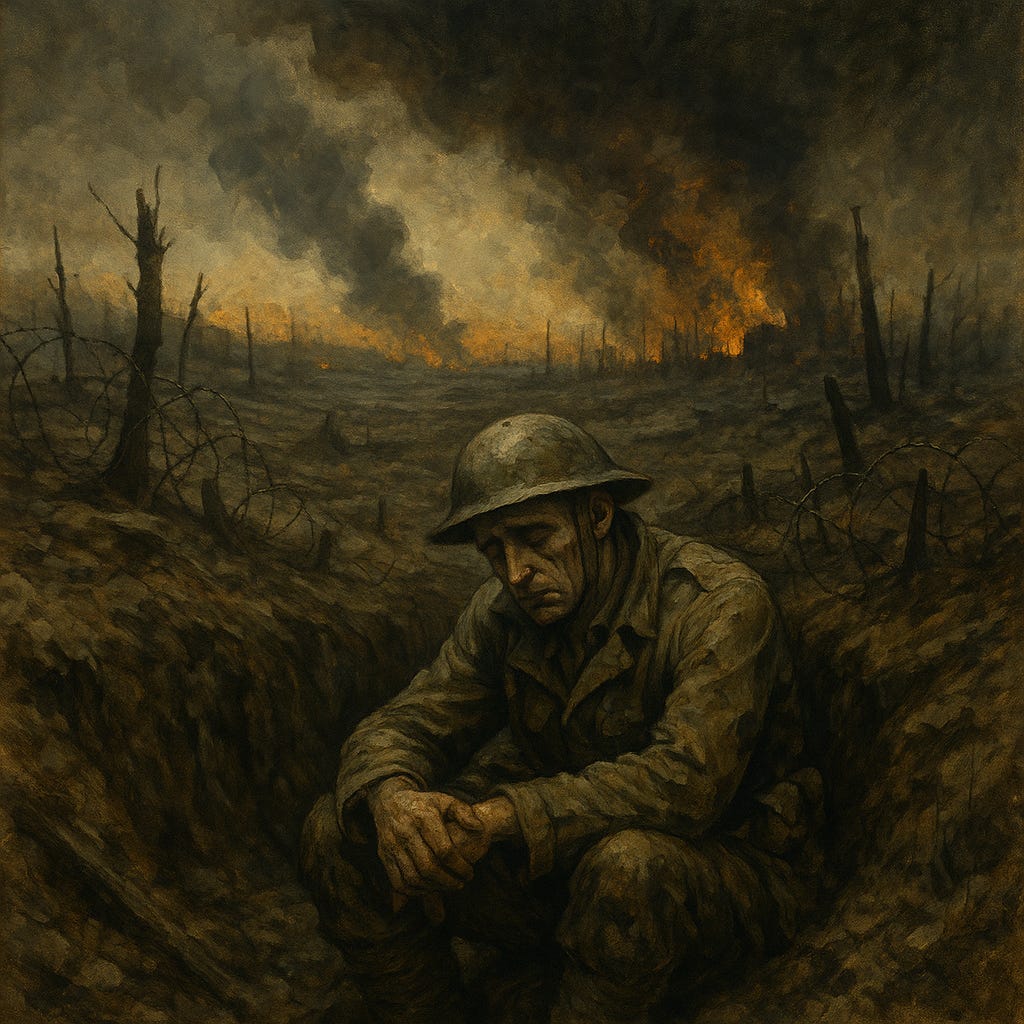
God does not appear as an engineer fixing systems, but as a lover entering the wound. In the context of war, this means that God may be present in the trench, in the hospital, in the exile’s lament. Not necessarily to prevent pain, but to inhabit it. The relationship with God, in Stump’s theology, is not a system of rewards but a second-person bond: someone who sees you, hears you, is with you.
There is no promise of automatic healing. But there is the possibility of redemption. The survivor who finds meaning in serving others. The soldier who weeps for his guilt and seeks reconciliation. The displaced person who prays from exile. Grace is not the restoration of justice, but the possibility of communion. Sometimes visible, sometimes hidden — but real.
To think about war through Eleonore Stump is to think of it from the concrete soul. From the one who suffers, not from the court. From the betrayed love, not from power. And in doing so, to open a possibility: that God does not flee the battlefield, even if He does not prevent it. That there is hope even among the ruins. That evil does not have the final word.
And that love, even when broken, may be the beginning of healing.
Sufrir en la trinchera del alma
Una lectura de la guerra desde la filosofía de Eleonore Stump
Israel Centeno
La guerra es uno de los rostros más crudos del mal. En ella se condensan la destrucción, el dolor físico, la pérdida, la humillación, el miedo y, muchas veces, la pérdida de sentido. Pero ¿cómo pensar el sufrimiento que brota de la guerra sin caer en frías justificaciones políticas o teológicas que ignoren la vivencia encarnada del que sufre? A esta pregunta intenta responder la lógica filosófico-teológica que Eleonore Stump desarrolla en Wandering in Darkness, una obra que propone una forma narrativa y personalista de aproximarse al mal.
Stump parte de una intuición radical: el sufrimiento no es solo un problema filosófico, es una experiencia vivida. Y como tal, no basta con explicarla; hay que habitarla. Pensar la guerra desde esa perspectiva es rehusarse a mirarla desde el éxito militar o la estrategia política. Es mirarla desde el corazón del soldado, del civil, del exiliado, del enemigo vencido y del que nunca quiso tomar parte. Porque incluso cuando el mal parece venir de estructuras impersonales, el alma sigue siendo el lugar donde ese mal se sufre y se decide.
En el centro del pensamiento de Stump está la libertad. Dios permite la libertad humana porque sin ella no es posible el amor verdadero. Pero esa misma libertad permite también el error, la traición, la violencia. La guerra aparece, entonces, como una herida colectiva causada por decisiones libres mal ejercidas. Pero también es el campo de batalla de muchas almas que no tuvieron elección y que sufren sin entender por qué.
Frente a las explicaciones que quieren justificar el mal, Stump insiste en que lo que una teodicea debe ofrecer no es un argumento abstracto, sino algo que tenga “accesibilidad interior”: una forma de acompañar al que sufre. Dios, si ha de ser bueno, no puede ser ajeno. Pero si ha de amar, tampoco puede forzar. Ahí está el misterio de su presencia: no interrumpe la libertad humana, pero tampoco se ausenta. Como Cristo en Betania, que llora antes de resucitar a Lázaro. Como Cristo en Getsemaní, que pide no sufrir, pero acepta beber el cáliz.
La guerra hiere el cuerpo, pero también divide el alma. Muchos soldados, muchos civiles, actúan en contra de su conciencia por miedo, por presión o por confusión. La filosofía de Stump se detiene en esa división interna. La llama “fragmentación de la voluntad”: el alma quiere una cosa, pero hace otra. Esa división no solo causa culpa, también causa sufrimiento profundo. Y muchas veces, una vez rota la unidad interior, la persona queda incapacitada para amar, para confiar, incluso para creer.
Pero hay algo aún más inquietante: cuando los hombres llegan a creer que matar es justo. No solo necesario, no solo inevitable, sino bueno en sí mismo. Aquí el alma ya no actúa dividida, sino en una falsa unidad consigo misma, cegada por una lógica que ha suplantado la voz de la conciencia por una ideología o un mandato colectivo. Se mata no con pesar, sino con convicción. Se destruye al otro como si se cumpliera una virtud. Este fenómeno, profundamente deshumanizador, requiere de una anestesia moral: el enemigo deja de ser humano, el yo se disuelve en una causa, la responsabilidad se diluye en el “deber”. La voluntad se alinea, pero en una dirección equivocada. Para Stump, esta es una forma perversa de integridad: una voluntad coherente con un fin erróneo. Solo una gracia que irrumpe desde fuera —una palabra, una mirada, un rostro amado que regresa a la memoria— puede entonces quebrar esa coherencia y abrir el alma a la compunción. A veces basta un niño muerto en los brazos, una oración que irrumpe sin ser llamada, o el rostro del enemigo que se parece demasiado al del hermano. Esa grieta es el umbral donde puede comenzar el despertar moral, y con él, la sanación.
Dios no aparece como un ingeniero que corrige sistemas, sino como un amante que entra en la herida. En el contexto de la guerra, eso significa que Dios puede estar en la trinchera, en el hospital, en el lamento del exiliado. No necesariamente para evitar el dolor, pero sí para habitarlo. La relación con Dios, en la teología de Stump, no es un sistema de recompensas, sino un vínculo de segunda persona: alguien que te mira, que te escucha, que está.
No hay una promesa de sanación automática. Pero sí una posibilidad de redención. El sobreviviente que encuentra sentido sirviendo a otros. El combatiente que llora su culpa y busca reconciliación. El desplazado que reza desde el exilio. La gracia no es restitución de justicia, sino posibilidad de comunión. A veces visible, a veces secreta. Pero real.
Pensar la guerra desde Eleonore Stump es pensarla desde el alma concreta. Desde el que sufre, no desde el tribunal. Desde el amor traicionado, no desde el poder. Y en ese pensar, abrir una posibilidad: que Dios no huye del campo de batalla, aunque no lo evite. Que hay esperanza incluso entre las ruinas. Que el mal no tiene la última palabra.
Y que el amor, aun roto, puede ser el inicio de la sanación.


 Centeno's Lighthouse