Tag: philosophy

  • 🇪🇸 La apertura del alma III: El espíritu que comprende/🇬🇧 The Opening of the Soul III: The Spirit That Understands

    Israel Centeno

    En la última curva del pensamiento de Edith Stein sobre la empatía, el horizonte se amplía. Ya no se trata solo de comprender los actos o los sentimientos ajenos, sino de reconocer la existencia del espíritu mismo que actúa, crea, ama y deja huella. Comprender, para Stein, no es solo interpretar, sino tocar, por un instante, el corazón invisible del mundo: su espíritu.

    La empatía abre el paso de la psicología a la historia. Sin ella, el pasado se reduce a crónicas vacías, a un catálogo de hechos sin alma. Pero con ella, el historiador o el filósofo ve encenderse, detrás de las acciones, el fuego que las mueve. Un solo gesto, una frase en una carta, puede revelar más del espíritu de una época que todos los archivos reunidos. Quien comprende desde la empatía penetra lo que Stein llama la inteligibilidad del carácter: no la copia de lo que sucedió, sino su sentido vivo. Lo histórico se vuelve real cuando el espíritu se hace presente en el comprender.

    Para Stein, el ser humano pertenece a dos mundos: el natural y el espiritual. La historia, si quiere ser verdadera, debe escuchar a ambos. Debe constatar los hechos, pero también captar la lógica secreta del espíritu, su legalidad racional, su aspiración al bien y a la verdad. De lo contrario, la historia degenera en un recuento ciego de causas y efectos, y el espíritu —ese mismo que da forma al destino de los pueblos— desaparece.

    Aquí aparece el diálogo con Dilthey. Ambos comparten la convicción de que la vida del espíritu está sometida a una legalidad racional. Pero Stein distingue entre la forma racional y el valor material. Una acción puede ser formalmente correcta y, sin embargo, carecer de peso moral si el valor perseguido es inferior. Hay un orden jerárquico que mide la profundidad de cada acto, una armonía entre la claridad del juicio y la nobleza del motivo. La inteligencia sola no basta; el espíritu se conoce por el modo en que ordena sus amores.

    La empatía, por eso, no es mera simpatía, sino un acto espiritual que reconoce en el otro un mundo de valores. A través de ella comprendemos tipos personales —estructuras estables de sentido— y los reconocemos como modos posibles de ser persona. Empatizar, en este nivel, no es imitar: es abrirse a lo inteligible en el otro, incluso cuando ese otro me excede. Puedo entender, sin serlo, al hombre religioso; puedo ver en su entrega un valor que reconozco como verdadero aunque yo no lo viva. La empatía revela, así, no solo la diversidad humana, sino la unidad del espíritu que se manifiesta en múltiples formas.

    De ese movimiento hacia afuera surge el conocimiento más profundo de uno mismo. Al comprender a otros, se despiertan en mí regiones dormidas: virtudes, carencias, anhelos. La empatía con naturalezas semejantes despierta lo latente; la empatía con naturalezas distintas ilumina lo que no soy. En ambos casos, el yo se amplía. Conocer al otro es reconocerse en lo que se es y en lo que falta. El espíritu se educa a sí mismo al reconocer los grados del valor en la vida ajena.

    Pero Stein no ignora el límite. Toda comunicación espiritual, en nuestra condición humana, está mediada por la corporalidad: la voz, la mirada, la escritura, la acción. No conocemos un espíritu puro sino a través de su encarnación. Y, sin embargo, deja abierta la pregunta: ¿puede el espíritu relacionarse directamente con el espíritu, sin mediaciones? Alude a quienes experimentan la gracia como una irrupción interior, un toque de lo divino que transforma el alma sin palabras. No afirma ni niega; se detiene en el umbral del misterio.

    En ese “non liquet” —esa suspensión reverente— se cierra su búsqueda filosófica y se abre el camino teológico. La empatía, que comenzó como método de conocimiento, termina como experiencia de comunión. Comprender al otro es participar en su ser; y en esa participación, el alma toca algo del Absoluto. No hay comprensión plena sin amor, ni amor verdadero sin reconocimiento espiritual. Comprender, al final, es dejar que el espíritu del otro revele la forma de Dios en nosotros.


    🇬🇧 The Opening of the Soul III: The Spirit That Understands

    In the final curve of Edith Stein’s reflection on empathy, the horizon widens. It is no longer only about understanding another’s acts or feelings, but about recognizing the very existence of the spirit that acts, creates, loves, and leaves traces. To understand, for Stein, is not merely to interpret, but to touch —for an instant— the invisible heart of the world: its spirit.

    Empathy opens the passage from psychology to history. Without it, the past is reduced to hollow chronicles, a catalogue of soulless events. But with it, the historian or philosopher perceives, behind actions, the fire that moves them. A single gesture, a line in a letter, may reveal more of the spirit of an age than all its archives. To understand through empathy is to penetrate what Stein calls the intelligibility of character: not the copy of what occurred, but its living meaning. History becomes real when the spirit becomes present in comprehension.

    For Stein, the human being belongs to two worlds: the natural and the spiritual. True history must attend to both. It must register facts, but also perceive the hidden logic of spirit —its rational law, its longing for good and truth. Otherwise, history degenerates into a blind chain of causes, and spirit—the very force shaping nations and souls—vanishes from view.

    Here arises her dialogue with Dilthey. Both recognize a rational structure governing spiritual life. Yet Stein distinguishes between formal rationality and material value. An act may be formally correct and still lack moral weight if it pursues an inferior good. There is a hierarchy of values that measures the depth of every act, a harmony between the clarity of reason and the nobility of motive. Intelligence alone is not enough; the spirit is known by the order of its loves.

    Empathy, then, is not mere sympathy but a spiritual act that perceives in the other a world of values. Through it, we understand personal types—stable structures of meaning—and recognize them as possible ways of being a person. Empathy at this level is not imitation; it is openness to what is intelligible in the other, even when it surpasses me. I can understand the homo religiosus without sharing his faith; I can see in his sacrifice a value that I acknowledge as true, even if I do not live it. Thus empathy discloses not only human diversity but the unity of spirit manifested in countless forms.

    From that movement outward arises the deepest self-knowledge. In understanding others, dormant regions awaken within me: virtues, lacks, desires. Empathy with similar natures revives what lies latent; empathy with different ones illumines what I am not. In both cases, the self expands. To know the other is to recognize both one’s fullness and one’s need. The spirit educates itself by discerning the degrees of value in another’s life.

    Yet Stein does not ignore the limit. All spiritual communication, in our human condition, is mediated by the body—by voice, gaze, writing, and action. We do not know pure spirit except through its incarnation. Still, she leaves open the question: can spirit relate to spirit directly, without mediation? She evokes those who experience grace as an interior breakthrough, a divine touch transforming the soul without words. She neither affirms nor denies; she pauses reverently at the threshold of mystery.

    In that non liquet—that luminous suspension—her philosophical inquiry closes and the theological path opens. Empathy, which began as a method of knowledge, ends as an experience of communion. To understand another is to participate in his being; and in that participation, the soul touches something of the Absolute. There is no true understanding without love, and no true love without spiritual recognition. To comprehend, in the end, is to let the spirit of the other reveal the form of God within us.
  • The Return of the Soul:Brandon Rickabaugh and J.P. Moreland and The Substance of Consciousness

    Israel Centeno


    Brandon Rickabaugh and J.P. Moreland have written a book that is both a refined rebuttal and a meticulous provocation. The Substance of Consciousness is not merely another defense of substance dualism; it is a contemporary rearticulation of an intuition that has long been buried—not refuted—under the weight of philosophical, ideological, and scientific prejudice. The thesis is clear: consciousness resists reduction, and the self, as the subject of experience, cannot be dissolved into brain functions or physical correlates without betraying the very nature of experience itself.

    From the opening pages, the reader is confronted with striking admissions. Notable materialists, like William Lycan, openly confess the insufficiency of the arguments for materialism. Russellian monists like José Gusmão Rodrigues lament the anti-dualist assumptions rampant in philosophical literature. Figures like Chalmers and Searle suggest that the rejection of dualism has more to do with fear than with reason—a fear of sounding religious, a fear of reviving Descartes, a fear of the soul. In this sense, the book is not merely arguing with theories, but with a cultural atmosphere that has pathologized certain questions. Why do we reject dualism? Is it conviction, or is it philosophical habit?

    Rickabaugh and Moreland do not fall back on easy arguments. They do not rescue dualism with nostalgia or mere appeals to intuition. Instead, they engage with precision, blending analytic philosophy, the history of metaphysics, cognitive science, and philosophical theology. By reminding us that dualism is not exclusive to theism—as shown by atheists like Popper, Huemer, and Fales—the authors dismantle the assumption that every defense of the soul is religious propaganda. At the same time, they demonstrate how theism provides a richer and more coherent framework for understanding what consciousness reveals about reality.

    One of the book’s most notable contributions is its critique of the disappearance of the “self” from 20th-century analytic philosophy. As philosophers grew obsessed with mental states, functions, and qualia, they lost sight of the subject who experiences them. Rickabaugh and Moreland recover the self—not as a vague construct, but as the ontological center of consciousness. They do so with philosophical rigor and without surrendering to scientism or metaphysical panic. The self returns, and with it, the mystery of the human.

    In an era where physicalism struggles to resolve the hard problem of consciousness—and theories like panpsychism and Russellian monism gain traction—the authors make their stance clear. This is not a syncretic compromise; it is a radical recovery. There are substances, and among them, at least one that thinks. The soul is not an illusion, not an epiphenomenon. It is the very condition of possibility for experience.

    Far from being an outdated apology, The Substance of Consciousness is a philosophical manifesto for our time. It dares. It refuses to flatter intellectual trends. And it reminds us that some truths, though denied, remain—waiting to be thought again, with courage.

  • Media Sacrifices.

    Girard, Aquinas, and the Banality of Evil in the Culture of Spectacle

    Israel Centeno

    Revisiting the Menéndez family case isn’t just a return to a chilling crime. It’s a distorted mirror reflecting the deeper cultural mechanisms at play in contemporary Western society. The Menéndez brothers brutally murdered their parents, José and Kitty Menéndez. It was a premeditated act, carried out with cold precision. And yet, after a televised trial—like that of O.J. Simpson—and years of media coverage, the narrative has shifted.

    Today, documentaries on popular streaming platforms no longer frame the parents as the main victims. The spotlight has moved. Childhood suffering, alleged abuse, trauma… The sons—self-confessed perpetrators—are now seen by many as victims. In this postmodern narrative, guilt dissolves. There is no evil. No sin. Only “contexts.” Only trauma. Only “systems.”

    From René Girard’s perspective, this is no accident—it’s mimetic logic. Society seeks a scapegoat, someone onto whom it can project its own frustrations, guilt, and hatred. At first, the sons were the scapegoats. They were convicted. But then, in a second mimetic turn, society redirects its longing for absolution toward them, and shifts the sacrificial blame onto the parents—now cast as the real culprits. Their crime? Representing authority, success, and privilege. Having already been physically murdered, they are now symbolically killed.

    This pattern repeats endlessly in our culture. Take the recent case of a health insurance CEO, gunned down in broad daylight and captured on a security camera. The killer, far from being labeled a criminal, was raised by media narratives to Robin Hood status. The story is rewritten: the perpetrator becomes the victim of “the system.” The real victim—the man shot—is erased. His face, his life, no longer matter. What matters is what he symbolized.

    And what did he symbolize? Power. Authority. Capital. The paternal figure. What the collective desire needs to destroy in order to declare itself innocent.

    Here Girard’s logic resounds with force: we are living in a culture that depends on rotating scapegoats to sustain cohesion and relieve guilt. The problem is that there’s no longer any ritual to channel the sacrifice. No altar, no redemption, no confession. Only spectacle. Only screens. Only live-streamed social trials.

    Through the lens of Thomas Aquinas, this culture reveals a structural absence of the good. For Aquinas, the good is not simply what pleases or benefits—it is what perfects a being in accordance with its nature. But in today’s mediatized world, that kind of perfection no longer matters. What is rewarded is what shocks, what provokes, what “goes viral.” The good is replaced by engagement.

    And when the notion of the good is lost, so is the idea of true guilt. There is no justice, only justification. No conversion, only competing narratives. Sin is no longer sin if it’s well explained. Murder is not murder if the “context is understood.” Slowly, hell ceases to be a place, becoming instead a screen where we all play the role of faceless judges.

    In American society—the epicenter of these phenomena—we are witnessing a deeper spiritual decomposition: the cult of fame, of exposure, of celebrity. We see it in the grotesque phenomenon of people falling in love with serial killers, writing letters to convicted criminals, or making viral content out of those who have openly embodied evil. What should horrify us now seduces. What ought to remain hidden is broadcasted.

    Why?

    Because hierarchy has dissolved. There is no longer good or evil, only “narratives.” No longer truth, only “perspectives.” God has been removed from the stage, as Nietzsche foresaw—not to make room for freedom, but to leave a void. And in that void echoes the hollow fascination with spectacle, violence, and nameless evil.

    This is what Hannah Arendt called the banality of evil. But now, that banality is not merely tolerated—it is adored. Evil is not just normalized—it is celebrated. It becomes desirable. It becomes content. It becomes trending.

    Girard would say that we adore the desires of others. That’s why we rush to look at what others are watching, to share what outrages, to viralize what scandalizes. But when that collective desire has no moral limits, it becomes a perpetual engine of sacrifice, where anyone can become a victim—and anyone, even a murderer, can become an idol.

    And so we live in a society with no center, no altar, no truth. The loudest voice wins the narrative. And what was once sacred—life, truth, innocence—is reduced to a currency in the infinite cycle of spectacle.

    Can Christians still speak of goodness, guilt, and justice without being canceled by the new priests of the trending topic?

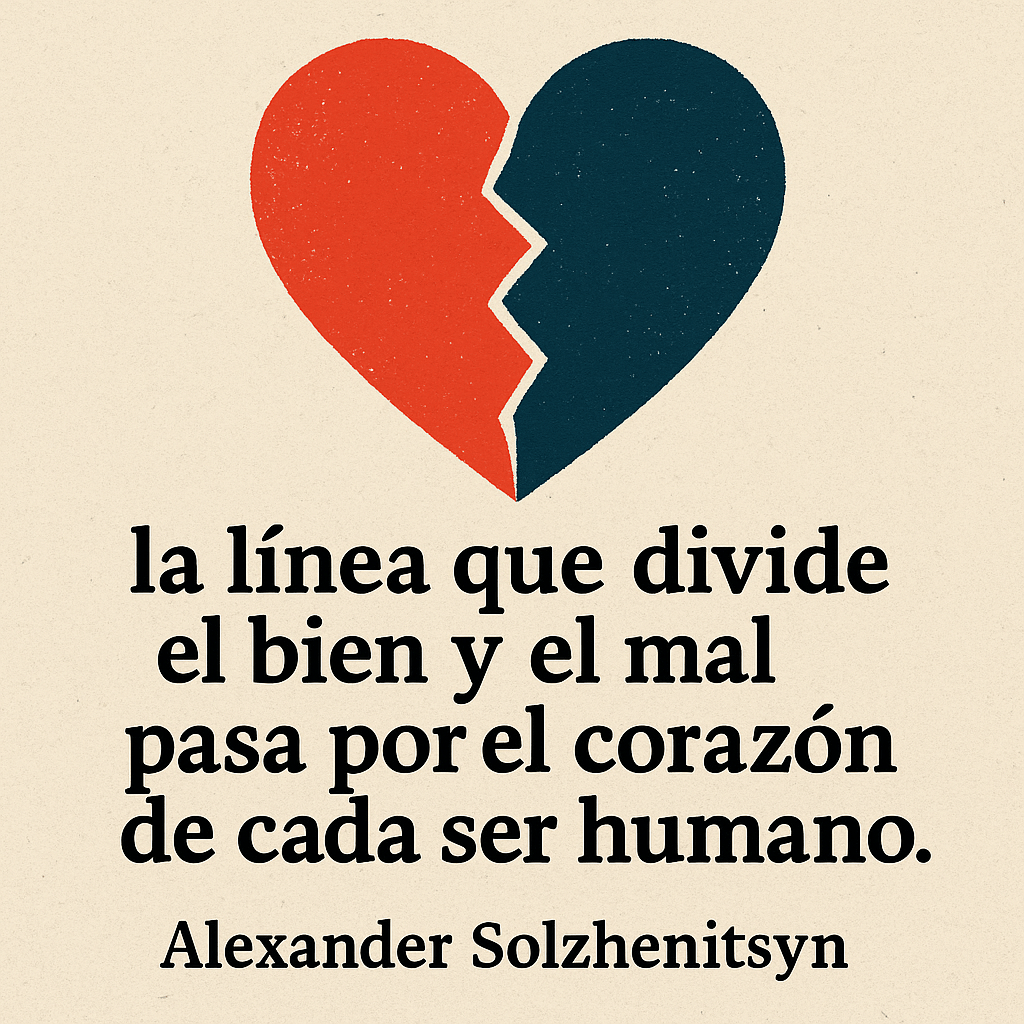
    Perhaps. But only with courage, compassion, and a deep awareness that evil is not merely “out there”—as Solzhenitsyn wrote, “the line dividing good and evil cuts through the heart of every human being.”

    And in a culture that has forgotten the heart, perhaps the only way to heal is to look up again.

    But the spectacle doesn’t end there. In the darker corners of digital culture, a new symptom of collapse emerges: the rebirth of totalitarian imagination. Hitler is no longer condemned with the moral clarity once deemed sacred. Stalin’s name no longer strikes fear. These figures return, like ghosts reshaped by scandal aesthetics and ironic provocation—figures who embodied absolute evil in the 20th century.

    Social media accounts now exalt their “strategic brilliance,” relativize their crimes, aestheticize their legacies. Young people who never experienced the horror consume it as entertainment, as an emblem of unchecked power. Ironic memes multiply, revisionist podcasts abound. It is the return of the repressed—without shame, without mourning, without awareness.

    And this doesn’t happen in a vacuum. It is the predictable result of removing God from the center. Without transcendence to orient our values, without truth to resist mimetic frenzy, the human soul is adrift—open to any fascination. And so Girard’s cycle reactivates in full: desire imitates, rivalry escalates, violence erupts, another sacrifice is demanded.

    When no new victim is available, an old one is summoned: the Jew, the foreigner, the other. Anti-Semitism returns. Xenophobia resurfaces. Values are inverted. The world plays with fire again, unaware that it has already burned everything down.

    Because when we abandon the notion of the good, the monstrous doesn’t vanish—it disguises itself, reinvents itself, goes viral.

    And in the end, the only real barrier against this infinite loop of destructive mimeticism is not the right ideology, the just party, or the perfect economic system.

    It is the human heart pierced by grace.
    It is God.
    Or the abyss.

  • The Contradictions of Penrose

    From the series: Modern and Fatigued Prometheuses

    Israel Centeno

    Or Truths That Contradict Themselves

    “Science, if pursued earnestly, leads to God.”
    —Edith Stein

    “The most incomprehensible thing about the universe is that it is comprehensible.”
    —Albert Einstein


    I. Introduction: The Prometheus of Modern Thought

    Roger Penrose is one of the last giants of modern science. A brilliant mathematician, a visionary physicist, and a 2020 Nobel laureate for his work on black holes and gravitational singularities, he helped shape the intellectual framework of contemporary cosmology. Yet in his final years, this towering figure has begun to contradict himself: he questions the foundations of quantum mechanics, revises his own views on the origin of the universe, and proposes a quantum theory of consciousness while resisting the notion of a spiritual soul.

    Not out of superficiality, but perhaps because he has reached the limits of the method. He senses that there is a deeper order, that the universe cannot be the result of blind chaos. But rather than taking the leap into metaphysics, he remains suspended at the threshold, where his truths begin to fracture into contradictions.

    This essay is not an attack on Penrose, but a meditation on the intellectual tensions he embodies. It is a tribute to his honesty — and a critique of his reluctance to step into the metaphysical light.


    II. Two Incomplete Maps: Micro and Macro Without a Bridge

    Modern physics stands on two foundational theories:

    • General Relativity (Einstein, 1915): describes the universe at large scales — gravity, space-time curvature, black holes.
    • Quantum Mechanics: describes the behavior of matter at subatomic levels — uncertainty, superposition, entanglement.

    Each works exquisitely within its domain. But they do not reconcile. The search for a theory of “quantum gravity” — a unified framework — remains elusive.

    Penrose has long criticized the standard Copenhagen interpretation of quantum mechanics, claiming that the collapse of the wavefunction must have an objective cause, not merely a probabilistic one. But he has not yet presented a full replacement theory, leaving the central chasm unresolved.


    III. Consciousness: A Rift Science Cannot Cross

    Penrose ventures even further when, with anesthesiologist Stuart Hameroff, he introduces the Orchestrated Objective Reduction (Orch-OR) theory — the idea that consciousness arises from quantum processes in the microtubules of the brain’s cytoskeleton.

    Here arises a profound inconsistency:

    • He rejects quantum mechanics as currently formulated.
    • Yet he uses quantum mechanics to explain the most immaterial and mysterious phenomenon: human consciousness.

    The theory, though imaginative, solves nothing. It introduces elements that are neither provable nor falsifiable, stepping outside the empirical method — without admitting the shift into metaphysics.


    IV. What Physics Cannot Grasp: The Nature of the Soul

    At the heart of the matter is this: consciousness is not matter.
    It cannot be weighed, duplicated, or scanned. It cannot be broken down into subcomponents or reduced to probabilities. Consciousness is the act by which the self becomes aware of itself, remembers, judges, chooses, and creates.

    I use my brain, yes.
    But the thinker is not the brain.
    It is the soul using the brain as an instrument.

    No MRI scan will ever locate a moral conviction.
    No particle accelerator will ever detect love, dignity, or hope.
    Because these belong not to the world of mass and motion, but to the invisible realm of spirit.


    V. Logic Is Not Matter

    Here lies the essential paradox: to do science, one must think.
    To think, one must use logic. And logic is not physical.

    • It has no mass or charge.
    • It is not made of particles.
    • It cannot be located in space.

    Logic — like grammar, syntax, symbols, mathematics — is an invisible architecture that shapes all reason. It is used in every scientific formula, but it belongs to the realm of metaphysics.

    How then can physics, which depends on logic, explain the very mind that generates logic?

    It is like trying to weigh a metaphor.
    Or to photograph a decision.
    Or to isolate a dream with a microscope.


    VI. The Legitimate Horizon of Science

    Science can say, honestly:

    “There exists a being — the human —
    that transcends the animal.
    Who uses the body but is not reducible to it.
    Who thinks, narrates, chooses, and loves.”

    That is its noble threshold.
    But if science tries to explain this being as pure matter, it betrays itself.
    It uses material tools to examine what is not material.


    VII. God and the Limits of Method

    God cannot be proven scientifically.
    But He cannot be ruled out either.
    Because God is not a hypothesis among others.
    He is the foundation of being, the ultimate Reason, the Logos.

    Einstein sensed this with humility:

    “The eternal mystery of the world is its comprehensibility.”
    “I want to know how God created this world. The rest is detail.”

    He also referred to the low entropy at the origin of the universe as the “fingerprint of God” — a mysterious order too precise to be accidental.

    Edith Stein, philosopher, mystic, and martyr, wrote:

    “Science, if pursued earnestly, leads to God. And it has led many to the doorstep of faith.”


    VIII. The Soul Cannot Be Split

    What Penrose shows us, perhaps unintentionally, is the limit of naturalism.
    The point at which physics becomes myth — or worse, theology without God.

    Because:

    • The soul cannot be split.
    • The will cannot be measured.
    • Consciousness cannot be engineered.

    To explain the soul as if it were a particle is to reduce man to mechanism.
    And to explain freedom without spirit is to turn the human being into an illusion.

    At some point, the scientist must remove the lab coat
    and enter barefoot into the sanctuary of mystery.


    IX. Epilogue: When Thought Becomes Prayer

    There is a kind of thought that ends not in formula, but in adoration.

    Edith Stein knew it. Einstein suspected it.
    Even Penrose, in his own way, stands at its edge.

    If the universe is intelligible, then there is a Logos.
    And if there is Logos, then consciousness is not an accident,
    but a summons.

    And if there is a summons,
    there is Someone who calls.

    And that Someone, though beyond proof,
    is more real than all proofs,
    for He is the very source of reason, love, and being.


    “Real thinking does not end in formulae, but in contemplation.”
    —Simone Weil


    📚 References

    • Penrose, Roger. The Emperor’s New Mind. Oxford University Press, 1989.
    • Penrose, Roger & Hameroff, Stuart. Consciousness in the Universe: Neuroscience, Quantum Space-Time Geometry and Orch-OR Theory. Journal of Cosmology, 2011.
    • Stein, Edith. The Science of the Cross. ICS Publications, 2002.
    • Einstein, Albert. The World As I See It. Philosophical Library, 1949.
    • Weil, Simone. Gravity and Grace. Routledge, 2002.

  • Romantic Shadows: When Right and Left Need Each Other to Exist

    Israel Centeno

    One of the few things that can be said with any certainty in our time is that politics has ceased to be about governance and become a theater of projection. The right and the left, in their current forms, no longer represent coherent ideologies; they function instead as mirrors, each defined by its hatred of the other. What we are witnessing is not a battle of ideas but a battle of reflexes. And as Carl Jung noted, the shadow we refuse to acknowledge in ourselves will inevitably appear in the face of our enemy.

    But this is not new. This is political romanticism, reincarnated.

    In the nineteenth and twentieth centuries, fascism and communism did not arise as symmetrical opposites. They were mirror images—each born from disillusionment with Enlightenment rationalism, each promising a redemption of history, a restoration of meaning, and a heroic future built upon sacrifice. Both movements relied on emotion over reason, myth over analysis, identity over universality. Both were totalizing. Both demanded enemies to define themselves.

    Today, that romanticism has returned—not in the form of grand ideologies, but as reactive tribalism dressed in digital aesthetics.

    The new populist right and the progressive identitarian left no longer resemble traditional conservatism or classical liberalism. They resemble, in attitude and structure, the old romantic ideologies of Europe:
    — the exaltation of feeling over thought
    — the sacralization of collective identity
    — the desire to break with the “corrupt present”
    — and the longing for a purifying crisis.

    Both sides offer an emotional theater. They no longer argue policy—they narrate moral epics. Their currency is outrage. Their method is exposure. Their weapon is humiliation. And they both rely on simplified archetypes: the oppressor, the victim, the savior.

    In this ecosystem, a name like Rosa Luxemburg becomes a brand. Her writings are not read, her contradictions not studied. She is invoked to validate the instinct, not to challenge it. Likewise, Jung is quoted by young conservatives who have never touched Psychological Types, simply because the word “shadow” sounds deep.

    The problem is not ignorance. The problem is the willingness to perform seriousness without the burden of depth.

    This is not politics. This is the return of the romantic impulse: the desire to redeem the world through purity, struggle, and identity. But it is a romanticism without poetry, without sacrifice—only curated indignation and algorithmic glory.

    Each side believes it is resisting. Each side claims to be the true victim. But in reality, both act within the same structure:
    — moral absolutism
    — the cult of the silenced voice
    — permanent offense as identity
    — and the refusal to engage the other without caricature.

    This was the logic of the 1930s, only now it’s digitized.

    The question is not who is right, but what system of thought can survive when everything becomes romanticized and moralized to the point that no shared framework remains.

    When fascism and communism clashed, they burned books, imprisoned thinkers, and demanded total allegiance. They were enemies, but they were also reflections of one another: both viewed politics as a sacred struggle and justified violence in the name of a better future.

    What we see today may be less violent—so far—but the logic is eerily familiar.

    The romantic shadow is seductive. It offers meaning. It offers identity. It offers clarity in chaos.

    But it never ends well.

    And if history teaches us anything, it is this: when politics becomes a mirror, sooner or later the glass breaks. And when it breaks, it cuts.


    Addendum:

    As of this week, an unexpected political phenomenon is taking shape in the United States: the strong possibility that New York City—the symbolic capital of global capital—may soon be governed by a self-declared Marxist. For the first time in history, a major financial and cultural epicenter could serve as a testing ground for the very ideology it once exiled.

    This has sparked contradictory reactions. Some, with visible suspicion, ask how such a figure could avoid being co-opted, especially given the millions in campaign donations from institutions like Goldman Sachs. Others claim, half-dismissively, “New York isn’t real America.” But the truth is: yes, it is. It is America in its most distilled capitalist form. Everything else is swamp and snakebite.

    If socialism cannot function in the very city where capital concentrates, then where can it function at all?

    The coming months will tell. For now, one thing is certain: even revolutionaries must learn to govern. And when they do, the romance tends to fade.

  • On the Mystery of Consciousness.

    By Israel Centeno

    The human brain is a structural marvel: complex, functional, alive. It is the operations center where stimuli are processed, memories stored, motor responses organized, and commands executed. From it, the heart is regulated, light becomes color, vibration becomes sound, loss becomes pain. It is, without doubt, the most powerful biological device known to science. But it is not consciousness.

    We can observe the brain through MRIs, dissect its lobes, stimulate specific regions electrically, identify patterns in its activity. But no brain scan has ever shown us where a metaphor is born, where a heroic decision takes shape, where forgiveness forms. The brain can become saddened, can release substances that bring us down or lift us up, but it does not know what it is to be sad. It does not know what sadness feels like. Or joy. Or love. The how of emotion, its infinite shades, are not generated in the flesh — they pass through it, but they are not reducible to it.

    This is the abyss David Chalmers called the “hard problem of consciousness”: to explain how qualia —subjective sensations— arise from a purely physical basis. Even if we fully understood the mechanisms that accompany an emotion, we would still have no idea why it feels the way it does. Thomas Nagel put it starkly: “there is something it is like to be a bat,” and no third-person description can capture that first-person experience. The question at hand is not a technical mystery — it is an ontological rupture.

    Even emergentism —the idea that consciousness arises as a higher-order property of organized matter— dissolves under scrutiny. It does not explain why or how this emergence occurs; it merely asserts it. But to name is not to explain. To say that consciousness is an epiphenomenon is to admit we have no clue what we are talking about.

    Panic cannot be described from the inside. We can list its signs: racing heart, sweating, disordered thoughts. But the core of panic —that overwhelming, uncontrollable presence— is ineffable. Two people can experience the same event —a reunion, a wound, a humiliation— and yet feel utterly different. Because every consciousness is a sealed world, accessible only to itself. And that difference in experience, unique and irreducible, can be found in no fold of the temporal lobe.

    The flesh —the body, the brain, the grey matter— is the center of operations. But it is not the seat of the soul. At best, it is the stage. At worst, a prison. What is felt —what is truly lived— cannot be captured by measurements or algorithms. The lab can induce chemical pleasure, but it cannot produce the sweetness of a remembered song in the midst of grief. It can simulate anxiety, but not the internal cry of one who loves and is not loved.

    Physicist Roger Penrose sensed this from another angle: if consciousness were computable, then an algorithm could replicate it. But it is not. Reproducing neural connections is not enough. There is a presence —an interiority— that is not reducible to code or calculation. As Wittgenstein observed, “subjective experience cannot be shared; it can only be shown.”

    We might attempt to write an equation:

    Consciousness = f(brain) + X

    And that X is everything that escapes. Everything that doesn’t fit into machines. Everything that makes me me, and you you. That irreducible remainder is what gives rise to freedom, identity, art, and faith. It is that remainder which allows someone, in the midst of hunger or pain, to give their life for another. It is there that the will is born which defies self-preservation, there where an ethic appears that does not obey evolutionary logic.

    That remainder —ignored by reductionism, vaguely gestured at by emergentism— is, for some, the trace of a soul. Or at least, a sign that there is something in us that is not merely physical. Something that can be wounded without touching the body. Something that can burn without fever.

    To deny this is to deny experience itself. And not even the most advanced science can do that without betraying itself.

    Español

    El misterio de la conciencia

    Por Israel Centeno

    El cerebro humano es una maravilla estructural: complejo, funcional, activo. Es el centro de operaciones donde se procesan estímulos, se almacenan recuerdos, se organizan respuestas motoras, se ejecutan comandos. Desde allí se regula el ritmo del corazón y se interpreta la luz como color, la vibración como sonido, la pérdida como dolor. Es, sin duda, el dispositivo biológico más poderoso conocido por la ciencia. Pero no es la conciencia.

    Podemos observar el cerebro con resonancias magnéticas, diseccionar sus lóbulos, excitar regiones específicas con estímulos eléctricos, identificar patrones en su actividad. Pero ninguna imagen cerebral nos ha mostrado aún dónde se produce una metáfora, dónde nace una decisión heroica, dónde se forma el perdón. El cerebro puede entristecerse, puede liberar sustancias que nos abaten o que nos elevan, pero no sabe qué es estar triste. No sabe cómo se siente la tristeza. Ni la alegría. Ni el amor. El cómo experienciamos las emociones, los matices infinitos del sentir, no se genera en la carne: atraviesa la carne, pero no es reducible a ella.

    Este es el abismo que David Chalmers llamó “el problema duro de la conciencia”: explicar cómo surgen los cualia, las sensaciones subjetivas, desde una base puramente física. Por más que entendamos todos los mecanismos cerebrales que acompañan una emoción, seguimos sin poder explicar por qué esa actividad se siente de una forma determinada. En palabras de Thomas Nagel, “hay algo que es ser un murciélago”, una vivencia desde dentro, y eso no puede ser reducido a una descripción externa. Lo que está en juego aquí no es un misterio técnico, sino ontológico.

    Incluso el emergentismo —esa postura filosófica que intenta salvar al materialismo diciendo que la conciencia emerge como propiedad superior de la materia compleja— termina desdibujando el problema. No explica por qué o cómo ocurre esa emergencia. Solo lo postula como si nombrarlo fuese suficiente. Pero nombrar no es explicar. Decir que la conciencia es un epifenómeno es confesar que no la entendemos.

    No se puede relatar cómo se siente el pánico. Podemos enumerar sus signos: sudoración, taquicardia, desorden mental. Pero el núcleo del pánico —esa presencia devastadora, incontrolable, abrumadora— es inefable. Dos personas pueden vivir un mismo hecho: un reencuentro, una herida, una humillación. Pero cada una sentirá de modo distinto. Porque cada conciencia es un mundo cerrado al que solo accede su dueño. Y esa diferencia experiencial, única, irreductible, no puede localizarse en ningún pliegue del lóbulo temporal.

    La carne, vuelvo a repetir, es el centro de operaciones. Pero no es el lugar donde se manifiesta el alma. En el mejor de los casos, es el escenario. En el peor, una cárcel. Lo que se siente —lo que en verdad se vive— no se deja atrapar por mediciones ni algoritmos. El laboratorio puede inducir placer químico, pero no puede producir la dulzura de una canción recordada en medio de la tristeza. Puede simular angustia, pero no el llanto interior de quien ama y no es amado.

    El físico Roger Penrose lo intuyó desde otra orilla: si la conciencia fuera computable, entonces un algoritmo podría replicarla. Pero no lo es. No basta con reproducir conexiones. Hay una presencia, una interioridad, que no es reducible a código ni a cálculo. Como también sospechó Wittgenstein: “la experiencia subjetiva no se puede compartir; solo se puede mostrar”.

    Podríamos escribir una ecuación:

    Conciencia = f(cerebro) + X

    Y ese X es todo lo que escapa. Todo lo que no entra en las máquinas. Todo lo que hace que yo sea yo, y tú seas tú. Es ese resto irreductible que funda la libertad, la identidad, el arte, la fe. Es ese resto el que hace posible que alguien, en medio del hambre o del dolor, decida dar su vida por otro. Es ahí donde nace la voluntad que contradice el instinto de conservación, la ética que no obedece a la lógica de la especie.

    Ese resto —que el reduccionismo ignora y el emergentismo apenas insinúa— es, para algunos, la huella de un alma. O al menos, el signo de que hay algo en nosotros que no es meramente físico. Algo que puede ser herido sin tocar el cuerpo. Algo que puede arder sin fiebre.

    Negar esto es negar la experiencia misma. Y eso, ni la ciencia más avanzada puede hacerlo sin traicionarse.