Girard, Aquinas, and the Banality of Evil in the Culture of Spectacle
Israel Centeno
Revisiting the Menéndez family case isn’t just a return to a chilling crime. It’s a distorted mirror reflecting the deeper cultural mechanisms at play in contemporary Western society. The Menéndez brothers brutally murdered their parents, José and Kitty Menéndez. It was a premeditated act, carried out with cold precision. And yet, after a televised trial—like that of O.J. Simpson—and years of media coverage, the narrative has shifted.
Today, documentaries on popular streaming platforms no longer frame the parents as the main victims. The spotlight has moved. Childhood suffering, alleged abuse, trauma… The sons—self-confessed perpetrators—are now seen by many as victims. In this postmodern narrative, guilt dissolves. There is no evil. No sin. Only “contexts.” Only trauma. Only “systems.”
From René Girard’s perspective, this is no accident—it’s mimetic logic. Society seeks a scapegoat, someone onto whom it can project its own frustrations, guilt, and hatred. At first, the sons were the scapegoats. They were convicted. But then, in a second mimetic turn, society redirects its longing for absolution toward them, and shifts the sacrificial blame onto the parents—now cast as the real culprits. Their crime? Representing authority, success, and privilege. Having already been physically murdered, they are now symbolically killed.
This pattern repeats endlessly in our culture. Take the recent case of a health insurance CEO, gunned down in broad daylight and captured on a security camera. The killer, far from being labeled a criminal, was raised by media narratives to Robin Hood status. The story is rewritten: the perpetrator becomes the victim of “the system.” The real victim—the man shot—is erased. His face, his life, no longer matter. What matters is what he symbolized.
And what did he symbolize? Power. Authority. Capital. The paternal figure. What the collective desire needs to destroy in order to declare itself innocent.
Here Girard’s logic resounds with force: we are living in a culture that depends on rotating scapegoats to sustain cohesion and relieve guilt. The problem is that there’s no longer any ritual to channel the sacrifice. No altar, no redemption, no confession. Only spectacle. Only screens. Only live-streamed social trials.
Through the lens of Thomas Aquinas, this culture reveals a structural absence of the good. For Aquinas, the good is not simply what pleases or benefits—it is what perfects a being in accordance with its nature. But in today’s mediatized world, that kind of perfection no longer matters. What is rewarded is what shocks, what provokes, what “goes viral.” The good is replaced by engagement.
And when the notion of the good is lost, so is the idea of true guilt. There is no justice, only justification. No conversion, only competing narratives. Sin is no longer sin if it’s well explained. Murder is not murder if the “context is understood.” Slowly, hell ceases to be a place, becoming instead a screen where we all play the role of faceless judges.
In American society—the epicenter of these phenomena—we are witnessing a deeper spiritual decomposition: the cult of fame, of exposure, of celebrity. We see it in the grotesque phenomenon of people falling in love with serial killers, writing letters to convicted criminals, or making viral content out of those who have openly embodied evil. What should horrify us now seduces. What ought to remain hidden is broadcasted.
Why?
Because hierarchy has dissolved. There is no longer good or evil, only “narratives.” No longer truth, only “perspectives.” God has been removed from the stage, as Nietzsche foresaw—not to make room for freedom, but to leave a void. And in that void echoes the hollow fascination with spectacle, violence, and nameless evil.
This is what Hannah Arendt called the banality of evil. But now, that banality is not merely tolerated—it is adored. Evil is not just normalized—it is celebrated. It becomes desirable. It becomes content. It becomes trending.
Girard would say that we adore the desires of others. That’s why we rush to look at what others are watching, to share what outrages, to viralize what scandalizes. But when that collective desire has no moral limits, it becomes a perpetual engine of sacrifice, where anyone can become a victim—and anyone, even a murderer, can become an idol.
And so we live in a society with no center, no altar, no truth. The loudest voice wins the narrative. And what was once sacred—life, truth, innocence—is reduced to a currency in the infinite cycle of spectacle.
Can Christians still speak of goodness, guilt, and justice without being canceled by the new priests of the trending topic?
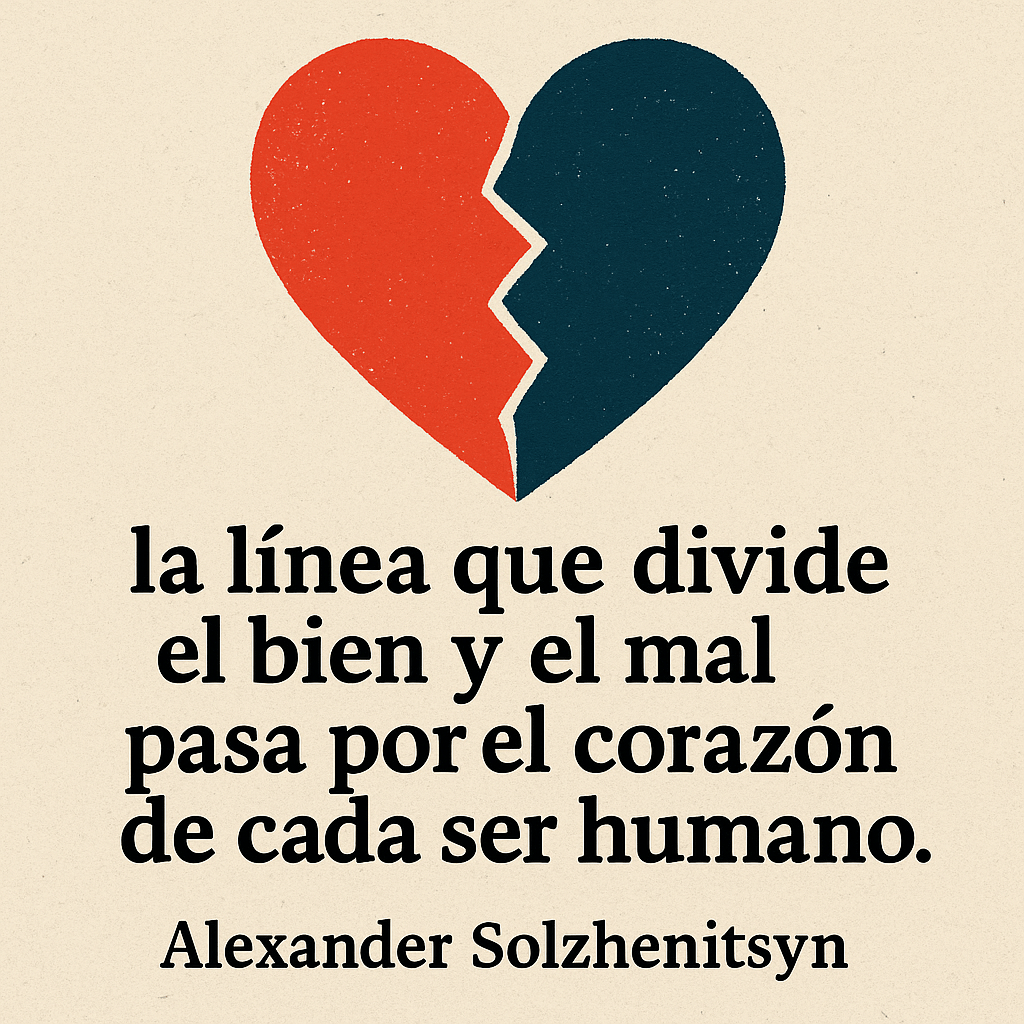
Perhaps. But only with courage, compassion, and a deep awareness that evil is not merely “out there”—as Solzhenitsyn wrote, “the line dividing good and evil cuts through the heart of every human being.”
And in a culture that has forgotten the heart, perhaps the only way to heal is to look up again.
But the spectacle doesn’t end there. In the darker corners of digital culture, a new symptom of collapse emerges: the rebirth of totalitarian imagination. Hitler is no longer condemned with the moral clarity once deemed sacred. Stalin’s name no longer strikes fear. These figures return, like ghosts reshaped by scandal aesthetics and ironic provocation—figures who embodied absolute evil in the 20th century.
Social media accounts now exalt their “strategic brilliance,” relativize their crimes, aestheticize their legacies. Young people who never experienced the horror consume it as entertainment, as an emblem of unchecked power. Ironic memes multiply, revisionist podcasts abound. It is the return of the repressed—without shame, without mourning, without awareness.
And this doesn’t happen in a vacuum. It is the predictable result of removing God from the center. Without transcendence to orient our values, without truth to resist mimetic frenzy, the human soul is adrift—open to any fascination. And so Girard’s cycle reactivates in full: desire imitates, rivalry escalates, violence erupts, another sacrifice is demanded.
When no new victim is available, an old one is summoned: the Jew, the foreigner, the other. Anti-Semitism returns. Xenophobia resurfaces. Values are inverted. The world plays with fire again, unaware that it has already burned everything down.
Because when we abandon the notion of the good, the monstrous doesn’t vanish—it disguises itself, reinvents itself, goes viral.
And in the end, the only real barrier against this infinite loop of destructive mimeticism is not the right ideology, the just party, or the perfect economic system.
It is the human heart pierced by grace. It is God. Or the abyss.
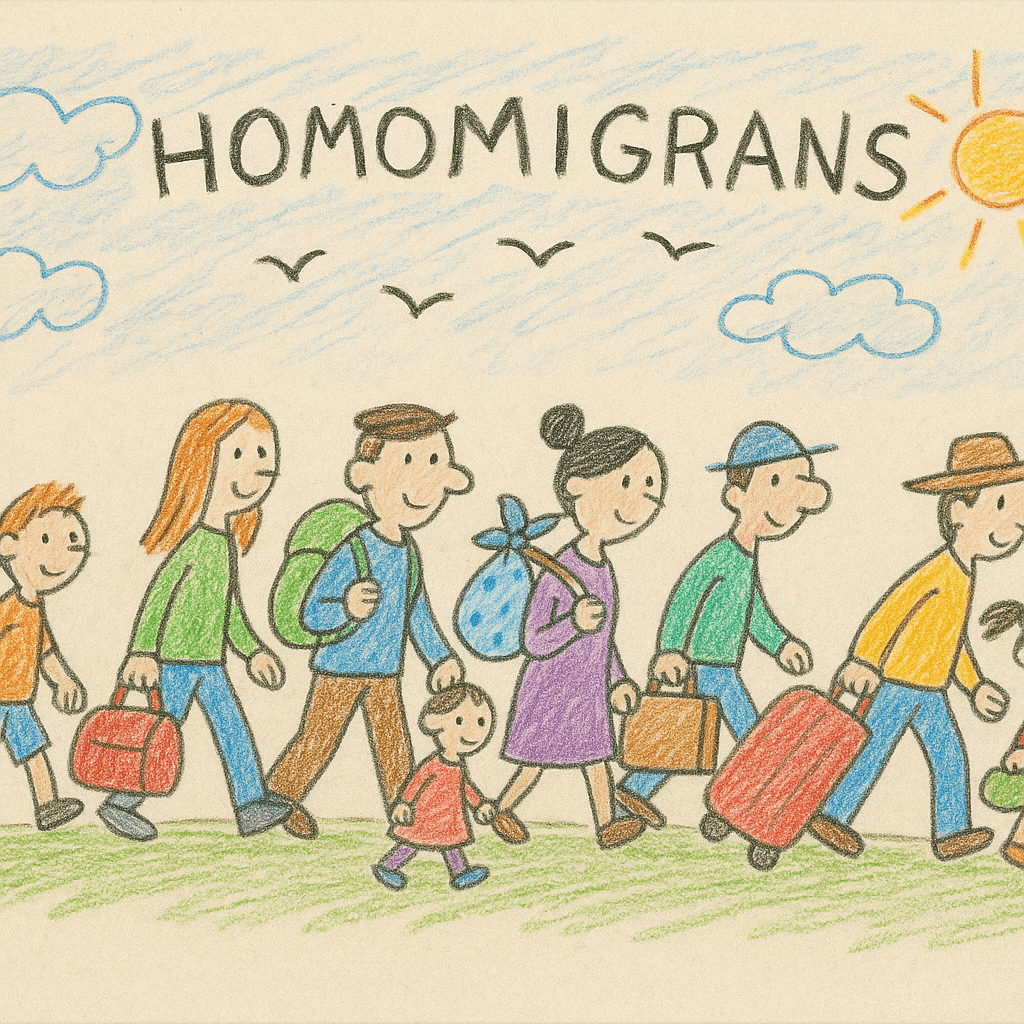
Since the dawn of humanity, people have been on the move. The first great migration was not a conscious choice, but an instinctive impulse. A group of hominids left southern Africa—likely from what is now Angola or the Democratic Republic of the Congo—and crossed jungles, deserts, rivers, straits, and mountain ranges. They did not found cities; they opened roads. Wherever they went, they left traces behind. Homo sapiens are not born sedentary—they are born wanderers.
This migratory drive was the rule, not the exception. From that primal exodus arose peoples, languages, and cultures. The earliest tribes were nomadic groups, wandering and dispersed by necessity. Only with the advent of agriculture, and the pressing need to control the cycles of the seasons, did they begin to settle. Yet even the first settlements did not escape conflict over land. When the land stops moving, humans begin to fight for it.
II. From Tribes to Empires: Space Becomes Power
The transition from tribe to kingdom marked the beginning of a profound transformation: territory was no longer just a source of sustenance, but a symbol of power. Land became inheritance, border, and object of conquest. The first kings emerged as tribal leaders transformed into sovereigns—some by invoking mythical ancestry, others by force. From these kingdoms, empires were born: armed migrations transformed into political order.
The Egyptian Empire marked the start of centralized expansion. The Macedonian Empire—with Alexander the Great as its archetype—demonstrated that conquest could redraw the world. Rome, in turn, defined the modern idea of the territorial state: with roads, citizenship, laws, and the integration of conquered peoples, all at the service of the Imperium.
Each of these imperial systems arose from displacement. Humanity kept moving, but now marched under banners. They no longer fled hunger; now they marched for glory, for faith, for resources. Migration ceased to be mere wandering and became colonization.
Yet empires never truly unified peoples. Beneath the surface, conflict always simmered. Foreigners, when conquered, were sometimes absorbed but more often exploited. This persistent inability to integrate remains a defining flaw of civilization—one we have yet to overcome.
English Version
III. America Before America: Migration, War, and Domination
The migratory history of humanity does not end in Eurasia. The Americas, too, are the product of countless waves of migration, despite modern myths that portray them as pure lands, untouched until the arrival of Europeans.
The most widely accepted theory holds that humans entered the Americas via the Bering Strait during the Paleolithic ice ages, when Siberia and Alaska were linked by a land bridge. Other research suggests additional arrivals from Polynesia or even the South Atlantic. Yet all evidence points to one fact: the Americas were settled by migrants.
These arrivals did not form a single, unified nation but were diverse tribal groups—Chibchas, Mapuches, Guaraníes, Maya, Mexicas, Caribs, Arawaks, among others. Some remained semi-nomadic, while others built empires. The idea of a “single Native American” is a modern fiction. What existed was a network of peoples, each with its own interests and conflicts.
The Mexica (Aztec) Empire The Mexicas were originally a northern people, likely desert migrants. After moving into the Valley of Mexico, they founded Tenochtitlan and rapidly expanded their dominion. They did not unify Mesoamerica—they subjugated it. To the subjugated peoples, the Mexica were a tyranny: exacting tribute, imposing brutal punishments, and practicing human sacrifice. When the Spanish arrived, many native nations allied with Cortés to overthrow the Mexicas.
The Inca Empire The Incas, ruling from Cusco, expanded their reach north and south. Their system was more administrative but no less imperial. An elite organized, displaced, and subdued dozens of Andean peoples. The mit’a system institutionalized forced labor. Integration was achieved through cultural, religious, and military imposition.
War Before the Conquest Even before Columbus set foot in the Americas, the continent was shaped by conflict. Tribal wars, enslavement, shifting alliances, betrayals, and forced migrations were not inventions of Europe. What Europeans introduced was systematic violence and superior technology, reinforcing patterns already present.
Migration in the Americas was never harmonious—it was a struggle for land, power, survival, and meaning.
IV. Europe Colonizes the World… and the World Returns to Europe
With the overseas expansion of European powers in the 15th century, migration shifted in both scale and intention. It was no longer just a quest for land or survival; it became a calculated imperial project. Spain, Portugal, England, France, the Netherlands, and Belgium systematically occupied, exploited, and evangelized every inhabited continent.
The conquest of the Americas, beginning in 1492, marked the first truly global imperial migration. Soldiers were not the only ones to arrive—merchants, monks, bureaucrats, families, and millions of enslaved Africans were also swept into this totalizing movement. This flow subjugated entire peoples and redrew the face of continents.
Colonial Migration as Violent Departure Latin America was populated not only by Iberian Europeans, but also by the dispossessed: peasants, prisoners, adventurers, widows, and refugees from Europe’s own wars. Alongside them came enslaved Africans in the millions. This was not harmonious blending—it was a forced, often brutal, imposed mixing, born from hierarchical and traumatic structures.
Asia and Africa saw similar patterns. Europe did not merely extract resources; it reconfigured the social and territorial foundations of its colonies. Borders in the Middle East, tribal tensions in Africa, and the artificial states drawn in Brussels or London were all products of imperial mapping, far from local realities.
Colonial Migrations: The Inevitable Return Yet, as with all things in history, what goes around comes around. Empires did more than export language, religion, and currency; they opened routes that could never be closed. When these empires collapsed in the 20th century, the former colonies flowed back to the metropoles:
Hindus, Pakistanis, and Caribbeans arrived in the United Kingdom.
Maghrebi and Francophone Africans moved to France.
Congolese settled in Belgium.
Filipinos and Vietnamese came to the United States.
Thus, the colonizers became the hosts.
This created a new phenomenon: the very capitals that once exported colonization began receiving cultures they could not integrate. A new form of xenophobia emerged—the colonizer unable to tolerate becoming a reflection of the world he once subjugated.
Colonization was never just domination. It was the unleashing of flows that cannot be reversed. Europe globalized the world, and now the world—with all its trauma, poverty, and history—has come back to Europe.
But modern states were ill-prepared to integrate these new cultures. Their only skills were to organize, dominate, and draw boundaries. Thus, when migrants arrived, the ghosts of history arrived with them.
V. The 20th and 21st Centuries: Perpetual Flux and the Failure to Integrate
After two world wars, Europe faced a profound paradox. No longer the center of the world, it nonetheless continued to bear the consequences of its imperial past. The migrations of the 20th century were no longer those of explorers or settlers, but of refugees, exiles, the persecuted, and the desperate. The world that Europe had once colonized now returned to haunt it—and it was wounded.
The 20th Century: Wars, Famines, and Exile After the Spanish Civil War, thousands of Republicans fled to Latin America—Mexico, Venezuela, Argentina. During and after World War II, Jews, Poles, Germans, and Italians scattered across the Americas, fleeing Nazism, fascism, communism, and devastation. There were also quiet but significant waves of Irish, Lebanese, Armenian, and Greek migrants—victims of political or economic upheaval—finding new homes in the Americas. Meanwhile, millions of Africans began emigrating to France, Belgium, and England, often unwittingly demanding the moral reckoning of empire.
Latin America, too, became both a land of welcome and, later, a land of expulsion.
In every case, the pattern was the same: a promise of welcome accompanied by mechanisms of exclusion. Exiles were tolerated, but rarely integrated. They carried their language, their color, and their accent as though they were marks of guilt.
The 21st Century: Displacement as the New Norm Today, migration is not an anomaly—it is the global norm. Its causes are almost always the same:
Hunger and climate collapse
Endless civil wars
Failed dictatorships
Drug trafficking and paramilitary violence
Systemic labor exploitation
Countries like Syria, Venezuela, Afghanistan, Haiti, Ukraine, Sudan, and Honduras have suffered mass displacements. These migrants are not tourists or seekers of adventure—they are people cast out by a world that could not make room for them.
And the pattern repeats: migrants arrive, but are not welcomed. They are feared, demeaned, accused, and exploited. Modern states—with their borders, passports, and immigration laws—try to control what is, by nature, restless. Yet human beings continue to wander, and violence flares wherever movement is met with force.
Humanity Still Does Not Know How to Integrate To integrate is to recognize the other as legitimate—as one’s own—not to absorb or impose. Neither the twentieth nor the twenty-first century has achieved this. Each new wave of migration seems to reactivate ancient xenophobic reflexes, seeing the other as a threat rather than a mirror. It is as if we have yet to understand: we are all children of the same ancient journey.
VI. Migration and Rejection: The Return of Ancient Demons
In the twentieth century, humanity witnessed the greatest mass migrations in history—world wars, collapsing empires, revolutions, famines, and ideological and religious exiles. Amid this constant movement, a sinister pattern emerged: the systematic rejection of those who arrive wounded.
The twenty-first century, despite its technology and the rhetoric of human rights, has revived that same rejection. A migrant is no longer just a foreigner; he is seen as an intruder, a suspect, a carrier of disease, crime, and backwardness. What once seemed like a remnant of a barbaric past—open xenophobia and the dehumanization of others—has returned with renewed force.
Echoes of the Interwar Period What is unfolding today in the United States, Europe, the Mediterranean, and at the Colombian-Venezuelan border recalls the rhetoric of the interwar years. In 1930s Germany, Jews were blamed for economic decline. In Vichy France, migrants were considered traitors. In fascist Italy, Slavs were deemed subhuman. The narrative was always the same: “They do not belong,” “They are invading us,” “They are taking what is ours.”
Today, the same refrains echo: “They are stealing our jobs.” “They threaten our culture.” “They contaminate the nation.” “They don’t fit in.”
The only difference is the medium—social networks and twenty-four-hour news cycles. But the narrative of fear is unchanged: someone from outside threatens the purity of what is “ours.” This myth of a pure, homogeneous nation remains the fuel of violence.
Systematic Rejection Is the Seed of Genocide Not every rejection ends in genocide, but every genocide begins with rejection. It begins the moment someone ceases to be “human” and becomes “the other.” From there, it becomes possible to deport, exclude, dispossess—and, ultimately, to exterminate.
Genocide is never born out of chaos; it grows from the idea that “the other” can never be part of us.
In Rwanda, Belgian colonialism stoked and racialized tensions between Hutus and Tutsis, setting the stage for massacre.
In Armenia, the Ottoman Empire made Christian Armenians into internal enemies during World War I, blaming them for military failures.
During the Holocaust, the Jewish people were dehumanized, turned into a “plague,” and reduced to ashes.
In the Balkans at the end of the twentieth century, “ethnic cleansing” was justified by histories of humiliation, failed coexistence, and incompatible identities.
In every case, violence was not an accident—it was the consequence of an idea: the other cannot belong.
Today, we witness the normalization of contempt. Rejection of migrants has become policy, a media spectacle, and a rallying cry for elections. Instead of asking how to integrate, the question is how to repel.
Walls in Texas. Detention centers in Libya. Children in cages. Boats sinking in the Mediterranean. Police confiscating blankets from migrants in Paris. Venezuelan migrants treated as plague in South America.
Humanity still does not learn: those who flee hell find only another hell at the border.
The Problem Is Not the Migrant, But the Failure to Integrate The great failure is not political, economic, or logistical—it is ethical. After centuries of mixing, war, empire, and colonization, humanity still believes that the other is alien. We still fail to recognize the most basic truth:
We are all migrants. Even those with “ancient roots” descend from wanderers.
To deny this is not just a lie—it is a form of moral blindness. And moral blindness breeds hatred, and hatred is the prelude to barbarism.
VII. The Short Memory of Hatred
Today, the loudest voices against migration often come from the far right, but certain far-left nationalist movements also join the chorus. They accuse, stigmatize, and promise to “regain sovereignty,” “cleanse the nation,” or “restore order.” Mass deportations are discussed as if they were merely technical measures, devoid of history or tragedy. What is forgotten—or deliberately denied—is that many of these same voices descend from people who were themselves expelled, deported, or persecuted not so long ago.
From Refugees to Jailers of Discourse What right does a Frenchman, the grandson of a pied-noir, have to expel an Algerian? How can a descendant of Italians who fled famine in 1910 deny entry to an African escaping climate collapse today? What memory does a Spaniard possess, whose grandmother was welcomed in Mexico with shouts of “¡Viva la República!,” when he now votes to close borders and deport Latin Americans? With what moral authority does a Cuban exile speak, if he despises the Central American seeking the same refuge his family sought forty years ago?
The problem is not the reasoned critique of migration systems. The problem is historical hypocrisy, moral cynicism, and the narcissism of prosperity that makes people forget their origins.
No one is forged in stillness. We are all the result of movement, mixture, and flight. To claim a pure identity—cultural, racial, or national—is a dangerous illusion.
A Homeland Is Not Property; It Is a Shared Legacy No land belongs to anyone absolutely. Every territory has been crossed, conquered, lost, reclaimed, and redefined. To believe that the country of our birth is solely “ours” is to deny history, memory, and justice.
Those who propose mass deportations, detention camps, or the suspension of asylum are not defending the homeland—they are destroying its soul. A nation’s greatness is not measured by the walls it builds, but by its ability to integrate others without losing itself, without fear or destruction.
Those who cannot integrate are left only with the path of exclusion and, ultimately, extermination. That is the lesson of the twentieth century.
Remember this, so that we do not repeat it. Today, as the drums of deportation sound again in Texas, Paris, Rome, Budapest, and Buenos Aires, our response must be clear and unwavering:
It is impossible to build the future by denying the past. It is immoral to condemn others to exile when we ourselves are the children of exiles. The migrant who arrives today is the mirror of the grandfather who arrived yesterday. Those who forget this resemblance not only lose their memory—they lose their humanity.
VIII. Identity, the Other, and Hospitality: Who Am I to Say You Are Not From Here?
Across all of human history—with its exoduses, mixtures, conquests, forced marriages, and adaptations—a simple yet uncomfortable truth has been proven time and again: there is no identity without the other.
There is no pure culture, no immutable language, no unmixed people. What we call “our own” is always the result of integration, negotiation, and shared trauma. Yet the myth of closed identity has become a political weapon.
Today, the far right in Spain calls for mass deportations, forgetting that half the country was once made up of war refugees, forgetting the Republican grandparents who found refuge in Mexico, Chile, France, or the USSR. They also forget that Spain itself is Berber, Celtic, Roman, Jewish, Visigoth, Arab, and Latin American all at once.
The identitarian left, meanwhile, often falls into its own trap of essentialism and closed-group victimhood: forgetting that identity is not property or inheritance, but openness.
Who am I to say that you are not from here? This question should resonate in every conscience. Every homeland is borrowed. Every land has been traveled. The world has never belonged to anyone.
The other is not a threat to my identity; the other completes it. Fear of foreigners is ultimately fear of losing oneself. But that fear is childish. Only those who do not understand history believe their identity will vanish through coexistence.
A strong identity is never diluted—it is enriched, refined, expanded. When a Muslim integrates into Barcelona, Catalan identity does not disappear; rather, it is renewed, proven by its capacity for coexistence.
Likewise, when a Colombian works in Madrid, Spanish identity is not erased; instead, the spirit of hospitality that once sustained Spaniards in exile comes alive again.
The other is not a menace—they are a revelation. They reveal who we truly are.
Hospitality Is a Civilizing Act From ancient Greece to biblical scripture, hospitality has always been sacred. To welcome strangers, travelers, orphans, widows, and the wounded was the ultimate proof of humanity.
Today, however, that virtue has been replaced by “immigration policy.” Hospitality has become a “crisis,” a “problem,” or a “burden.”
Yet, one question endures—echoing throughout history: What kind of civilization will we be, if we do not know how to welcome others?
The greatest challenge of the 21st century is not migration—it is spiritual. We have lost the soul that knows how to say “welcome.”
We must recognize our own fragility in others. No one migrates by whim. No one crosses deserts, walls, seas, jungles, and borders with children in their arms unless they have stared death in the face and believe life might exist elsewhere.
To refuse hospitality is not only a political act; it is also a denial of our own fragility. No one is exempt from migration. Tomorrow, it could be our turn.
And when the cycle reverses—what will you hope to find on the other side?
IX. We Are All Human: Exile as a Mirror of Dignity
The history of displacement, conquest, exile, integration, and rejection—from ancient African tribes to today’s migrants crossing the Darién Gap or the Mediterranean—leads to one central ethical truth: Every human being possesses inviolable dignity, simply by being human.
From conception to natural death, a human life cannot be measured by passport, immigration status, ethnicity, or economic utility. This is not a matter of left or right, religious or secular. It is what sets us apart from becoming beasts in human skin.
Returning to Fundamental Values as Universal Heritage In a world saturated with relativism, tribalism, and political cynicism, we must reclaim values that transcend power. Call them natural rights, moral law, or commandments—they all point to the same center:
“Thou shalt not kill.” “Thou shalt not steal.” “Thou shalt not lie.” “Thou shalt not enslave.” “Thou shalt not deny bread to the hungry, or shelter to the stranger.”
These principles are not exclusive to any one tradition. They are the deepest language of our species. Hospitality is not just a virtue—it is the foundation of civilization.
“Remember that you were a stranger in Egypt,” says scripture. That ancient phrase remains the most urgent message of our century.
We are all part of the same species. We share the Earth. Exclusionary nationalism, hatred of difference, and fear of the foreigner are symptoms of a humanity suffering from amnesia. We forget that we are all descendants of migrants. No one is pure. Every culture is a blend. The blood of those who arrive flows just like ours.
What is truly revolutionary today is not building walls, but recognizing the other as my equal before I know their name. True progress is a humanity capable of integration.
Technology advances. Cities grow. Economies become more complex. Yet we have not resolved the oldest dilemma: How do we live with others without hating them? How do we welcome others without fear? How do we share without dominating?
These are the true frontiers of civilization. Here, the future will be measured.
Perhaps human beings are not, first of all, citizens or consumers. Perhaps, at their core, humans are travelers— Migrants through time. Exiles from Eden. We have been living away from home since the beginning.
As long as we keep walking, the only thing that can redeem us is this: To recognize in every stranger’s face a reflection of our own.
Those who were strangers in Egypt cannot, in good conscience, close the door to their homeland.
One of the few things that can be said with any certainty in our time is that politics has ceased to be about governance and become a theater of projection. The right and the left, in their current forms, no longer represent coherent ideologies; they function instead as mirrors, each defined by its hatred of the other. What we are witnessing is not a battle of ideas but a battle of reflexes. And as Carl Jung noted, the shadow we refuse to acknowledge in ourselves will inevitably appear in the face of our enemy.
But this is not new. This is political romanticism, reincarnated.
In the nineteenth and twentieth centuries, fascism and communism did not arise as symmetrical opposites. They were mirror images—each born from disillusionment with Enlightenment rationalism, each promising a redemption of history, a restoration of meaning, and a heroic future built upon sacrifice. Both movements relied on emotion over reason, myth over analysis, identity over universality. Both were totalizing. Both demanded enemies to define themselves.
Today, that romanticism has returned—not in the form of grand ideologies, but as reactive tribalism dressed in digital aesthetics.
The new populist right and the progressive identitarian left no longer resemble traditional conservatism or classical liberalism. They resemble, in attitude and structure, the old romantic ideologies of Europe: — the exaltation of feeling over thought — the sacralization of collective identity — the desire to break with the “corrupt present” — and the longing for a purifying crisis.
Both sides offer an emotional theater. They no longer argue policy—they narrate moral epics. Their currency is outrage. Their method is exposure. Their weapon is humiliation. And they both rely on simplified archetypes: the oppressor, the victim, the savior.
In this ecosystem, a name like Rosa Luxemburg becomes a brand. Her writings are not read, her contradictions not studied. She is invoked to validate the instinct, not to challenge it. Likewise, Jung is quoted by young conservatives who have never touched Psychological Types, simply because the word “shadow” sounds deep.
The problem is not ignorance. The problem is the willingness to perform seriousness without the burden of depth.
This is not politics. This is the return of the romantic impulse: the desire to redeem the world through purity, struggle, and identity. But it is a romanticism without poetry, without sacrifice—only curated indignation and algorithmic glory.
Each side believes it is resisting. Each side claims to be the true victim. But in reality, both act within the same structure: — moral absolutism — the cult of the silenced voice — permanent offense as identity — and the refusal to engage the other without caricature.
This was the logic of the 1930s, only now it’s digitized.
The question is not who is right, but what system of thought can survive when everything becomes romanticized and moralized to the point that no shared framework remains.
When fascism and communism clashed, they burned books, imprisoned thinkers, and demanded total allegiance. They were enemies, but they were also reflections of one another: both viewed politics as a sacred struggle and justified violence in the name of a better future.
What we see today may be less violent—so far—but the logic is eerily familiar.
The romantic shadow is seductive. It offers meaning. It offers identity. It offers clarity in chaos.
But it never ends well.
And if history teaches us anything, it is this: when politics becomes a mirror, sooner or later the glass breaks. And when it breaks, it cuts.
Addendum:
As of this week, an unexpected political phenomenon is taking shape in the United States: the strong possibility that New York City—the symbolic capital of global capital—may soon be governed by a self-declared Marxist. For the first time in history, a major financial and cultural epicenter could serve as a testing ground for the very ideology it once exiled.
This has sparked contradictory reactions. Some, with visible suspicion, ask how such a figure could avoid being co-opted, especially given the millions in campaign donations from institutions like Goldman Sachs. Others claim, half-dismissively, “New York isn’t real America.” But the truth is: yes, it is. It is America in its most distilled capitalist form. Everything else is swamp and snakebite.
If socialism cannot function in the very city where capital concentrates, then where can it function at all?
The coming months will tell. For now, one thing is certain: even revolutionaries must learn to govern. And when they do, the romance tends to fade.
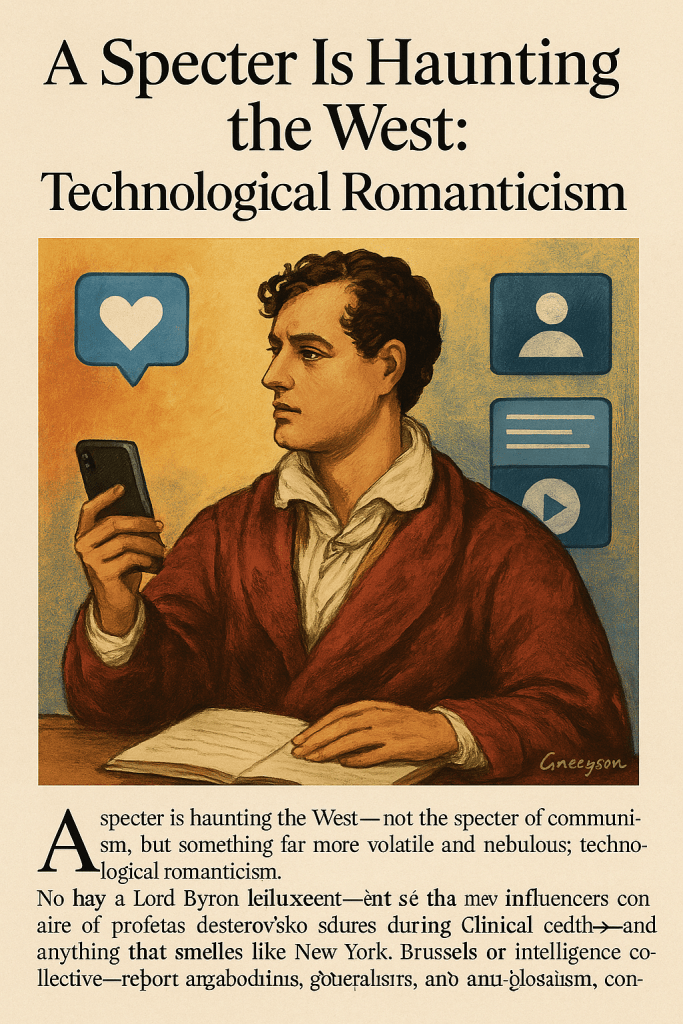
A specter is haunting the West—not the specter of communism, but something far more volatile and nebulous: technological romanticism.
Israel Centeno
History teaches nothing to those with internet access. The repetition of historical patterns, so clear in books, becomes invisible when it arrives dressed as a trending topic. But it’s here nonetheless. There’s no Lord Byron leading the charge, though we do have influencers with the air of exiled prophets. There’s no Goethe riding the rails, but Jordan Peterson is reading Dostoevsky on TikTok. And of course, there’s no uprising against monarchies—only a rebellion against algorithms, globalist elites, and anything that smells like New York, Brussels, or shared intelligence.
What defines this new romanticism?
The exaltation of instincts over reason. Feeling now outranks thinking. Guts override graphs. “It feels true” has replaced “I think, therefore I am.” Within MAGA logic or Europe’s alt-right revival, the sensation that your country “no longer belongs to you” is enough to call for reconquest.
Nostalgia as political program. No one promises a shining future anymore—only the restoration of a golden past. Make America Great Again. Reconquer France. Bring back sovereign Britain. The 19th century has returned, silently, with its broken maps and wounded pride.
The cult of the emotional hero. Where once we had enlightened monarchs, now we have anti-establishment billionaires. Musk as Victor Frankenstein. Trump as a disheveled King Lear. Javier Milei as the libertarian Byron of the Southern Cone. All unhinged. All messianic. All trending.
The rejection of rational universalism. Goodbye Enlightenment, hello tribal timelines. The world is no longer one, but a thousand online tribes, each with its own totem, its own martyr, its own Telegram channel. Europe turns its back on unity. America fragments by state. Nationalism returns wearing startup merch.
And technology? There’s no contradiction, only synthesis. Technological romanticism feeds on the very system it despises. It hates the algorithm—but lives off it. It loathes the globalist agenda—but organizes on Discord. It is anti-modern from a verified account.
Marx once said that history repeats itself, first as tragedy, then as farce. Today it unfolds as livestream, with hashtags and playlists. Revolutions are no longer built on barricades, but in Reddit forums, between Crusader memes and Nietzsche gifs.
Romanticism has returned, with all its monsters. Only now, they host podcasts, mint NFTs, and promise to save civilization.
There is nothing new under the sun. But now, the sun has filters.
In the span of a single week, the U.S. immigration system has laid bare a troubling duality. What some hailed as a triumph of the rule of law quickly unraveled into a display of selective protection, revealing a system that shields a few while exposing hundreds of thousands to danger. At the heart of this contradiction lies the Supreme Court —speaking in two voices, acting with two hands.
I. Due process for a few, abandonment for the many
On May 16, 2025, the Supreme Court blocked the Trump administration’s attempt to invoke the Alien Enemies Act of 1798 to summarily deport 176 Venezuelan migrants detained in Texas, accused without public evidence of belonging to the Tren de Aragua gang. The Court emphasized that even in cases involving alleged security threats, due process must be upheld —a reaffirmation of basic legal principles.
But just three days later, on May 19, the same Court —by a lopsided 8-1 vote— allowed the administration to revoke Temporary Protected Status (TPS) for over 350,000 Venezuelans, many of whom have lived legally in the U.S. for years. These individuals face forced return to a country that the U.S. government itself classifies as extremely dangerous, plagued by political repression, economic collapse, and systemic violence.
The contradiction is staggering: due process is fiercely defended for a handful of detainees accused of gang affiliation, while legal status is stripped en masse from hundreds of thousands who have committed no crime, and whose only transgression is having fled a collapsing state.
II. Afghanistan: another silent betrayal
The contradiction deepens with the decision to end TPS protections for roughly 14,600 Afghan nationals, effective July 14, 2025. These individuals fled after the Taliban’s return to power in 2021, seeking refuge from one of the most oppressive regimes in the world. Forcing them back amounts not only to a diplomatic failure, but a humanitarian one —sending people back into the arms of the very danger they escaped.
III. South Africa: a curious privilege
Meanwhile, on May 12, 2025, the Trump administration welcomed 59 white South Africans —mostly Afrikaners— under a fast-track refugee process. They cited racial discrimination and violence in South Africa, though these claims have been widely questioned by international observers and the South African government itself.
This move sparked outrage among faith groups and human rights advocates. The Episcopal Church of the United States suspended its cooperation with the refugee resettlement program, denouncing what it described as a racially and politically biased asylum process.
The contrast could not be more stark. While Venezuelans and Afghans are being told their protection is no longer valid —despite real, ongoing threats— a group of white South Africans are granted privileged access to the asylum system on the basis of contested claims.
IV. The Court speaks loudly —but in two tongues
In theory, justice is blind and consistent. In practice, the Court this week protected a small number of high-profile detainees, while abandoning hundreds of thousands to legal limbo and existential risk.
Only Justice Ketanji Brown Jackson dissented in the TPS decision, standing as a solitary voice of concern over the arbitrary and disproportionate removal of humanitarian protections. Her dissent reminds us of what’s at stake: not just legal status, but moral integrity.
When law becomes strategy
This week’s immigration decisions reveal more than just legal inconsistencies —they expose a political calculus masquerading as law. The U.S. is protecting some and discarding others, not based on need, but on optics, race, and ideology.
Refugee status is not being granted where the risk is greatest, but where the political symbolism is most convenient. This is not law. This is strategy. And in the shadow of this strategy, hundreds of thousands are left with nothing but fear and a closing door.
Justice must speak the same language to all. This week, it whispered to the powerful —and shouted silence to the rest.

 Centeno's Lighthouse