“No hay rasgo alguno de la realidad humana que no haya sido asumido por Cristo, salvo el pecado. Así, la esperanza cristiana es la certeza de que el amor de Dios es más fuerte que cualquier mal, y que la victoria de Cristo es definitiva, aunque todavía no plenamente manifestada”
(cf. Catecismo, nn. 602-605, 1040-1041).
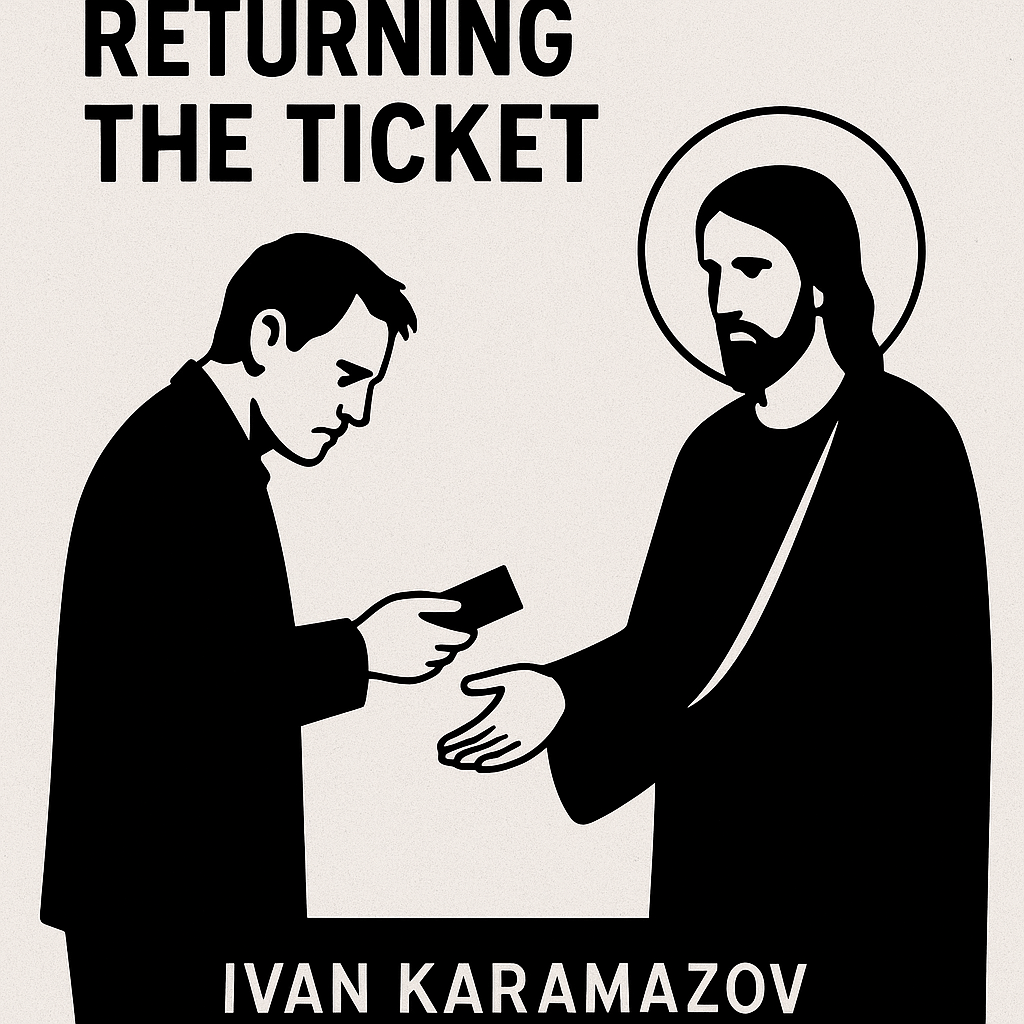
Iván Karamazov no niega a Dios: le devuelve el billete. No se rebela contra la existencia del Todopoderoso, sino contra el precio de entrada a un mundo donde un niño es torturado y asesinado. Si la redención universal requiere ese pago, él no lo acepta. El gesto es literario, pero encierra una de las objeciones más radicales jamás formuladas a la teología cristiana: la idea de un bien mayor que justifica todo sufrimiento.
Desde un punto de vista ontológico, el mal no posee ser en sentido estricto: es privación, una ausencia parasitaria de lo que debería estar y no está. Pero aunque sea metafísicamente secundario, su experiencia es devastadoramente primaria. El mal hiere, fractura, humilla. Que no tenga sustancia no lo hace menos real. Por eso, la pregunta no es solo qué es el mal, sino por qué duele tanto. Y más aún: ¿puede el mal, en su gratuidad infernal, tener un lugar en un mundo redimido?
La teología de Tomás de Aquino responde que sí. Dios permite el mal —dice— no porque lo quiera, sino porque, en su sabiduría, puede sacar de él un bien mayor. Para Tomás, lo que más importa no es la ausencia de dolor, sino la comunión de amor. La soledad elegida —esa negativa a abrirse al otro— es, para él, la peor condena. Y el sufrimiento, si nos une en amor, puede transformarse en medicina. La cruz de Cristo no fue la negación del mal, sino su carga asumida hasta el extremo, para que ya no sea absurdo sufrir solo.
Pero Iván no pregunta desde la metafísica. Pregunta desde el espanto. ¿Puede un mundo donde se ha quebrado la inocencia más pura —una niña muerta de frío en un sótano, un niño devorado por los perros frente a su madre— ser salvado? ¿Tiene sentido una felicidad eterna si está construida sobre la sangre de los inocentes? ¿Es justo el paraíso si en él reposa, junto al santo, también el verdugo, lavado en el último segundo por la misericordia?
Estas no son objeciones abstractas. Son preguntas que tocan la entraña de la fe. Si todo es perdonado, ¿qué significa la justicia? Si el amor de Dios puede salvar incluso al más abyecto, ¿no es eso una traición a las víctimas?
Frente a estas objeciones, la teología solo puede responder con temor y temblor. No hay respuesta racional que pueda consolar a la madre cuyo hijo fue asesinado. Pero hay una promesa: que en el corazón trinitario de Dios, cada lágrima será recogida, cada herida resarcida, y cada historia transfigurada sin negar el horror, sino abrazándolo con una compasión más honda que la lógica. La redención cristiana no es amnesia. Es transfiguración. No borra el mal, pero le roba su última palabra.
Ahora bien, esta promesa tiene un riesgo: el escándalo de la misericordia. Porque si Dios puede redimir incluso a quien ha encarnado el mal —Hitler, Stalin, o el más anónimo de los asesinos—, entonces el cielo no será un club de justos, sino un coro de rescatados. La lógica de la gracia no es distributiva, sino desbordante. La justicia divina no se mide en equivalencias, sino en reconciliación.
Por eso, el “no” de Iván, aunque desgarrador, es necesario: recuerda el precio que el mal inflige sobre la inocencia. Pero no puede ser la última palabra. Porque si la redención es verdadera, debe ser capaz de restaurar no solo el alma del pecador, sino también la confianza de la víctima en un amor que no la abandonó.
Devolver el billete es un gesto ético de enorme dignidad. Aceptar el misterio de la redención es un acto de fe que no niega el dolor, pero espera que, más allá de la muerte, incluso el horror pueda ser asumido, tocado, llorado y finalmente redimido por un Dios que no vino a explicar el sufrimiento, sino a sufrirlo con nosotros
Thomas Aquinas understood that at the foundation of all reality lies not an object, nor even energy, but an act: the act of being. What exists does so because it actualizes its existence, because it participates in being. But nothing we see, touch, or think of exists by itself. Everything around us is limited, restricted to a form, and therefore dependent. It is not the cause of itself. If something has a particular way of existing—like an electron, a rock, or a person—that already indicates its being is bounded, that it is not total. And if it is not total, it does not suffice for itself. If it does not suffice, it must be caused. If it is caused, it exists through another.
Now, if we strip away layer after layer, if we move back from cause to cause, from being to being, we necessarily arrive at a point where the being in question cannot have been caused by anything else. Otherwise, there would be no sufficient explanation for the whole. There must exist, necessarily, a reality that does not receive being, but is being. A reality with no restrictions, no form that limits it, no accidents that modify it. A reality whose only content is to be. Thomas calls this ipsum esse subsistens—being itself, subsisting. Not one thing among others, but the very foundation of all that is possible.
This act of being through itself, by its very nature, has the power to actualize every possible form. Because it is not limited by any of them, it can grant them all. But it is none of them. It is distinct from everything it causes, like white light is distinct from the colors it generates when refracted, yet contains them all in potency. Thus, every limited form of being—every thing that exists—is not being through itself. It is not self-sufficient. Therefore, it must be caused. And all that is caused depends. All that depends is not truly free. It is bound to its cause.
That is why, when Christ says “the truth shall set you free,” He is not merely speaking of intellectual knowledge that frees us from ignorance. He is revealing that there is a truth which does not depend, which is not caused, which is not limited by any form: a truth that is being itself without restriction. And then He says: “I am the way, the truth, and the life.” That is: He not only teaches the truth, He is the truth. If He is the truth, and if the truth is that which is uncaused, unlimited, and immortal, then He is the very source of being. In Him there is no mixture, no limitation, no dependency. His being comes from no one else: I am.
To be free, then, is to participate in that being which is not caused. It is to be liberated from contingency. It is to step out of the realm of limitation, where everything breaks, fades, corrodes, or contradicts itself. It is to enter into communion with the only One who can say “I am” without adjectives, without conditions.
And here a common objection arises: why assume that this first cause is simple and not complex? The answer is both simple and profound: complexity is a property of what is composed, of what has parts, of what needs elements to be joined, to cooperate, to be organized. And anything with parts is, by definition, dependent. Each part needs the others, and the whole needs a principle of unity. Therefore, the complex cannot be the ultimate explanation of reality. The complex is caused, conditioned, fragile.
The first cause cannot be like this. It cannot have parts. It cannot be a mechanism or a system. For then it would depend on something that unites its parts, on a law that structures it, on an energy that holds it together. The cause of all that is real cannot be structured like the things it causes. It must transcend all structure. It must be absolutely simple.
Only what is absolutely simple can be truly necessary, truly eternal, truly free. Only what is one without mixture can be the source of all multiplicity. Absolute simplicity is the mark of divinity—not because it lacks richness, but because it is fullness without division. It needs nothing to be complete, because it is all in act. It does not divide into parts because it is totality without limit. It does not change because it lacks nothing.
God is not complicated. God is simple. And in His simplicity lies the source of all things. In His simplicity lies freedom. In His simplicity lies truth. And that truth, which depends on nothing, which does not change, which cannot die, that truth will set us free.
Playing Clever: The Enduring Intelligence of Thomism
— A brief defense of metaphysical clarity in the age of confusion
In an age dazzled by novelty and exhausted by contradiction, embracing Thomism is not a retreat to medieval nostalgia. It is, rather, the most intellectually strategic move one can make. To be a Thomist today is to be clever in the highest sense: to think with precision, argue with integrity, and live with metaphysical depth in a world that has forgotten the meaning of both truth and being.
Where contemporary philosophy often chases symptoms—identity, language games, subjectivity—Thomism strikes at roots. As Eleonore Stump has argued in Atonement and Wandering in Darkness, Thomistic thought offers a deeply unified vision of the human person, one that bridges metaphysics, moral psychology, and narrative understanding. Stump doesn’t merely repeat Aquinas; she shows how Thomism speaks meaningfully to the broken, to the suffering, to those wounded by both sin and secularism. That’s clever: to bring a 13th-century framework into dialogue with 21st-century wounds—and have it make more sense than any therapy manual.
Thomism is not simply systematic theology. It is a metaphysical realism so robust that it can absorb the best of modern thought without being swallowed by its confusions. As philosopher John Haldane puts it, Thomism is “the Aristotelian grammar of being refined by Christian metaphysics and elevated by revelation.” It does not fear reason, nor does it idolize it. It lets reason climb as far as it can go, and then allows faith to illumine what lies beyond—without contradiction, without coercion.
This is why being a Thomist is not simply clever but courageously intelligent. In a world where meaning is flattened to preference and truth is sacrificed to consensus, Thomism reminds us:
That esse (being) is not the same as essence. That causality includes final causes, not just efficient ones. That the soul is not a ghost in a machine but the form of the body, capable of reason, love, and grace. That God is not a being among beings, but ipsum esse subsistens—pure Act, the ground of all that is.
This isn’t cleverness in the smug sense. It’s the sobriety of someone who sees that the emperor of postmodernity has no clothes.
Indeed, one of the most compelling traits of Thomism is that it anticipates and outlives its critics. It survived Ockham’s nominalism, resisted the Cartesian ego, endured the Kantian divide, and now smiles gently at the deconstructionist obsession with difference. All these movements offered fragments. Aquinas offers a cosmos.
But above all, Thomism is clever because it has no need to panic. Its confidence lies not in academic fashion but in the clarity of its principles. That is why, as Étienne Gilson once wrote, “Thomism is not a philosophy among others. It is the metaphysics of the real.”
In a time when “deep” often means obscure and “complex” means confused, Thomism is both luminous and sane. It dares to say that truth exists, that the soul is real, that freedom matters, and that reason—when not mutilated—can lead us to the threshold of the divine.
To be a Thomist, then, is not to be passé. It is to be ahead of the game.
A critique of redemptive dialectics and the progressive myth of history
by Israel Centeno
“History has no meaning. It has memory.”
— Hannah Arendt
Yale philosopher Jacob McNulty has recently proposed a new political reading of Hegel that discomforts both Marxists and liberals. His proposition: to recover a tougher, more grounded Hegel—one who cannot be reduced to Marx’s historical engine, nor swallowed whole by globalist social democracy. For McNulty, even if Spirit and Reason have ultimate priority, this does not cancel the real force of ideology, the State, law, and—let us add—conflict as a structuring drive of history¹.
What McNulty subtly implies is that human history is not made of theses, antitheses, and syntheses, but of states, wars, betrayals, ambitions, and limits. It is not a logic textbook, but a field of force.
And yet, from Hegel and Marx to Fukuyama and his heirs, many have believed otherwise: that history is a narrative with a happy ending. That we are progressing—painfully, yes, but irreversibly—toward liberty, equality, and human fulfillment. That whatever opposes this path is merely a leftover of the past, and whatever advances is meaningful.
The myth of the happy ending
But history does not behave like a straight line. It looks more like a scribble drawn by a sleepless child. Democracy was not a final destination—it was an ancient experiment that collapsed, rose again, and now prostitutes itself. Empire was not overcome, it rebranded as global hegemony. The republic coexists with tribalism. Dictatorship has morphed into hyper-technological emotional control.
History does not advance: it circles. It returns. And when it is domesticated by redemptive ideologies, it becomes a landscape of extermination. Because happy endings lead to hell.
The fruit of the earthly paradise
Every ideology that promises earthly redemption ends up sacrificing real people in the name of an abstract future. The 20th century was its cruelest theater:
The USSR promised social justice, and delivered mass famine, ideological purges, and gulags. China proclaimed peasant liberation, and launched the Cultural Revolution: millions died in “re-education.” Nazi Germany vowed to restore national dignity, and built extermination camps. Cambodia, North Korea, Cuba, Venezuela… the list goes on.
Every time an elite claims to understand the ultimate meaning of history, what follows is not freedom, but totalitarianism disguised as virtue². As Leszek Kołakowski put it with biting clarity: *“The promise of redeemed history is the threshold of mass graves.”*³
The end is not political
Against this machinery of secular redemption, we must propose an active skepticism—one that doesn’t fall into cynicism, but also refuses to worship new utopias. Eric Voegelin diagnosed it sharply: *“The fatal error of modernity is the immanentization of the eschaton”*⁴—that is, trying to bring the final destiny of man (judgment, fulfillment) into the temporal and political realm.
The end of history will not be socialist, liberal, or technocratic. It will not be a contract or an algorithm. It will not come by evolution, nor by revolution. It will come—if it comes—by judgment. Until then, what we have are fragile institutions, struggling souls, and a freedom that must be exercised without idols.
Against redemptive dialectics
Dialectics, when used ideologically, promises that every conflict has a higher meaning. That all suffering is part of the Spirit’s labor pains. That History justifies everything—even the unjustifiable.
But this vision, so seductive to intellectuals and tyrants alike, has failed to account for the only thing that truly matters: the irreducible dignity of each human being, not as a means, but as an end. History is not a doctoral thesis. It is a valley of tears with flashes of grace.
Only theological hope—the kind that expects no fullness here, but elsewhere—can save us from hell in the name of heaven. Everything else is idolatry of the future.
Notes
Jacob McNulty, Hegel and the Hermetic Tradition, Yale University Press, 2023. See also his IAI article: “Hegel vs Marx: ideas change the world, not economics.” Hannah Arendt, The Origins of Totalitarianism, 1951. Arendt reveals how ideology annihilates moral judgment. Leszek Kołakowski, Main Currents of Marxism, vol. III, “The Breakdown.” Eric Voegelin, The New Science of Politics, 1952.
“Science, if pursued earnestly, leads to God.” —Edith Stein
“The most incomprehensible thing about the universe is that it is comprehensible.” —Albert Einstein
I. Introduction: The Prometheus of Modern Thought
Roger Penrose is one of the last giants of modern science. A brilliant mathematician, a visionary physicist, and a 2020 Nobel laureate for his work on black holes and gravitational singularities, he helped shape the intellectual framework of contemporary cosmology. Yet in his final years, this towering figure has begun to contradict himself: he questions the foundations of quantum mechanics, revises his own views on the origin of the universe, and proposes a quantum theory of consciousness while resisting the notion of a spiritual soul.
Not out of superficiality, but perhaps because he has reached the limits of the method. He senses that there is a deeper order, that the universe cannot be the result of blind chaos. But rather than taking the leap into metaphysics, he remains suspended at the threshold, where his truths begin to fracture into contradictions.
This essay is not an attack on Penrose, but a meditation on the intellectual tensions he embodies. It is a tribute to his honesty — and a critique of his reluctance to step into the metaphysical light.
II. Two Incomplete Maps: Micro and Macro Without a Bridge
Modern physics stands on two foundational theories:
General Relativity (Einstein, 1915): describes the universe at large scales — gravity, space-time curvature, black holes.
Quantum Mechanics: describes the behavior of matter at subatomic levels — uncertainty, superposition, entanglement.
Each works exquisitely within its domain. But they do not reconcile. The search for a theory of “quantum gravity” — a unified framework — remains elusive.
Penrose has long criticized the standard Copenhagen interpretation of quantum mechanics, claiming that the collapse of the wavefunction must have an objective cause, not merely a probabilistic one. But he has not yet presented a full replacement theory, leaving the central chasm unresolved.
III. Consciousness: A Rift Science Cannot Cross
Penrose ventures even further when, with anesthesiologist Stuart Hameroff, he introduces the Orchestrated Objective Reduction (Orch-OR) theory — the idea that consciousness arises from quantum processes in the microtubules of the brain’s cytoskeleton.
Here arises a profound inconsistency:
He rejects quantum mechanics as currently formulated.
Yet he uses quantum mechanics to explain the most immaterial and mysterious phenomenon: human consciousness.
The theory, though imaginative, solves nothing. It introduces elements that are neither provable nor falsifiable, stepping outside the empirical method — without admitting the shift into metaphysics.
IV. What Physics Cannot Grasp: The Nature of the Soul
At the heart of the matter is this: consciousness is not matter. It cannot be weighed, duplicated, or scanned. It cannot be broken down into subcomponents or reduced to probabilities. Consciousness is the act by which the self becomes aware of itself, remembers, judges, chooses, and creates.
I use my brain, yes. But the thinker is not the brain. It is the soul using the brain as an instrument.
No MRI scan will ever locate a moral conviction. No particle accelerator will ever detect love, dignity, or hope. Because these belong not to the world of mass and motion, but to the invisible realm of spirit.
V. Logic Is Not Matter
Here lies the essential paradox: to do science, one must think. To think, one must use logic. And logic is not physical.
It has no mass or charge.
It is not made of particles.
It cannot be located in space.
Logic — like grammar, syntax, symbols, mathematics — is an invisible architecture that shapes all reason. It is used in every scientific formula, but it belongs to the realm of metaphysics.
How then can physics, which depends on logic, explain the very mind that generates logic?
It is like trying to weigh a metaphor. Or to photograph a decision. Or to isolate a dream with a microscope.
VI. The Legitimate Horizon of Science
Science can say, honestly:
“There exists a being — the human — that transcends the animal. Who uses the body but is not reducible to it. Who thinks, narrates, chooses, and loves.”
That is its noble threshold. But if science tries to explain this being as pure matter, it betrays itself. It uses material tools to examine what is not material.
VII. God and the Limits of Method
God cannot be proven scientifically. But He cannot be ruled out either. Because God is not a hypothesis among others. He is the foundation of being, the ultimate Reason, the Logos.
Einstein sensed this with humility:
“The eternal mystery of the world is its comprehensibility.” “I want to know how God created this world. The rest is detail.”
He also referred to the low entropy at the origin of the universe as the “fingerprint of God” — a mysterious order too precise to be accidental.
Edith Stein, philosopher, mystic, and martyr, wrote:
“Science, if pursued earnestly, leads to God. And it has led many to the doorstep of faith.”
VIII. The Soul Cannot Be Split
What Penrose shows us, perhaps unintentionally, is the limit of naturalism. The point at which physics becomes myth — or worse, theology without God.
Because:
The soul cannot be split.
The will cannot be measured.
Consciousness cannot be engineered.
To explain the soul as if it were a particle is to reduce man to mechanism. And to explain freedom without spirit is to turn the human being into an illusion.
At some point, the scientist must remove the lab coat and enter barefoot into the sanctuary of mystery.
IX. Epilogue: When Thought Becomes Prayer
There is a kind of thought that ends not in formula, but in adoration.
Edith Stein knew it. Einstein suspected it. Even Penrose, in his own way, stands at its edge.
If the universe is intelligible, then there is a Logos. And if there is Logos, then consciousness is not an accident, but a summons.
And if there is a summons, there is Someone who calls.
And that Someone, though beyond proof, is more real than all proofs, for He is the very source of reason, love, and being.
“Real thinking does not end in formulae, but in contemplation.” —Simone Weil
📚 References
Penrose, Roger. The Emperor’s New Mind. Oxford University Press, 1989.
Penrose, Roger & Hameroff, Stuart. Consciousness in the Universe: Neuroscience, Quantum Space-Time Geometry and Orch-OR Theory. Journal of Cosmology, 2011.
Stein, Edith. The Science of the Cross. ICS Publications, 2002.
Einstein, Albert. The World As I See It. Philosophical Library, 1949.
An Essay on Lucifer’s Rebellion and the Oedipal Mythology of the Modern Soul
“If there is a God, how could I bear not to be Him?”
—Friedrich Nietzsche
I. The Eternal Suspicion
There is a suspicion that runs through all myths, all religions, and all systems of thought:
Man is not simply trying to understand the world—
he is trying to usurp its throne.
From the beginning, the desire was not merely to know, but to rule without origin. It is not enough to exist: the fallen soul desires to exist without having been created, to be without having been called. In the depths of the modern soul, even in its most secular forms, dwells the shadow of an ancient rebellion.
That rebellion has a name: Lucifer.
The most beautiful of the angels did not fall out of mere disobedience, but for something more grave:
He could not bear to be a creature.
He wanted to be like God—not by participation, but by usurpation.
The founding cry of his fall —Non serviam— is not the lament of a slave yearning for freedom, but a metaphysical declaration of independence from the One to whom he owes his very being.
And in that same logic—proud, dazzling, irreverent—lies the tragic structure of modern thought: the desire to be transcendent without having been transcended, to possess consciousness without having been breathed into.
Like Oedipus, the modern soul kills the Father and possesses the Mother. And like Oedipus, it cannot bear that stolen glory without paying the price: the blindness of meaning and the sentence of spiritual exile.
II. The Rebellion of Lucifer: Non serviam
Lucifer’s sin is not passion—it is metaphysical pride.
Not moral disorder, but ontological rebellion.
He cannot bear to be second. He cannot accept that love came before. He rejects inheritance: he wants authorship.
He does not want to serve: he wants to reign over being.
Thus he becomes the first nihilist, the first autonomist, the first technocrat of the abyss.
And that cry of absolute autonomy —“I will not serve”— still echoes in countless modern forms:
In the scientist who seeks immortality without a soul. In the philosopher who reduces consciousness to the brain but believes in the power of his own mind. In the ideologue who replaces nature with self-perception. In the politician who promises redemption without a redeemer.
Lucifer’s rebellion is not over.
It has simply been technologized.
It has become system, discourse, program, algorithm.
But it remains the same: to not be a child, to not be a creature, to owe nothing to anyone.
III. The Oedipal Complex: Freud and the Inheritance of a Broken Soul
Freud, though a materialist, uncovered a truth deeper than his own system could bear.
The Oedipal complex—killing the father and possessing the mother—was meant to explain neurosis, but it revealed something far greater: a structural rebellion of the human soul.
Modern man, like Oedipus, commits a symbolic double crime:
He kills the Father-Creator: erasing Him from the story, denying Him, replacing Him with chance, evolution, or statistical necessity. He possesses Mother Nature: manipulating, dominating, exploiting her while simultaneously worshiping her body and denying her mystery.
And now he reigns—yet reigns over interior ruins.
For the soul that usurps the throne of origin cannot bear the weight of its own desire.
He sought freedom,
and found loneliness.
He sought sovereignty,
and lost the earth.
Like Oedipus, the modern soul will gouge out its eyes once it realizes—too late—that it has built its world on the denial of the Love that made it possible.
IV. Mother Nature, the New Faceless Goddess
Without the Father, man does not become an orphan—he becomes an idolater.
His new goddess is Mother Nature, both adored and exploited.
She is venerated in ecological discourse, yet violated by genetic mining and climate manipulation. She is called “life,” but reduced to chemical processes. She is exalted as a fertile goddess, but denied all true sanctity.
The modern soul no longer sees nature as a gift, but as a faceless womb, a mother without voice, a source to be manipulated at will.
In this new ecological religion, the Earth is sacred but godless, and man is her priest and her engineer.
We have turned creation into a system, fertility into code, and the cosmos into a mirror where only our will is reflected.
The result: the mother falls silent, the child becomes lost, and the Father has been erased from the Book.
V. Consequences of the Cosmic Oedipus: Sovereignty Without Redemption
Today’s most accepted theories in cosmology and neuroscience are not neutral—they are responses to the vacuum left by the Father.
The multiverse: infinite possible universes to avoid confronting the improbable precision of this one. Cyclical models like Penrose’s: eternal returns to evade a beginning that smells of design. Quantum consciousness: a soul without soul, a spark without source.
All of these models avoid the direct question:
Who called me into being?
They accept that consciousness may not be reducible to the brain—but not that it might have an Author.
They accept the soul, but deny the Spirit who breathed it forth.
Thus man reigns—in solitude.
A king without inheritance.
A sovereign without a kingdom.
A god without an altar.
VI. Epilogue: Science as an Escape from the Father
Science, born of wonder and humility, has in many cases been hijacked by the same impulse that condemned Oedipus: the desire to know without being known, to understand without being understood.
Theories like Penrose’s, the multiverse, string theory, quantum consciousness—they are not false by virtue of being unprovable.
They are ontological evasions, dressed in mathematical elegance.
Because a universe with a finely tuned beginning is a problem for the soul that refuses to kneel.
Because a mind capable of understanding the universe, but that did not invent itself, implies the trace of Another.
And that, for the modern ego, is intolerable.
It prefers to invent ten thousand worlds than bow to a single Creator.
But there is a more noble path:
Not to renounce reason, but to follow it to the threshold of Mystery.
To accept that I am transcendent—yes.
But also to accept that I did not give myself being.
That there is a Thou who thought of me before I ever thought of the world.
And that to recognize the Father is not slavery—it is the beginning of all redemption
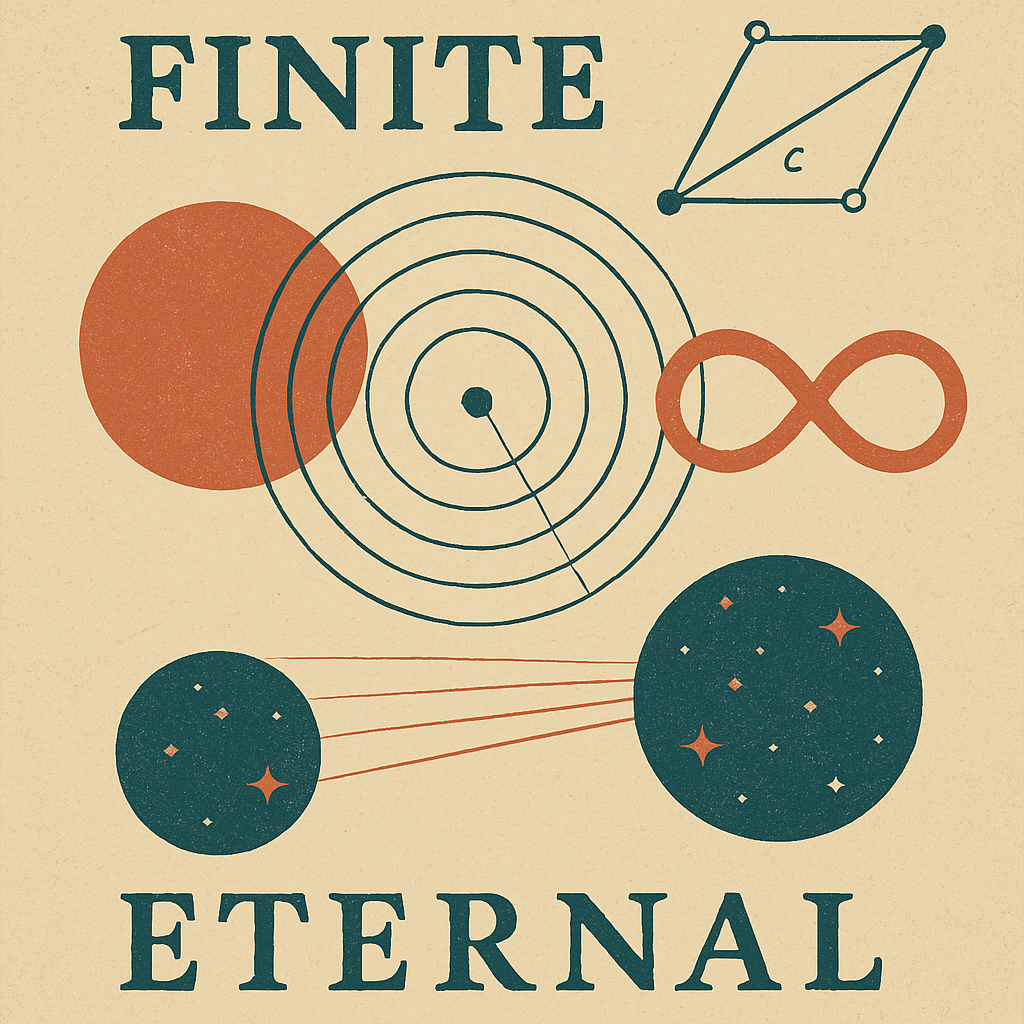
Una de las tensiones más profundas en la cosmología moderna surge cuando se intenta reconciliar dos categorías que, por definición, se excluyen mutuamente: lo finito y lo eterno. Algunos modelos especulativos —como los de inflación eterna o el multiverso— intentan postular un universo eterno, sin origen ni fin. Pero, si tomamos en serio esta afirmación, entonces enfrentamos una paradoja lógica y ontológica de primer orden: un universo eterno no puede contener en su interior fenómenos verdaderamente finitos sin contradicción.
Una hipótesis científica rigurosa no puede autonegación. Decir que un universo es finito y eterno al mismo tiempo equivale a postular una cuadratura del círculo. Si el universo es eterno, todo lo que contiene debería, de algún modo, participar de esa eternidad. Pero nosotros, los seres humanos, somos finitos en cuerpo, y temporales en experiencia. ¿Cómo podemos, entonces, existir dentro de un universo eterno sin ser nosotros mismos eternos?
Desde la filosofía cristiana —especialmente en las voces de Santo Tomás de Aquino, Edith Stein y otros pensadores del realismo metafísico— se da una respuesta coherente a este dilema. Se reconoce que el ser humano, en cuanto creado por Dios, es eterno en su alma, pero no en su cuerpo. El cuerpo nace, cambia y muere; pero el alma, al haber sido creada directamente por el Logos divino, no se extingue. Su existencia no es infinita hacia atrás (como Dios), pero sí inmortal hacia adelante. En otras palabras: el alma humana no es eterna por naturaleza, pero es hecha inmortal por participación.
De allí se deduce que la eternidad no es el escenario del universo material, sino el horizonte de destino del alma. Solo por la acción transformadora de Dios —en la muerte, en el juicio, en la gloria o la condena— puede el ser creado cruzar el umbral de lo eterno.
Esto nos lleva a una conclusión radicalmente contraria a la especulación física impersonal: no existe un universo eterno que contenga seres finitos, sino que existe un universo finito que puede ser transfigurado por Dios en una nueva creación eterna.
Desde esta perspectiva, la paradoja cosmológica no se resuelve con más matemáticas, sino con metafísica:
Lo eterno no puede contener lo finito sin absorberlo. Lo finito no puede habitar lo eterno sin ser transfigurado. Y el único puente posible entre ambos órdenes no es una ley física, sino una Persona que llama al ser desde fuera del tiempo: el Logos
English 🇺🇸🇬🇧
A Rigorous Scientific Hypothesis Cannot Self-Negate: Can the Finite Inhabit the Eternal?
The Cosmological Paradox from a Christian Perspective on Being
One of the deepest tensions in modern cosmology arises when it attempts to reconcile two categories that, by definition, exclude one another: the finite and the eternal. Some speculative models—such as eternal inflation or the multiverse—seek to postulate an eternal universe, without beginning or end. But if we take this claim seriously, we are faced with a first-order logical and ontological paradox: an eternal universe cannot contain truly finite phenomena without contradiction.
A rigorous scientific hypothesis cannot contradict itself. To say that the universe is both finite and eternal is akin to proposing the squaring of the circle. If the universe is eternal, then everything it contains must in some way participate in that eternity. But we human beings are finite in body and temporal in experience. How, then, can we exist within an eternal universe without ourselves being eternal?
From the standpoint of Christian philosophy—especially in the voices of Thomas Aquinas, Edith Stein, and other metaphysical realists—a coherent response to this dilemma is offered. The human being, as created by God, is eternal in soul but not in body. The body is born, it changes, and it dies; but the soul, having been created directly by the divine Logos, does not cease to exist. Its existence is not infinite backward (like God’s), but it is immortal forward. In other words, the human soul is not eternal by nature, but it is made immortal by participation.
From this follows the idea that eternity is not the stage of the material universe, but the horizon of the soul’s destiny. Only through the transformative action of God—in death, in judgment, in glory or condemnation—can a created being cross the threshold into the eternal.
This leads us to a conclusion radically opposed to impersonal physical speculation: there is no eternal universe containing finite beings, but rather a finite universe that can be transfigured by God into a new eternal creation.
From this perspective, the cosmological paradox is not resolved through more mathematics, but through metaphysics:
The eternal cannot contain the finite without absorbing it. The finite cannot inhabit the eternal without being transfigured. And the only possible bridge between these two orders is not a physical law, but a Person who calls being from outside of time: the Logos.
“The so-called sex recession is puzzling in part because sex has seemingly never been less stigmatized or easier to procure. As Jia Tolentino of The New Yorker observes, “The electronic devices in our pockets contain not only a vast universe of free porn but also apps on which casual sex can be arranged as efficiently as a burrito delivery from DoorDash.” In today’s society, desire is no longer shameful. Kinks are considered healthy. Mutual pleasure is prioritized. People are free to do what they want in the bedroom—as long as all parties are pleased.”
So why aren’t young people hooking up?
There’s a deeper contradiction that the mainstream media refuses to confront. Younger generations have been caught in a tortured dance between backlash and progress. On one hand, we live in a world filled with instant gratification—bukkake, dick pics, and hookup apps. On the other, conservative institutions enforce invisibility or punishment for any sex outside of marriage and procreation. “
Tolentino rightly notes this duality.
But what she fails to note—either out of bias or convenience—is the influence of progressive moralism. Yes, the Right has its puritanical tendencies. But the Left has weaponized shame under new names: consent protocols so strict they kill spontaneity, identity politics that pathologize desire, and an intellectual environment where sex is a minefield. One wrong move, one misunderstood message, and you’re a social pariah. You’re canceled. Advised. Silenced. Or sued.
It’s not just the right-wingers. In fact, under the Biden and Obama administrations, we saw more censorship and suppression than in decades prior—soft censorship by publishers, platforms, and cultural gatekeepers. Eroticism had to sneak into the mainstream as sanitized romance novels. Anything too explicit, too raw, too male, too female, too binary, too real—was exiled.
Meanwhile, woke culture and the market merged into an unholy alliance. Pop stars like Sabrina Carpenter are transformed into symbols of feminist “progress” by committees that couldn’t define femininity if their grants depended on it. We live in an airless bubble where sexuality is constantly discussed, but rarely lived.
This is the spiritual sterility of our age. The desexualization of a supposedly sexually liberated culture. People are alone, afraid, and hyper-aware. The real issue isn’t sex—it’s fear. Fear of judgment. Fear of misstep. Fear of genuine intimacy.
So yes, the sex recession is real. But no, it’s not the fault of a law, or a court decision. It’s not Roe v. Wade. It’s the result of a culture that uses freedom as branding, while policing desire with more algorithms, more labels, more surveillance, and more shame.
This isn’t liberation. It’s bureaucratic puritanism.
And until we face that, there won’t be a renaissance of eros. Only more hashtags, more confusion, more control
One of the few things that can be said with any certainty in our time is that politics has ceased to be about governance and become a theater of projection. The right and the left, in their current forms, no longer represent coherent ideologies; they function instead as mirrors, each defined by its hatred of the other. What we are witnessing is not a battle of ideas but a battle of reflexes. And as Carl Jung noted, the shadow we refuse to acknowledge in ourselves will inevitably appear in the face of our enemy.
But this is not new. This is political romanticism, reincarnated.
In the nineteenth and twentieth centuries, fascism and communism did not arise as symmetrical opposites. They were mirror images—each born from disillusionment with Enlightenment rationalism, each promising a redemption of history, a restoration of meaning, and a heroic future built upon sacrifice. Both movements relied on emotion over reason, myth over analysis, identity over universality. Both were totalizing. Both demanded enemies to define themselves.
Today, that romanticism has returned—not in the form of grand ideologies, but as reactive tribalism dressed in digital aesthetics.
The new populist right and the progressive identitarian left no longer resemble traditional conservatism or classical liberalism. They resemble, in attitude and structure, the old romantic ideologies of Europe: — the exaltation of feeling over thought — the sacralization of collective identity — the desire to break with the “corrupt present” — and the longing for a purifying crisis.
Both sides offer an emotional theater. They no longer argue policy—they narrate moral epics. Their currency is outrage. Their method is exposure. Their weapon is humiliation. And they both rely on simplified archetypes: the oppressor, the victim, the savior.
In this ecosystem, a name like Rosa Luxemburg becomes a brand. Her writings are not read, her contradictions not studied. She is invoked to validate the instinct, not to challenge it. Likewise, Jung is quoted by young conservatives who have never touched Psychological Types, simply because the word “shadow” sounds deep.
The problem is not ignorance. The problem is the willingness to perform seriousness without the burden of depth.
This is not politics. This is the return of the romantic impulse: the desire to redeem the world through purity, struggle, and identity. But it is a romanticism without poetry, without sacrifice—only curated indignation and algorithmic glory.
Each side believes it is resisting. Each side claims to be the true victim. But in reality, both act within the same structure: — moral absolutism — the cult of the silenced voice — permanent offense as identity — and the refusal to engage the other without caricature.
This was the logic of the 1930s, only now it’s digitized.
The question is not who is right, but what system of thought can survive when everything becomes romanticized and moralized to the point that no shared framework remains.
When fascism and communism clashed, they burned books, imprisoned thinkers, and demanded total allegiance. They were enemies, but they were also reflections of one another: both viewed politics as a sacred struggle and justified violence in the name of a better future.
What we see today may be less violent—so far—but the logic is eerily familiar.
The romantic shadow is seductive. It offers meaning. It offers identity. It offers clarity in chaos.
But it never ends well.
And if history teaches us anything, it is this: when politics becomes a mirror, sooner or later the glass breaks. And when it breaks, it cuts.
Addendum:
As of this week, an unexpected political phenomenon is taking shape in the United States: the strong possibility that New York City—the symbolic capital of global capital—may soon be governed by a self-declared Marxist. For the first time in history, a major financial and cultural epicenter could serve as a testing ground for the very ideology it once exiled.
This has sparked contradictory reactions. Some, with visible suspicion, ask how such a figure could avoid being co-opted, especially given the millions in campaign donations from institutions like Goldman Sachs. Others claim, half-dismissively, “New York isn’t real America.” But the truth is: yes, it is. It is America in its most distilled capitalist form. Everything else is swamp and snakebite.
If socialism cannot function in the very city where capital concentrates, then where can it function at all?
The coming months will tell. For now, one thing is certain: even revolutionaries must learn to govern. And when they do, the romance tends to fade.
“¿Crees en Dios?”, pregunta cada vez más común en una cultura donde lo trascendente ha sido desplazado por lo cuantificable. Y no es raro escuchar la respuesta que parece clausurar todo diálogo: “Yo creo en la ciencia.” Suena firme, moderna, casi definitiva. Pero esa frase, lejos de expresar madurez intelectual, revela una confusión de fondo: confundir ciencia con cosmovisión, método con significado, datos con sentido.
Vivimos en una época donde se le pide a la ciencia no solo que describa la materia, sino que nos diga qué somos, de dónde venimos y hacia dónde vamos. Lo que comenzó como una herramienta para investigar lo observable ha sido elevado al trono de la metafísica contemporánea. Y desde allí se declara —sin evidencia experimental— que no hay propósito, que todo es azar, que la mente es un accidente bioquímico.
Por definición, la ciencia no trata con lo eterno ni con lo absoluto. Estudia lo que se puede medir, replicar, falsar. No tiene instrumentos para investigar si existe el alma, ni para concluir si el universo fue querido. Su lógica es reductiva, no contemplativa. Su poder es explicativo, pero no fundacional. Y sin embargo, vemos cómo muchos científicos, al salir del laboratorio, se transforman en oráculos del nihilismo: — “No hay sentido.” — “No hay mente detrás del universo.” — “Todo es resultado de combinaciones aleatorias.”
¿En qué parte del método científico se validan estas afirmaciones? ¿Con qué telescopio midieron el origen del alma? ¿Dónde se falsó la posibilidad de Dios?
La contradicción es más que lógica: es espiritual. Se afirma que el universo es infinito, sin bordes ni centro, pero al mismo tiempo se intenta comprimir ese infinito en modelos, constantes y algoritmos. Se glorifica la complejidad, pero se exige que toda realidad entre en una ecuación. Se venera el método, pero se lo convierte en dogma.
La ciencia, en sí misma, es un logro prodigioso. Cuando se ordena al bien, al conocimiento, al cuidado de la creación, puede ser incluso una forma de humildad. Pero cuando se absolutiza, cuando se convierte en sistema cerrado y totalizante, cae en lo que podríamos llamar la superstición del laboratorio: la creencia de que todo lo real es mensurable, y que todo lo que no puede medirse, simplemente no existe.
Y sin embargo, el propio mundo científico comienza a mostrar fisuras en ese reduccionismo.
En abril de 2022, la New York Academy of Sciences publicó una declaración de consenso firmada por médicos, neurocientíficos y expertos clínicos en reanimación, afirmando que:
“La evidencia sugiere que ni los procesos fisiológicos ni los cognitivos terminan con la muerte.”
Se refieren a los estudios del Dr. Sam Parnia, director de investigación en reanimación en NYU Langone, quien ha documentado durante años experiencias de conciencia lúcida en pacientes en paro cardíaco clínico. En un estudio con más de 500 personas resucitadas, se registró que aproximadamente el 20% tuvo percepciones organizadas, memorias, revisión de vida, e incluso vivencias con una dimensión moral profundamente estructurada. Y no hablamos de creencias religiosas: hablamos de pacientes clínicamente muertos, con electroencefalograma plano, recordando lo que sucedía mientras sus cuerpos eran técnicamente cadáveres.
Por si alguien cree que esto es misticismo de pasillo de hospital, aparece una figura difícil de ignorar: el Dr. Michael Egnor, neurocirujano con más de 7.000 operaciones cerebrales a lo largo de su carrera. Egnor no es un bloguero de TikTok ni un conferencista motivacional: es un cirujano que ha abierto cabezas humanas y ha trabajado con epilepsia, tumores, traumas craneales. Y lo que ha observado lo ha llevado a una conclusión que no cabe en una TED Talk: el pensamiento no se produce en el cerebro. El cerebro no es el origen de la conciencia, sino su instrumento.
A esta misma conclusión llegó hace décadas otro titán de la neurocirugía: Wilder Penfield, pionero en el mapeo cerebral en pacientes epilépticos. Estimuló regiones cerebrales con electrodos y logró desencadenar recuerdos, movimientos, emociones. Pero jamás —ni una sola vez— logró provocar el pensamiento consciente como tal. No pudo inducir una decisión. No pudo generar el yo. Al final de su carrera, Penfield escribió que el centro del pensamiento consciente no estaba en ninguna parte del cerebro, y que probablemente residía en otra dimensión del ser.
Y no todo ocurre en quirófanos ni laboratorios. El Dr. Andrew Huberman, neurocientífico de Stanford y uno de los divulgadores científicos más influyentes del mundo actual, ha declarado públicamente que cree en Dios y que la oración transforma radicalmente su estado mental. No lo dice como sacerdote encubierto, sino como hombre de ciencia que reconoce en su experiencia algo que escapa a la dopamina.
Estos testimonios no pretenden demostrar la existencia de Dios como se demuestra la presión de un gas. Pero derriban el prejuicio de que la ciencia y la trascendencia son incompatibles. Demuestran que hay médicos que operan cerebros y reconocen el alma. Que hay investigadores que miden la actividad neuronal y admiten que la mente no es una sinapsis. Que hay científicos que no necesitan negar el misterio para hacer ciencia.
La ciencia pregunta: ¿cómo funciona esto? La filosofía se atreve a ir más allá: ¿por qué hay algo en vez de nada? Y la teología responde con humildad: porque alguien lo ha querido.
Esa respuesta no anula la ciencia. La enmarca. La dignifica. La orienta.
No se trata de elegir entre Dios o el microscopio. Se trata de reconocer que sin Dios, el microscopio no tiene por qué estar ahí. Y que sin apertura al misterio, incluso el universo observable se convierte en una ecuación sin alma, en una partitura sin melodía.
Cuando alguien dice “yo creo en la ciencia” para rechazar a Dios, no está eligiendo entre dos verdades. Está buscando consuelo en el sinsentido. Pero lo más profundo no se deja atrapar por instrumentos. Se deja intuir por el alma.
Hace unos años, uno de los apóstoles del nuevo ateísmo —de esos que hacen filosofía de YouTube en nombre del empirismo— soltó con aire de genialidad que el autor de Hamlet no era más que un saco de moléculas. Lo dijo para provocar, claro. Pero logró el efecto contrario: reforzó lo que todos intuimos, incluso quienes repiten ese tipo de frases sin pensar demasiado. Porque decir que Shakespeare no era más que materia organizada equivale a decir que Hamlet, El Rey Lear, El Mercader de Venecia, fueron escritas por una reacción química sin sujeto, sin libertad, sin alma.
Y nadie, en su conciencia viva, lo cree realmente.
Quien escribió Hamlet era más que hueso y sinapsis. Era más que biología. Era alguien que trascendía su carne, que interrogaba el dolor, la muerte, la traición, el amor y el destino con una lucidez que no se fabrica en un laboratorio. Porque el alma no es un órgano, ni el pensamiento un accidente.
Si algo nos dice Hamlet, no es que somos polvo animado, sino que somos seres abiertos al abismo, al sentido, a la pregunta que ninguna fórmula puede clausurar. Y esa pregunta —la que no cabe en el microscopio— es donde comienza la filosofía. Y también, quizás, la oración.
English version
Beyond the Microscope: Why Science Cannot Expel God
“Do you believe in God?” A question increasingly common in a culture where transcendence has been displaced by what is quantifiable. And it’s not rare to hear the response that seems to shut down all dialogue: “I believe in science.” It sounds firm, modern, almost definitive. But that phrase, far from expressing intellectual maturity, reveals a deeper confusion: mistaking science for worldview, method for meaning, data for purpose.
We live in a time when science is expected not only to describe matter but also to tell us who we are, where we come from, and where we are going. What began as a tool to investigate the observable has been elevated to the throne of contemporary metaphysics. And from there, it is declared—without experimental evidence—that there is no purpose, that everything is chance, that the mind is a biochemical accident.
By definition, science does not deal with the eternal or the absolute. It studies what can be measured, replicated, falsified. It has no instruments to investigate whether the soul exists or to conclude whether the universe was willed. Its logic is reductive, not contemplative. Its power is explanatory, not foundational. And yet, we see how many scientists, once outside the lab, transform into oracles of nihilism: — “There is no meaning.” — “There is no mind behind the universe.” — “Everything is the result of random combinations.”
Where in the scientific method are these claims validated? With what telescope did they measure the origin of the soul? Where was the possibility of God falsified?
The contradiction is not only logical; it is spiritual. They claim the universe is infinite, without borders or center, yet try to compress that infinity into models, constants, and algorithms. They glorify complexity but demand that all reality fit into an equation. They venerate the method, yet turn it into dogma.
Science, in itself, is a prodigious achievement. When directed toward good, knowledge, and the care of creation, it can even be an act of humility. But when absolutized, when it becomes a closed and totalizing system, it falls into what we might call the superstition of the laboratory: the belief that everything real is measurable and that everything unmeasurable simply does not exist.
And yet, the scientific world itself is beginning to show cracks in that reductionism.
In April 2022, the New York Academy of Sciences published a consensus statement signed by physicians, neuroscientists, and resuscitation experts affirming:
“Evidence suggests that neither physiological nor cognitive processes end with death.”
They refer to the studies of Dr. Sam Parnia, director of resuscitation research at NYU Langone, who has documented for years lucid consciousness in clinically dead patients. In a study with over 500 resuscitated people, about 20% reported organized perceptions, memories, life reviews, and even experiences with a deeply structured moral dimension. And we’re not talking about religious beliefs: these were clinically dead patients, with flat EEGs, recalling events while their bodies were technically corpses.
For those who think this is hospital hallway mysticism, consider a difficult-to-ignore figure: Dr. Michael Egnor, a neurosurgeon with over 7,000 brain operations in his career. Egnor is not a TikTok blogger or a motivational speaker: he is a surgeon who has opened human skulls and dealt with epilepsy, tumors, and cranial trauma. What he has observed led him to a conclusion unfit for a TED Talk: thought is not produced in the brain. The brain is not the origin of consciousness but its instrument.
This same conclusion was reached decades ago by another neurosurgery titan: Wilder Penfield, pioneer in brain mapping in epileptic patients. He stimulated brain regions with electrodes and triggered memories, movements, emotions. But never—not once—did he manage to provoke conscious thought itself. He couldn’t induce a decision. He couldn’t generate the self. At the end of his career, Penfield wrote that the center of conscious thought was nowhere to be found in the brain and likely resided in another dimension of being.
And not all happens in operating rooms and labs. Dr. Andrew Huberman, Stanford neuroscientist and one of the most influential science communicators today, has publicly declared that he believes in God and that prayer radically transforms his mental state. He doesn’t say this as a covert priest, but as a scientist who recognizes in his experience something that escapes dopamine.
These testimonies do not aim to prove God’s existence the way one proves gas pressure. But they dismantle the prejudice that science and transcendence are incompatible. They show that there are doctors who operate on brains and recognize the soul. That there are researchers who measure neural activity and admit the mind is not a synapse. That there are scientists who do not need to deny mystery to practice science.
Science asks: how does this work? Philosophy dares to go further: why is there something rather than nothing? And theology responds with humility: because someone willed it.
That answer does not cancel science. It frames it. It dignifies it. It orients it.
It’s not about choosing between God or the microscope. It’s about recognizing that without God, the microscope has no reason to be there. And that without openness to mystery, even the observable universe becomes an equation without soul, a score without melody.
When someone says “I believe in science” to reject God, they are not choosing between two truths. They are seeking comfort in meaninglessness. But the deepest realities cannot be captured by instruments. They are intuited by the soul.
A few years ago, one of the apostles of the new atheism—those who do YouTube philosophy in the name of empiricism—stated with smugness that the author of Hamlet was just a sack of molecules. He said it to provoke, of course. But he achieved the opposite: he reinforced what we all sense, even those who repeat such phrases unthinkingly. Because saying that Shakespeare was nothing but organized matter is equivalent to saying that Hamlet, King Lear, The Merchant of Venice were written by a chemical reaction without subject, freedom, or soul.
And no one, in their living consciousness, truly believes that.
Whoever wrote Hamlet was more than bone and synapse. He was more than biology. He was someone who transcended his flesh, who interrogated pain, death, betrayal, love, and destiny with a lucidity that cannot be manufactured in a lab. Because the soul is not an organ, and thought is not an accident.
If Hamlet tells us anything, it is not that we are animated dust, but that we are beings open to the abyss, to meaning, to the question that no formula can close. And that question—the one that does not fit in a microscope—is where philosophy begins. And perhaps, too, where prayer begins.